
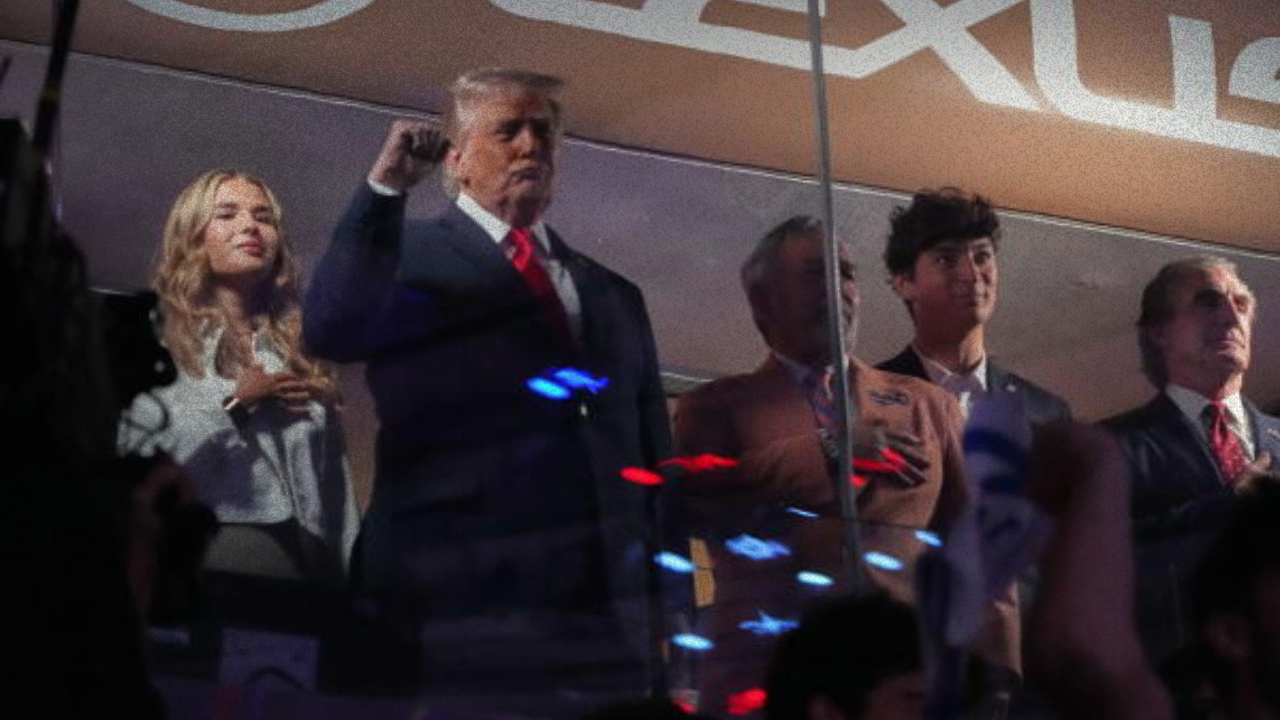
Donald Trump did not just attend Game 3 of the NBA Finals. He brought the presidency, the police perimeter, the security state, and the owner’s suite into Madison Square Garden.
Madison Square Garden did not boo the flag. It booed the man trying to stand inside it.
That was the cleanest read of the night. Before Game 3 of the NBA Finals, the arena was already deep inside the familiar machinery of American sports ritual: the anthem, the flag, the giant screen, the unified crowd noise, the patriotic frame that leagues stage so smoothly it can feel like part of the hardwood.
Then Donald Trump appeared on the video board, giving a military salute.
The reaction changed. The “U-S-A” chants gave way to loud boos. When the flag followed him on the screen, the boos ended. When Knicks players appeared, the building cheered. When the San Antonio Spurs were mentioned, the building booed them too, because this was still New York, still the Finals, still a basketball crowd with a basketball enemy.
That sequence matters because it cuts through the lazy reading that any rejection of Trump must be a rejection of the country, the anthem, or the troops. The crowd separated those things in real time. It cheered the ritual, rejected Trump’s use of it, cheered the Knicks, and booed the opponent. There was no confusion in the stands. The confusion came from the political project that keeps insisting Trump and the nation are the same object.
The people in Madison Square Garden did not accept that merger. They broke it on live television.
Trump Came as the State
Trump became the first sitting president to attend an NBA Finals game, which sounds like a trivia item until his attendance is placed back inside the building that had to absorb it. He was not a normal celebrity in the crowd. He was not even just a rich guy trying to be seen courtside, which was his old New York lane before the presidency transformed his relationship to public space.
He arrived as a moving state operation.
Marine One flew from his home in New Jersey and landed near Wall Street. A motorcade carried him through Manhattan to Madison Square Garden. The NYPD and Secret Service had already turned the area around the arena into a controlled zone. By the time he reached the building, Trump was not entering the Finals as a fan. He was entering as a security event.
Inside, he watched from Knicks owner James Dolan’s suite. That detail is not incidental. It is the geography of the whole story. Trump was not with the crowd. He was not in the public body of the arena. He was above it, beside the owner, protected by the architecture of wealth and power.
His guest list made the point louder. He was there with granddaughter Kai Trump, adviser Boris Epshteyn, and cabinet officials including Lee Zeldin, Sean Duffy, and Doug Burgum. NBA Commissioner Adam Silver and political figures moved through the same orbit. This was not just a sports night with a famous attendee. It was a scene where state power, sports ownership, political networking, celebrity spectacle, and police logistics occupied the same building.
The game was Knicks-Spurs. The event was Trump, Dolan, NYPD, and Secret Service.
Security Laundered the Lockdown
The official language is always “security.” That word does a lot of laundering.
Security sounds neutral. It sounds technical. It sounds like a public good. But at Madison Square Garden, the security operation did not protect the fan experience. It reorganized the fan experience around the movement of one powerful man.
The NYPD and Secret Service set up a large perimeter around the Garden. Fans had to show tickets or passes at checkpoints before they could even approach the normal arena screening process. They went through TSA-style magnetometers. Secret Service personnel and police were positioned throughout the area. Bags were banned. Streets and pedestrian routes were restricted. The watch-party scene near the Garden was moved away from the building and outside the perimeter.
This is how policing changes the meaning of public space. A city celebration becomes a checkpoint. A playoff crowd becomes a managed flow. A street outside an arena becomes a security corridor. The people who came to watch basketball are treated first as logistical problems.
The most revealing quote came from Knicks fan Greg Weldon, who said he had asked cops, Secret Service, and “guys with machine guns” where to go, only to get no clear answer. “Nobody knows,” he said.
That line should be engraved above every overpoliced public event in America. There were guns everywhere. There were barricades everywhere. There were uniforms everywhere. There were checkpoints, machines, agents, officers, closures, and instructions. What there was not, apparently, was a coherent answer for ordinary people trying to get into a basketball game.
That is not a side effect. That is the structure. Policing does not have to make public life legible. It only has to make power movable. Trump had to get in. The motorcade had to get through. The perimeter had to hold. The rest of the city could improvise around the disruption.
This is why the “security inconvenience” framing is too soft. Inconvenience is a long line because the arena is understaffed. This was public space remade around executive protection. The cops did not arrive as helpers. They arrived as the local arm of a federal security operation, turning a basketball crowd into a crowd to be filtered, contained, delayed, redirected, and watched.
The Suite Explained the Night
Every political story has a floor plan. This one was easy to read.
Upstairs, Trump sat with Dolan in the owner’s suite. Around him were cabinet officials, advisers, security, and invited power. Downstairs and outside, fans waited in lines, emptied their bags, searched for entrances, dealt with barricades, and tried to figure out how to participate in a night many of them could no longer afford to see in person.
The owner’s suite is not just a nicer seat. It is the building’s class structure made visible. It is where sports stops pretending to be a shared civic ritual and reveals itself as an asset environment. The court may produce collective emotion, but the building is owned. The access is priced. The best sightlines belong to the people who already own everything else.
That is why Dolan’s role matters. Trump did not randomly appear in the crowd. He came as the guest of the owner. He entered the Knicks’ biggest home game in a generation through the private channel of sports capital. The city got lockdowns. The fans got confusion. The president got the suite.
The contrast was brutal because the Finals were already absurdly inaccessible. Reports put get-in prices above $5,000, with premium seats listed far higher. Mayor Zohran Mamdani said he paid about $1,000 for a standing-room-only ticket. For most Knicks fans, the Garden was not a building they could enter. It was a building they could gather around.
That made the watch party important. It was not just an overflow event. It was the public version of a privatized spectacle. When ticket prices push ordinary fans out of the arena, the street becomes the democratic substitute. People gather near the building, watch together, yell together, suffer together, and feel like the game still belongs to them.
Trump’s security perimeter attacked that substitute. The rich kept the suite. The public lost the sidewalk.
Modern sport binds emotion, infrastructure, policing, media, and state power into one operating system. Game 3 made that system visible without needing to explain itself. The building held the capital. The street held the public. The police decided how much of the public could remain near the capital.
Public Joy Became Collateral
The Knicks’ Finals run was bigger than the Knicks. It was a city event.
Madison Square Garden had not hosted an NBA Finals game since 1999. The Knicks were chasing their first championship since 1973. They had won 13 straight playoff games. Subway stations, bars, streets, watch parties, office chatter, jerseys, celebrity rows, old fan trauma, and new fan delirium had all collapsed into one rare feeling: the Knicks mattered again.
That kind of sports emotion is one of the few remaining forms of public joy that still feels spontaneous. It is commercialized, broadcast, sponsored, priced, and branded, but it still spills. It leaks out of the arena and into the street. It makes strangers talk to each other. It makes the subway feel like part of the pregame show. It gives a city a temporary shared language that is not rent, work, cops, landlords, or elections.
Then the president arrives, and that public joy gets treated like a risk environment.
The watch party outside the Garden had become a major feature of the playoff run. With Trump attending, it was moved away from the building and outside the security perimeter. Fans who could not afford the Garden, or who simply wanted to experience the night together, were pushed away from the symbolic center of the event.
That is the political meaning of the night. The people least able to access the game were the people most likely to be policed around it. The wealthier you were, the closer you could get. The more public your participation was, the more vulnerable it became to barricades, bag bans, checkpoints, and cops telling you to move along.
Trump did not create that class structure. The NBA, Madison Square Garden, resale markets, billionaire owners, and urban policing already had it in place. His attendance intensified it and made it impossible to ignore.
Trump Tried to Rewrite the Sound
After the game, Trump told reporters the reaction was “mostly cheers.”
That line is almost too predictable, but it still matters. The boos happened in the arena. The denial happened for the cameras.
This is one of Trump’s most durable political habits: he tries to overwrite visible reality before it hardens into public memory. A hostile crowd becomes enthusiasm. A disruption becomes a great night. A humiliating reaction becomes proof of popularity. The point is not whether anyone who heard the boos believes him. The point is to create a second version for circulation, one that his supporters and friendly media can repeat until the original event becomes just another contested image.
But the Garden reaction was hard to spin because the sequence was too precise. The crowd chanted “U-S-A” during the anthem. It booed when Trump appeared. It stopped when the flag appeared. It cheered the Knicks. It booed the Spurs.
That is not a mixed reception in any meaningful political sense. That is a crowd making distinctions.
Trump’s problem was not that the crowd hated everything. His problem was that the crowd knew exactly where to place him. He tried to appear inside the patriotic frame, saluting during the anthem like the living embodiment of the country. The crowd pulled him back out of it.
That is why the denial came so quickly. The boos were not just noise. They were an interruption of the image Trump wanted. They broke the spell. He needed to repair it before the night was over.
Trump’s sports appearances keep trying to turn crowd reaction into political atmosphere. The difference at Madison Square Garden was that the atmosphere did not cooperate cleanly. The ritual stayed intact. Trump was the thing rejected inside it.
The Game Escaped the Script
Then the Spurs ruined the coronation.
New York entered the night with a 2-0 series lead, a 13-game postseason winning streak, and the first Finals game at Madison Square Garden since 1999. The setup begged for a Knicks civic epic. Trump’s appearance added another layer of bad theater to it, as if the game needed one more famous man trying to absorb the room.
But basketball does not always obey the room.
San Antonio won 115-111. Victor Wembanyama delivered 32 points, eight rebounds, six assists, three blocks, and two steals. Stephon Castle added 23 points, five rebounds, and five assists. The Spurs controlled enough of the turnover math, survived late pressure, and cut the series deficit to 2-1. Jalen Brunson scored 32 and OG Anunoby had 28 for New York, but the Knicks’ streak ended and the Garden went from roaring to stunned.
That is what games can still do at their best. They escape the preferred narrative. The cameras can search for Trump. The broadcasters can mention the dignitaries. The cops can control the streets. The owner can host the president. The league can smooth the optics. But once the ball is live, the script has to survive actual play.
It did not.
The Spurs won the basketball game. The crowd delivered the political verdict. Trump got the attention he came for, but not the adoration he wanted. The cops got their lockdown, but not public gratitude. Dolan got his suite tableau, but the city’s actual emotional center stayed closer to the people chanting, booing, waiting, and trying to watch.
The Image Was Refused
The useful way to read this night is not as a celebrity sighting, a Trump anecdote, or a funny clip of boos during the anthem. It was a map of how power moves through sports.
Trump brought the office. The cops brought the perimeter. Dolan provided the suite. The NBA provided the stage. Fans paid the cost.
This is what happens when a public sports celebration collides with presidential spectacle. The building keeps selling itself as a shared civic temple, but access is rationed by wealth. The street becomes the release valve for everyone priced out, until the state decides the street is a security problem. The police call it protection. The politicians call it normal. The league calls it unity. The fans call it what it is, sometimes without needing words.
They booed.
That sound did not stop the motorcade. It did not remove the barricades. It did not lower ticket prices or reopen the public space around the Garden. It did not change the class structure of the NBA Finals. But it did something smaller and still useful: it refused the image.
Trump wanted to be absorbed into the anthem, the flag, the Finals, the Garden, and the city’s biggest basketball night in a generation. The crowd declined. It cheered the country. It cheered the Knicks. It booed the opponent. It booed the president.
State spectacle in sport works by turning participation into image control. Madison Square Garden broke that control for a few seconds. It did not solve anything. It did not need to. It showed that the image still has to pass through the public before it becomes myth.
Madison Square Garden knew what it was watching.
Sources
- Associated Press via ABC7 Chicago – Trump booed by Madison Square Garden crowd at Knicks-Spurs NBA Finals game, June 9, 2026
- ABC News / Associated Press – US President Donald Trump booed at NBA Finals clash after havoc outside Madison Square Garden, June 9, 2026
- Reuters – Street closures, Secret Service-level security expected as Trump to attend NBA Finals, June 6, 2026, updated June 8, 2026
- NBA.com – Recap: Spurs silence Madison Square Garden with Game 3 win, June 9, 2026
- Sportsnet – NBA Finals Takeaways: Knicks’ task gets tougher as Spurs, Wembanyama fire back, June 9, 2026
- TIME – Trump Booed at NBA Finals Game in New York City’s Madison Square Garden, June 9, 2026
- GQ – The Vibe Inside Madison Square Garden During Knicks-Spurs Game 3, June 9, 2026
- Sparked Sports – Sports as Infrastructure: How Games Power Capital and State, February 6, 2026
- Sparked Sports – Trump at UFC 327 and the Collapse of Political Deliberation, April 13, 2026
- Sparked Sports – Why the Auston Matthews Trump Backlash Was Inevitable, February 26, 2026