
Auston Matthews’ White House visit triggered backlash not because of Trump alone, but because fans mistake elite athletes for moral proxies inside state spectacle.
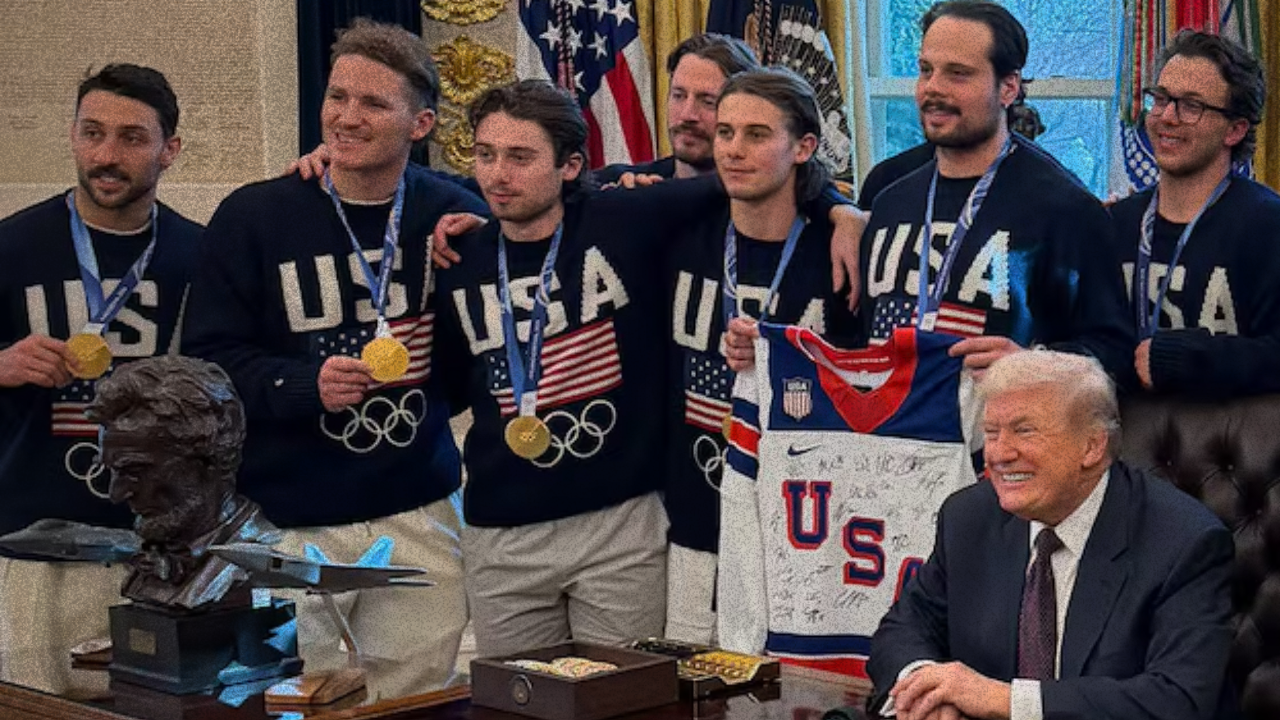
On February 25, around 20 members of Team USA wore matching American flag sweaters, hung their gold medals around their necks, and posed for photographs with Donald Trump in the Oval Office. Auston Matthews was among them. White House social media posted the video with the caption “AMERICAN DOMINANCE.” Matthews smiled. He shook hands. He looked, by all accounts, comfortable.
Five players declined. The women’s team, who also won gold, declined. Matthews did not.
The backlash from Toronto Maple Leafs fans was immediate and visceral. It was not simply disappointment. It was the language of rupture: betrayal, shame, permanent loss of respect. “Never want to see him wear the blue and white again.” “No moral code.” “How do you smile, shake the hand and be Trump’s prop.” One fan pointed to the Martin Luther King Jr. quote tattooed on Matthews’ chest and asked, simply: read it.
The response makes sense on its face. Matthews is not a neutral figure to Leafs fans. He is the captain, the franchise player, the generational talent around whom nearly a decade of hope has been organized. He is also half Mexican, raised partly in Toronto, carrying a tattoo about moral courage in moments of controversy. That symbolism collided directly with the image of Matthews cheerfully participating in a ritual of American state power under a president many Canadians associate with xenophobia, annexation rhetoric, and documented civil liability for sexual abuse.
But the Matthews moment reveals something deeper than a single act of bad judgment. It exposes a fantasy many fans did not realize they were maintaining: the belief that elite athletes can function as moral proxies for political identity, and that symbolic gestures inside state spectacle can meaningfully affirm or betray those identities. What collapsed was not Matthews’ character. It was the story fans were telling themselves about what sports heroes are capable of being.
What Matthews Actually Said
When asked about the visit, Matthews framed it narrowly and deliberately. “To me, I don’t like to get political or get into that kind of stuff,” he told reporters. “We’re proud Americans. Winning a gold medal — it’s been 46 years since the men’s ice hockey team has done that. The team that wins the Stanley Cup every year accepts the White House invitation to go. It is something that you do because we are proud Americans.”
On Trump’s specific controversies, he declined engagement entirely. “It is an honour to be invited, no matter who is in office.” The tone was familiar to anyone who has followed elite sports long enough: patriotic, non-confrontational, procedural.
That framing did not calm the reaction. It intensified it. For many fans, the refusal to engage was itself the offense.
Ceremony Is Not Neutral, Even When It Pretends to Be
It is tempting to treat White House visits as apolitical rituals that exist outside ideology. That temptation is the foundation of Matthews’ defense and the source of the backlash against it. State ceremony is never neutral. It is how power normalizes itself.
Athletes standing beside heads of state, wearing national colors, smiling for cameras, and participating in patriotic ritual are not making policy. But they are lending legitimacy. They are affirming continuity, stability, and national belonging. That is the point of the ritual. It transforms political authority into something warm, human, and celebratory.
This does not require the athlete to agree with the president’s politics. It does not require conscious endorsement. It works precisely because it operates below the level of explicit belief. Ceremony launders power by making it feel customary rather than coercive.
That is why fans experienced Matthews’ presence as endorsement-by-proximity. Not because they believe he voted a certain way, but because participation itself carries meaning. Matthews did not invent that meaning. He stepped into it.
The institutional logic that makes this stepping-into-meaning structural rather than individual — how modern sports bind emotion, nationalism, and capital into a system that monetizes loyalty while shaping politics — is examined in the analysis of sports as infrastructure powering capital and state.
Why the Timing Made It Explosive
The reaction was magnified by what was happening simultaneously. On February 24 — the day before the White House visit — NPR published an investigation finding that the Department of Justice had withheld more than 50 pages of FBI interview notes related to a woman who alleged that Trump sexually abused her when she was 13 years old. The allegation, documented in a DOJ internal PowerPoint, describes an incident in 1983 involving Jeffrey Epstein. House Oversight Democrats opened a formal investigation the same day. By the time Matthews walked into the Oval Office, this was the dominant political news cycle.
The allegations have not resulted in criminal charges. No court has found Trump guilty of this conduct. But the allegation is documented in federal law enforcement files, and the DOJ’s apparent suppression of those files was itself under congressional investigation when Matthews showed up, smiled, and called it an honour.
Fans reacting to Matthews were not parsing legal standards of proof. They were responding to moral proximity. For them, seeing their captain laughing alongside Trump at that specific moment felt grotesque. The word “pedophile,” which circulated widely in fan reactions, was not a legal claim. It was a moral verdict — an expression of disgust and refusal to compartmentalize.
This matters because it clarifies what the outrage is and is not. It is not an attempt to adjudicate Trump’s guilt. It is a refusal to treat proximity to him as benign at a moment when that proximity felt particularly costly. Matthews’ invocation of tradition did nothing to address that refusal.
The Language of Betrayal
One of the most revealing aspects of the backlash was its emotional vocabulary. Fans said they felt betrayed, let down, embarrassed, and ashamed. These are not political terms. They are relational ones.
Disappointment requires expectation. Betrayal requires imagined obligation. Fans were not reacting as distant observers of a public figure. They were reacting as participants in a parasocial relationship — one in which Matthews had been tacitly assigned a role far beyond scoring goals.
This is not irrational. Modern sports culture actively encourages it. Captains are branded as leaders. Athletes are marketed through narratives of character, resilience, and values. Charity work, personal background, and curated personas are woven into identity arcs designed to deepen emotional attachment. Fans are not inventing meaning out of nothing. They are responding to cues the machine generates deliberately.
The problem is that parasocial politics mistakes emotional identification for political alignment. Fans feel represented, so they interpret actions as moral signals. When those signals conflict with the identity fans have projected, the rupture feels personal rather than systemic.
The MLK Tattoo and the Trap of Values Branding
The tattoo became a focal point because it condensed the entire controversy into a single image. The quote — “The ultimate measure of a man is not where he stands in moments of comfort and convenience, but where he stands at times of challenge and controversy” — speaks explicitly about moral courage in times of controversy. Fans did not invent its relevance. Matthews placed it on his body and allowed it to become part of his public identity.
This is where values branding becomes a trap. Under capitalism, moral symbolism is cheap. It is easily displayed, endlessly circulated, and rarely tested. Tattoos, slogans, and curated personas create the impression of depth without requiring confrontation.
When a test arrives, the symbolism does not protect the athlete. It indicts him. The MLK quote did not demand that Matthews give a speech or denounce Trump. It simply made neutrality visible as a choice. When Matthews chose comfort and ceremony over friction, the contrast became unavoidable.
This does not make Matthews uniquely hypocritical. It makes him representative of a system that encourages moral aesthetics while insulating participants from moral cost.
Incentives, Not Character, Explain the Decision
Fans repeatedly returned to Matthews’ background — his Mexican heritage, his years in Toronto, his exposure to Trump-era rhetoric. One fan put it bluntly: “dude your mom is mexican, YOURE MEXICAN.” The argument was not that heritage automatically confers moral clarity. It was that it removes plausible ignorance.
Matthews almost certainly does know the terrain. He simply chose not to act on that knowledge. And that choice was not driven by character failure. It was driven by incentive.
Elite athletes operate within tightly constrained systems. League expectations, sponsorship agreements, national team obligations, and brand management all push toward risk avoidance. Friction is punished. Compliance is rewarded. Refusing a White House invitation would not have transformed Matthews into a hero. It would have made him a liability — to the NHL, to USA Hockey, to his sponsors, to his next contract negotiation.
Fans imagine themselves refusing. That imagination is free. It carries no material consequence. Matthews’ reality is different.
Choosing ceremony over confrontation is not courageous. It is not villainous either. It is structurally rational. Systems do not require monsters to function. They require people who behave predictably under pressure.
Why Anger Focuses on the Player Instead of the Machine
If the problem is structural, why does the outrage land on one man?
Because personal condemnation is manageable. It provides moral clarity without requiring systemic confrontation. Fans cannot meaningfully challenge the NHL’s entanglement with nationalism, corporate sponsorship, and state power. They can boo a player, argue online, and withdraw emotional investment.
This is how spectacle absorbs dissent. Anger is redirected toward symbolic figures rather than institutional arrangements. Fans feel politically engaged while nothing material changes. Matthews becomes a lightning rod not because he is uniquely culpable, but because he is visible and therefore useful.
The broader pattern — outrage cycling through symbolic figures rather than institutional arrangements, spectacle absorbing dissent before it reaches structural targets — is examined in the analysis of why the Trump hockey outrage missed the point, which traces the same dynamic through the locker room call, the petition culture, and the women’s team question.
Canadian Exceptionalism and Contamination Anxiety
The reaction also exposes a specifically Canadian dynamic. Many Canadians define political identity in opposition to American conservatism. Trump functions less as an individual than as a symbol of what Canada imagines itself not to be — especially now, during active trade hostility and renewed annexation rhetoric that has made the Canada-US relationship feel genuinely precarious.
The emotional infrastructure that makes this contamination anxiety so acute — how Canadian identity has been constructed relationally against the United States, with hockey as the primary arena where that hierarchy is briefly suspended — is examined in the analysis of why McDavid’s overtime goal felt like national relief.
When Matthews appeared comfortably inside American nationalist spectacle, it felt like contamination. The contradiction that had always existed — American player, Canadian captain — had been managed for years through performance, loyalty, and silence. The White House moment shattered the illusion that the contradiction could stay dormant.
The outrage was not simply “how dare he meet Trump.” It was “how dare he remind us that he does not belong to our moral self-image.”
The Curse, the Trickster, and the Folklore of Powerlessness
As the controversy bled back into on-ice struggles — the Leafs lost 4-2 in Tampa the following night — the language shifted from outrage to myth. Fans spoke of curses, trickster spirits, and the particular misery of being a Toronto fan in this era of sports. This was not random. It was coping.
When rational explanations fail to provide comfort, myth steps in. The Leafs’ decades-long inability to deliver a championship has trained fans to narrativize disappointment as fate. The Matthews moment fit seamlessly into that narrative. Another hope anointed. Another wound opened. Another lesson learned and immediately forgotten. The curse does not discriminate. It simply endures.
Myth makes powerlessness bearable. If failure is fated, it is at least coherent. And coherence, in Toronto, has always been worth something.
What Actually Changed
The most important thing about the Matthews controversy is that nothing essential changed. Matthews did not suddenly become reactionary. Trump did not suddenly become controversial. The NHL did not suddenly entangle itself with nationalism and state spectacle. All of that was already true.
What changed was audience awareness. For a moment, fans were forced to confront the reality that elite sport is not an extension of their politics. It is a machinery that normalizes power, capital, and nationalism through the carefully managed spectacle of athletic performance.
That realization is destabilizing. Outrage is how destabilization feels.
After the Spell Breaks
This was not a scandal. It was a moment of clarity.
The outrage will fade. The season will continue. Matthews will score. The next savior will be anointed. The fantasy will quietly reassemble itself, because the fantasy is not optional — it is the product being sold, and fans keep buying it.
The lesson is not that fans were wrong to care. It is that caring was being routed into a dead end. Unless fans stop confusing the rink for a political arena, and athletes for political allies, the same cycle will repeat — same infrastructure, different player, same rupture, same grief.
The handshake did not betray the fantasy.
It revealed it.