
Baseball isn’t just a game—it’s a system of emotional management, civic identity, and state power that shapes how cities gather, feel, and understand themselves.
Baseball has always occupied a peculiar place in North American civic life. It is treated as entertainment, nostalgia, tradition, and even national myth—but beneath the surface it functions as something far more complex.
Contemporary research into crowd behaviour helps clarify this. For instance, Gabriel Baranowski-Pinto and colleagues found in 2022 that stadium attendance produces “transformative experiences” and deep social bonding, revealing that what looks like leisure is actually a powerful synchronizing mechanism for collective emotion.
Understanding this helps us see baseball not just as pastime, but as an emotional management system, a civic ritual, and a form of soft statecraft that shapes how people gather, how they feel in public, and how they understand themselves as part of a collective.
Cities like Toronto rely on sports to project unity and identity.
This isn’t merely cultural shorthand—it operates as emotional infrastructure. Scholars like G. Thonhauser, writing in Frontiers in Psychology (2019), show that emotional sharing in sports crowds is a structured relational process, not a random group mood.
Corporations, politicians, and municipal governments all harness this structured emotional terrain. Police departments, too, use it to rehearse authority and fine-tune crowd control, a process well-documented in studies of event policing such as the 2023 analysis of major sports events by European public-order researchers, who demonstrate that police treat stadium crowds as both a security challenge and a training environment.
Media, for its part, frames the spectacle in ways that naturalize these institutions and obscure their political functions. The deeper logic of this framing becomes clearer when we consider John Bale’s foundational work on sports spaces.
In his analysis of the modern stadium, Bale shows that the enclosure, architecture, and spatial design of sporting venues are not neutral—they are forms of power.
Drawing on Michel Foucault, he argues that the stadium operates as a kind of panoptic environment, a space engineered for surveillance, discipline, and the production of compliant subjects.
Media coverage reinforces this structure by presenting the stadium’s security apparatus and institutional presence as simply part of the entertainment, folding the mechanisms of control into the spectacle itself.
Through this framing, the media helps transform policing, surveillance, and state authority into background scenery, normalizing them as essential features of the sports experience rather than revealing their underlying political purpose.
Fans believe they are experiencing a game. What they actually experience is a highly structured civic event that governs emotion, directs collective behaviour, and channels mass feeling into safe, predictable, and profitable forms.
Recognizing baseball as a political technology does not undermine its pleasure. Rather, it clarifies why that pleasure is so carefully curated and why so many actors have a vested interest in shaping its emotional terrain.
Baranowski-Pinto’s study shows that fans feel a sense of “home,” belonging, and identity inside stadiums—but as Korean scholars Lee, Lee, Seo, and Green observed in their 2012 study of “stadium sensoryscapes,” these feelings are intentionally engineered through architecture, sound design, pacing, and lighting.
The stadium may be a place of joy, but it is also a site of governance.
Teams as Civic Infrastructure
The political function of baseball becomes clearer when we examine how deeply it is woven into civic identity. Teams serve as municipal symbols long before they exist as athletic organizations.
Sociological research on stadium ritual—such as a 2025 study by Su, Lu, and colleagues on the “holy place” structure of soccer stadiums—demonstrates how teams anchor communal belonging and act as emotional infrastructure for residents who may share little else.
A team’s victory becomes a moment of collective triumph; its failure becomes shared disappointment across lines of class, geography, and ideology.
Politicians instinctively exploit this attachment, appearing at opening days or donning team colours during campaigns. Public subsidies for stadiums are regularly justified as “investments in civic spirit,” even though researchers like Baklouti (2013) show that these mega-event security and funding models primarily serve corporate and state interests, not the public.
This is not incidental. Baseball functions as soft power. It produces civic pride, provides political leaders with ready-made pathways to emotional connection, and offers a controlled arena for expressing belonging.
These forms of public emotion—what psychologists call “collective affective contagion”—are powerful tools for regulating emotional life.
Policing as Part of the Ritual
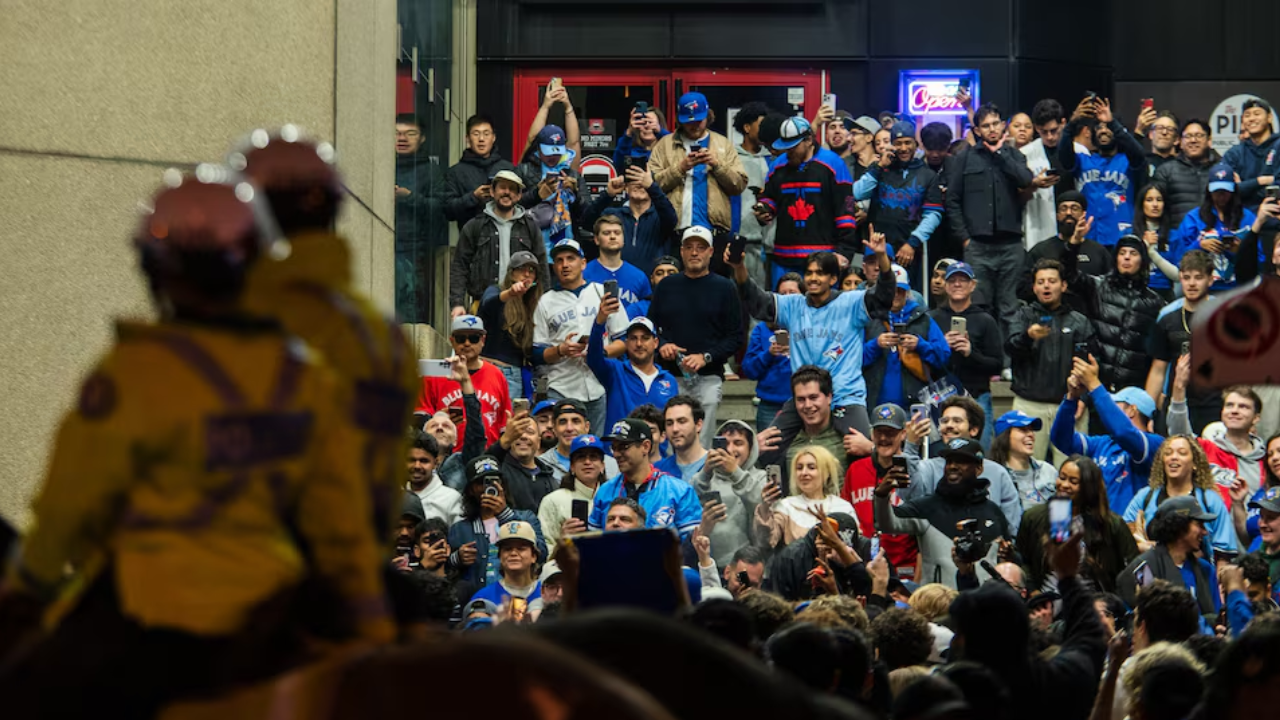
Once the political dimension of baseball becomes visible, the role of policing emerges as central. Police do not merely respond to crowds; they become part of the ritual.
Alec Hoggett’s seminal research (Crowd Psychology and the Policing of Football Crowds, 2009) demonstrates that officers consciously position themselves not only as guardians but as emotional regulators—appearing friendly, visible, and authoritative to manage public feeling.
Officers surround stadiums, transit hubs, and fan zones, forming architectures of supervision that communicate both reassurance and restraint.
Stott’s Policing & Society study (2019) shows how this dual role—civic-minded conviviality paired with coercive authority—sets the outer limits of acceptable public emotion.
Even moments of permissiveness are calculated. The state allows joy up to the point where it becomes unruly.
This choreography of authority becomes part of the entertainment.
The Media as Narrative Engineer
Sports media plays a central role in shaping how fans understand the environment around them. It routinely turns security into part of the spectacle, presenting crowd control as a matter of “keeping the city safe,” praising police vigilance, and normalizing heavy security as an expected response to large gatherings.
This framing embeds state presence into the entertainment itself and masks its political purpose.
When disorder does occur, media narratives make the distinction even clearer. The same behaviours that would be condemned as dangerous or destabilizing in a political context are described as harmless “rowdiness” when they happen around sports.
This selective framing teaches the public that collective emotion is acceptable only when it aligns with state-sanctioned forms of gathering, reinforcing the idea that public feeling requires supervision to be legitimate.
Engineered Emotional Infrastructure
Modern stadiums are not passive venues. Lee, Lee, Seo, and Green’s work on the “sensoryscape” shows how architecture, lighting, acoustics, and crowd flow are engineered to create emotional highs and lows. Su’s 2025 Nature study further demonstrates that stadiums mirror religious architecture in their ability to transform ritual into belonging.
Crowd-flow scholars like Sieben, Schumann and Seyfried (arXiv, 2017) show that the controlled movement of fans through fan zones and transit routes creates an illusion of spontaneous gathering while tightly regulating mobility and density. Everything from scoreboard prompts to pregame ceremonies is calibrated to manage emotion.
Fans believe their excitement is organic. The infrastructure ensures it is contained.
Fan Emotion as Surrogate Politics
The emotional unity inside a baseball stadium reveals fundamental truths about collective power. Tens of thousands of people can coordinate feeling, synchronize their voices, and experience a shared identity with remarkable ease.
Stadium rituals create deep psychological alignment, showing how readily individuals form a unified collective.
These same emotional capacities are the ones required for political mobilization; the difference lies entirely in how they are allowed to be expressed.
The state tolerates and even encourages emotional unity when it takes the form of spectacle, but it constrains or suppresses that unity when it is directed toward political demands.
Why Sports Crowds Are Permitted
Social psychologists and policing scholars consistently show that collective emotion becomes threatening to the state only when it carries political meaning.
Sports crowds are typically tolerated because they present emotion without consequence—forms of unity that make no demands and pose no challenge to power.
The police response to the 2025 Dodgers World Series celebrations illustrates how conditional that tolerance actually is.
Across Los Angeles, the familiar behaviours of sports celebration—crowd surges, fireworks, street takeovers, and mass public excitement—were initially treated as routine expressions of civic joy.
In East Los Angeles, however, where the celebration unfolded in a racialized and heavily policed community, the same emotional intensity was reinterpreted as potential unrest.
This reframing led deputies to fire pepper balls at children and deploy tear gas indiscriminately against families.
This shift reflects the fact that police responses depend less on what a crowd does and more on what authorities believe the crowd could become.
The behaviour itself—joyful gathering, loud streets, and occasional vandalism—was indistinguishable from countless other sports celebrations. What changed was the meaning assigned to the crowd in that particular context.
The state’s management of public gatherings operates on this logic of significance: emotion is permitted when it serves spectacle and contained when it appears connected to grievance, marginalization, or potential dissent.
The Dodgers World Series celebration makes this double standard unmistakably clear. The state does not fear disorder; it fears interpretation.
The same behaviours that are harmless when aligned with civic mythology become threatening when the state perceives—even without cause—that they might carry political weight.
Sports as a Template for Mobilization
If sports disorder shows that the state can absorb chaos, sports unity demonstrates the public’s capacity for collective transformation.
Human beings already know how to gather, synchronize, and act as a unified body, and stadium rituals clearly generate deep group solidarity.
These environments reveal the same emotional capacities required for political change—capacities the state has no interest in allowing to develop beyond the boundaries of spectacle.
The emotional energies that fuel sports fandom could, if directed toward political goals, form a powerful collective force.
The Politics of Public Emotion
Baseball is more than entertainment; it functions as a political technology in multiple intertwined ways. It operates as a system for managing collective emotion, shaping how crowds feel, react, and understand themselves in relation to one another.
It also serves as an arena where public feeling is monitored, guided, and, when necessary, contained by the state.
At the same time, baseball becomes a powerful narrative device through which media constructs and reinforces ideas of civic order and unity.
Stadiums are deliberately engineered emotional environments, designed to amplify feeling, direct attention, and regulate behaviour through architecture, sound, pacing, and ritual.
Sports also function as a template for suppressed political potential: they reveal the public’s capacity for shared identity, coordinated action, and emotional synchronization, but redirect those capacities away from political life and into spectacle.
Recognizing these forces does not diminish the joy people experience inside the stadium. Instead, it clarifies why that joy is carefully curated, permitted, and policed—and why the state relies on sports to channel collective emotion into safe and manageable forms.
What happens inside the stadium demonstrates that another kind of collective life is possible. The real question is what it would mean for that emotional power to move beyond the arena and take shape in public life outside it.