
Ty France hit the Milwaukee roof at 105.3 mph and 49 degrees. Statcast says 325 feet. The physics explains why the play fooled everyone.
Milwaukee now leads San Diego 2-0 in the National League Division Series, and somehow one of the strangest questions from the first two games still has almost nothing to do with the actual series score.
Ty France came to the plate in the ninth inning of Game 1 with the Padres down 3-2, Dustin Harris on first and one out. Trevor Megill threw him a 98.9 mph fastball. France hit it 105.3 mph toward left field and sent it almost straight into the sky.
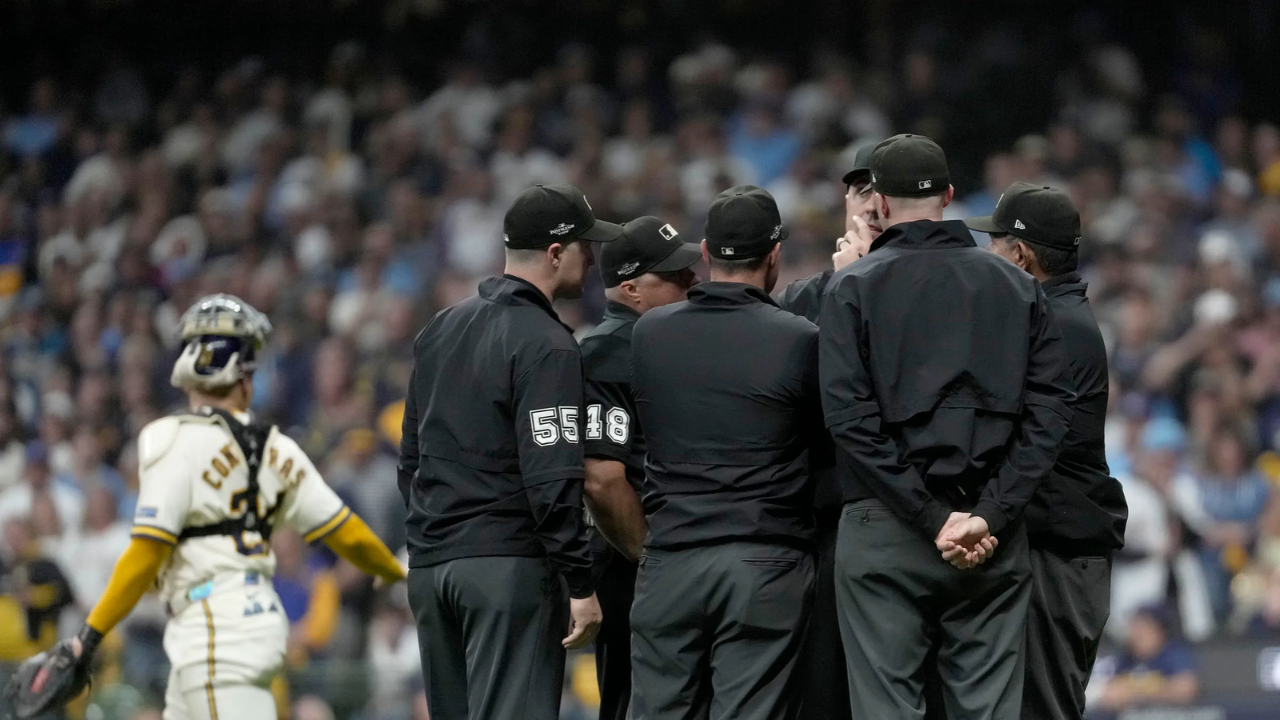
The ball kept climbing until it struck a cable attached to the closed roof at American Family Field. Jackson Chourio adjusted underneath it and made the catch. San Diego challenged the play. The ruling stood. France was out, and Milwaukee finished the 3-2 win one batter later.
The reaction was immediate because the visual seemed obvious. France crushed the ball. It hung in the air forever. It went high enough to collide with the stadium itself. A ball that looks that violent is supposed to be a home run.
Statcast recorded something stranger: 105.3 mph exit velocity, a 49-degree launch angle and a projected distance of 325 feet.
The left-field foul line in Milwaukee is 342 feet away.
That gap is where the fun begins.
The Play That Looked Like a Home Run
France himself believed the ball was leaving the park. Several Brewers thought the same thing. From behind the plate, William Contreras believed it had plenty of distance. Padres manager Craig Stammen described it afterward as a possible home run.
That reaction makes complete sense because baseball spectators spend thousands of hours building an internal model of batted-ball flight. Hard contact plus enormous height usually signals danger. A hitter standing at home plate admiring a ball reinforces the impression. A fly ball colliding with a roof cable somewhere over deep left field feels like visual confirmation.
Then the measurements arrive and make the play less intuitive.
MLB lists the ball at 105.3 mph off the bat and 49 degrees. Only 10 over-the-fence home runs in the entire Statcast era have been hit at a launch angle of at least 49 degrees. American Family Field has never seen a homer above 46 degrees.
CBS Sports, citing Statcast’s park comparison, reported that France’s trajectory would have been a home run in only one of the 30 MLB parks: Houston, where the Crawford Boxes create an unusually short target in left field.
A baseball can be hit extremely hard and still be hit too high.
What Statcast Actually Recorded
The three headline measurements tell us different things.
Exit velocity tells us the speed of the ball immediately after contact. Launch angle tells us how steeply it left the bat. Hit distance in Baseball Savant’s current Statcast data is a projected distance for the batted ball.
That last word matters because France’s baseball never completed an unobstructed flight. It hit architecture. Statcast therefore has to use the tracked portion of the event and estimate the trajectory beyond the obstruction.
The published number is 325 feet. Milwaukee’s official dimensions list 342 feet down the left-field line and 370 feet in the left-field power alley. A straight comparison therefore places the projected landing point at least 17 feet short of even the nearest part of the left-field fence.
That does not produce absolute certainty about a flight we never observed. It gives us the best public tracking estimate of that flight.
Why 49 Degrees Changes Everything
The visual illusion starts with the launch angle.
A ball leaving the bat at 105.3 mph carries an enormous amount of initial speed. The direction of that speed determines what the ball does with it. At 49 degrees, a large share is pointed upward.
In a simple vector decomposition, before worrying about drag or spin, 105.3 mph at 49 degrees works out to roughly 69 mph of initial velocity in the horizontal plane and about 79 mph vertically.
That is why the ball climbs so aggressively. The same feature that makes it look monumental also makes the trajectory inefficient for reaching a distant wall.
MLB defines the launch-angle sweet spot for batted balls as 8 to 32 degrees. France was 17 degrees above the top of that range.
Real baseball flight is much more complicated than breaking one velocity vector into two numbers. Aerodynamic drag slows the ball. Backspin can produce lift through the Magnus effect. Air density, temperature, humidity, wind and the precise direction of the hit can all affect how far a baseball travels.
The basic geometry still explains why our eyes were vulnerable. France generated enormous vertical displacement. The ball had enough upward movement to reach the architecture. That tells us it got extraordinarily high. Height alone cannot tell us how far across the ground it would eventually travel.
Robert Adair Would Have Loved This
The entire play feels like something designed in a laboratory for Robert K. Adair.
Adair was a Yale physicist and Sterling Professor whose primary career was in nuclear and particle physics. He was elected to the National Academy of Sciences and chaired Yale’s physics department. Baseball became the side project for which a much larger public eventually knew him.
Bart Giamatti recruited Adair to bring an actual physicist’s perspective to baseball while Giamatti was leading the National League. Adair eventually became known as the league’s physicist, and his work developed into The Physics of Baseball.
The enduring appeal of Adair’s work is the willingness to interrogate things baseball people already feel they understand. A curveball moves. A bat sends a ball flying. Humidity affects flight. A home run looks like a home run. Adair’s approach was to ask what physical forces actually permit those things to do.
France’s fly ball is an almost perfect modern version of that exercise because the eye test and the instrument reading appear to disagree so violently.
The eye sees 105 mph and a ball hitting the ceiling.
The tracking system sees 49 degrees and 325 feet.
Now somebody has to explain why both observations can describe the same baseball.
The Roof Creates Two Different Questions
The question people keep asking sounds simple: Where would the ball have landed without the roof?
There are actually two versions of that experiment.
The first version is the one a tracking model can approximate. Keep the baseball exactly as it was measured at contact. Keep the same exit velocity, launch angle, spin and atmospheric conditions. Let the ball travel through the same air. Then magically remove only the cable or roof structure it eventually strikes.
That is a useful mathematical counterfactual. Statcast can take the observed trajectory and estimate where the ball probably continues.
The second version sounds almost identical but describes a different physical event: What if American Family Field’s roof had actually been open?
Opening a retractable stadium changes the environment in which the ball flies. Outdoor air movement can enter the problem. Local wind patterns can change. Temperature and air conditions may differ. The airflow through and around the building may no longer match the closed-roof environment where France actually hit the ball.
We cannot simply assume the second baseball follows precisely the same path as the first.
The closed stadium gave Statcast the actual launch conditions and most of the actual trajectory. The same closed stadium also supplied the obstruction that prevented the ball from completing that trajectory.
Open the building and you remove the obstruction while potentially changing some of the conditions that produced the original flight.
That is a remarkably annoying baseball problem.
A Model Is Not an Alternate Replay
This is also why arguing that Statcast cannot know anything because the roof interrupted the flight goes too far.
Models exist precisely because we regularly want to estimate things we cannot directly observe. Statcast measured the initial conditions and tracked a meaningful portion of the flight. Baseball has a large historical database of batted balls against which that trajectory can be compared. The park dimensions are known.
That is real evidence.
It remains evidence about a counterfactual. The baseball never landed unobstructed. There is no hidden camera angle that can reveal the alternate ending. The 325-foot estimate should therefore be treated as an estimate rather than a recording of an event that physically occurred.
The opposite standard makes even less sense. If the interrupted trajectory is unknowable in principle, watching television does not restore the missing information. The fact that a fly ball looked enormous cannot somehow provide more certainty than the measured launch conditions, tracked flight, comparable batted balls and park geometry.
Visual intuition belongs in the discussion. It does not outrank the instruments simply because the replay looked spectacular.
What the Rules Actually Say
The rule itself was much simpler than the physics.
American Family Field’s published ground rules state that a batted ball striking the roof, roof truss or roof cable over fair territory remains in play. If a fielder catches it, the batter is out and runners advance at their own risk. A ball striking the structure over foul territory is dead.
The umpires had even reviewed that exact scenario with the clubs before Game 1. Brewers third-base coach Matt Erickson joked during the pregame ground-rule meeting that he had not seen it happen in years and therefore it would probably happen that night.
Hours later, France hit the cable.
San Diego’s replay challenge focused on whether the ball had struck the structure over foul territory. Replay allowed the call to stand, leaving Chourio’s catch as the second out.
The rule answers the question baseball actually had to resolve during the game: what happened to a live batted ball inside the physical ballpark being used that night?
France’s proposed technological solution asks baseball to answer something else.
Should Statcast Decide a Roof Ball?
France pointed afterward to the amount of tracking technology available to MLB and questioned why baseball could not use that information to reach a different outcome when architecture interrupts a batted ball.
MLB could write such a rule. A ball strikes an obstruction, the tracking system reconstructs the projected trajectory, and the umpires award whatever result the model estimates.
That would create a much more complicated rule than ordinary replay review.
Replay usually tries to establish the past. Did the runner touch the base? Did the fielder catch the ball before it hit the ground? Did the ball cross the foul line?
A Statcast roof rule would ask the system to construct a future that never happened.
How certain must the model be before an out becomes a home run? Is 90 percent enough? What happens at 60? Does the system model the closed-roof environment with the obstruction deleted, or does it attempt to model the conditions of a physically open roof? How does baseball handle a projected double versus a triple, or a ball whose ultimate fair-foul status becomes uncertain after the obstruction?
Those are policy questions disguised as tracking questions.
The technology may become good enough to offer excellent probabilities. MLB would still have to decide whether a probability about an unrealized event should overrule the event that occurred on the field.
The Best Answer Is Probabilistic
The evidence available to the public points in one direction.
France hit the ball at 105.3 mph. The 49-degree launch angle was extraordinarily steep. MLB’s play page lists 325 feet. The left-field wall begins at 342. Only 10 Statcast-era home runs have cleared a fence at 49 degrees or higher, and none has done so above 46 degrees at American Family Field.
Put those pieces together and the most defensible conclusion is that France’s ball probably would have remained in the park in Milwaukee if the obstruction had somehow disappeared while the rest of the measured environment stayed the same.
Probably is doing important work there.
The public does not have a perfect three-dimensional alternate trajectory. Spin, drag, spray direction, local atmospheric effects and other variables remain part of the real flight. A projection should carry the uncertainty appropriate to a projection.
The available evidence is still substantially stronger than judging the ball by how violent it looked.
The Illusion Was the Interesting Part
The roof controversy survives because the play assembled nearly every visual signal our brains associate with a home run.
France hit it hard enough to make everyone react. The ball climbed for an absurd amount of time. It reached the stadium structure itself. The hitter thought it was gone. Players watching from both dugouts thought it might be gone.
Those observations accurately describe an extraordinary batted ball.
They do not determine its horizontal range.
That is why the play belongs in the same broad tradition as the baseball problems Robert Adair loved. Baseball gives us a physical event that looks simple until somebody asks exactly what the forces are doing. Then the ordinary language starts breaking down.
A 105.3 mph baseball can be hit too high. A ball can collide with a roof without having enough projected distance to clear the wall. A tracking system can give us useful information about an event that never finished. A perfectly legal ground rule can produce a result that feels intuitively ridiculous.
And a playoff fly ball can turn into an argument about aerodynamics, measurement, uncertainty, perception and the philosophy of replay review before it ever comes back down.
Milwaukee got the out. Statcast gives us the best estimate of what might have happened next. The gap between those two things is where this play becomes much more interesting than a complaint about a roof.
Sources
MLB, Ty France roof-cable Game 1 highlight and Statcast data | Milwaukee Brewers, American Family Field Ground Rules | Baseball Savant, Statcast Search CSV Documentation | MLB Statcast Glossary, Projected Home Run Distance and Launch Angle | MLB, Ty France roof-cable Game 1 report | Yale Department of Physics, Robert K. Adair biography | CBS Sports, Statcast park comparison for France roof ball | MLB Gameday, Padres-Brewers NLDS Games 1 and 2