
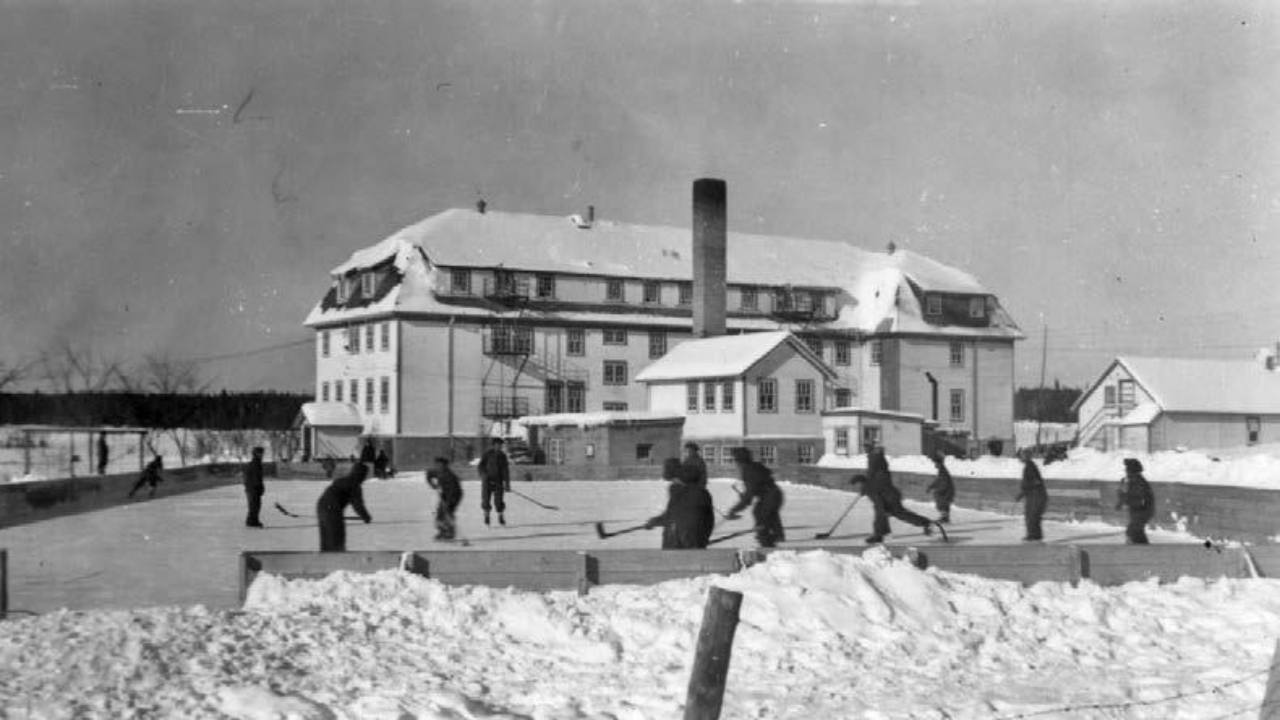
How confronting racism, restoring Indigenous history, and reshaping power in hockey challenges the myths at the heart of Canadian national identity.
Hockey is often described as the core of Canadian identity. Media organizations such as CBC, as well as cultural institutions like The Canadian Encyclopedia, have long framed the sport as a unifying national symbol.
Legally, hockey is recognized as Canada’s national winter sport under the National Sports of Canada Act of 1994, as documented by the Government of Canada.
Yet this national mythology conceals a deeper truth. The sport’s development and cultural positioning occurred within a colonial system that marginalized Indigenous peoples and erased their influence.
Scholars such as Janice Forsyth and Kevin Wamsley explained in their 2006 International Journal of Canadian Studies article that Canadian sport was built through policies designed to assimilate Indigenous peoples.
Sport historian Bruce Kidd similarly has argued in his that Indigenous exclusion was a structural element of how Canadian sport was shaped.
Today, both Indigenous and non-Indigenous athletes are working to confront this history and reclaim Indigenous presence within the game.
Racism as a Structural Reality
Racism in hockey has been well documented by historians, journalists, and policymakers.
The Truth and Reconciliation Commission’s Calls to Action on sport note that Indigenous athletes experienced widespread discrimination within Canadian sport systems.
Janice Forsyth expanded on this in her book Reclaiming Tom Longboat, where she chronicled the racism Indigenous athletes encountered, including segregated leagues, racist taunts, and systemic exclusion.
Modern examples continue this pattern. CBC News reported in 2019 on the First Nation Elites Bantam AAA team, whose players were subjected to repeated racist abuse at a Quebec tournament, demonstrating the ongoing nature of anti-Indigenous hostility in the sport.
These incidents are not isolated. They reflect long-standing structures that shape hockey culture, governance, and access.
The Aboriginal Sport Circle, which acts as Canada’s national voice for Indigenous sport, has repeatedly emphasized that high costs, racism, and limited developmental pathways prevent many Indigenous athletes from reaching elite levels.
The continuation of these barriers mirrors broader colonial dynamics within Canadian institutions.
Indigenous Roots of the Game
The origins of hockey cannot be understood without acknowledging Indigenous influence.
Mi’kmaq oral histories, as recounted by authors such as Rita Joe, describe Mi’kmaq communities playing stick-and-ball games on ice well before hockey became codified.
Sports historian Garth Vaughan supported this in his book The Puck Starts Here, where he explained that Mi’kmaq winter games were closely related to early forms of hockey.
These games developed at the time of first contact with Europeans and evolved in conversation with European sports such as shinty and hurling.
Mi’kmaq craftsmanship also played a foundational role.
Heritage Nova Scotia’s historical exhibit on Mi’kmaq sport shows that the Mi’kmaq were the earliest large-scale manufacturers of hockey sticks.
Their sticks were used across Canada throughout the nineteenth and early twentieth centuries and were even featured in Eaton’s catalogues.
Despite these documented contributions, mainstream hockey histories continue to center settlers while minimizing or ignoring Indigenous influence.
This erasure is a direct result of colonial storytelling practices that shaped how the sport’s past was recorded and taught, rather than a reflection of what actually happened.
Reclaiming Indigenous contributions is therefore essential for presenting an accurate account of how hockey developed.
Education as a Decolonizing Tool
Education is essential for transforming hockey culture.
Victoria Paraschak argued in her Sport and Reconciliation article in the Journal of Sport and Social Issues that meaningful reconciliation requires centering Indigenous histories and voices within Canadian sport.
Researchers Courtney Mason & Joshua Koehli have written about how anti-racist and culturally grounded education is necessary for challenging the colonial narratives that have shaped sport in Canada.
Indigenous athletes, in interviews with APTN News, have emphasized the need for anti-racism workshops, coaching certification reforms, youth programs grounded in Indigenous culture, and public storytelling that accurately reflects the Indigenous origins of hockey.
Education is not symbolic. Without it, the myths that sustain colonial attitudes remain intact and continue to reproduce inequality within the sport.
Indigenous Leadership in Hockey
Increasing Indigenous representation on the ice is important, but decolonizing hockey requires Indigenous leadership at every level of the sport.
Research compiled in Aboriginal Peoples and Sport in Canada, edited by Janice Forsyth and Audrey Giles, argues that representation without decision-making power allows colonial sport structures to persist unchanged.
Michael Robidoux, in his chapter in that same collection, demonstrates that Indigenous inclusion in sport has historically been limited to participation, while leadership and governance have remained controlled by settler institutions.
The Aboriginal Sport Circle has echoed this point by calling for Indigenous representation in coaching, administration, and executive governance.
When Indigenous people hold leadership roles, the culture of hockey changes—from how teams are managed, to how youth programs are run, to how incidents of racism are addressed.
Indigenous leadership enables structural transformation rather than superficial inclusion.
Creating Safe and Inclusive Spaces
Safe and inclusive hockey environments must go beyond preventing overt racism.
The National Inquiry into Missing and Murdered Indigenous Women and Girls identified sport as both a site where Indigenous youth have faced harm and a potential site for healing and community connection.
Interviews conducted by Victoria Paraschak and cited in her reconciliation research show that Indigenous athletes equate safety with cultural recognition and belonging, not just the absence of insults or discrimination.
Safe hockey environments require visible Indigenous language and artwork, consistent enforcement of anti-racism policies, recognition of Indigenous customs during events, meaningful partnerships with Indigenous communities, financial accessibility for players, and proper training for officials to recognize and respond to racialized violence.
Indigenous athletes, in interviews with CBC and other media outlets, have described how persistent racist abuse and the absence of meaningful institutional action make hockey an unsafe environment.
They stress that the sport will only feel genuinely safe when Indigenous presence is recognized as a normal and fundamental part of hockey culture rather than an exception.
Decolonizing Hockey as National Transformation
Hockey continues to be one of the central stories Canada tells about itself. Scholars such as Linda Tuhiwai Smith, Patrick Wolfe, and Paulette Regan have all uniquely argued that decolonization requires challenging the narratives settler societies construct to justify their identity.
In Canada, hockey is one of those narratives.
By addressing racism, reclaiming Indigenous contributions, expanding Indigenous leadership, supporting culturally grounded education, and creating environments that respect Indigenous belonging, we are not merely improving a sport.
We are challenging the colonial foundations of Canadian nationalism.
Decolonizing hockey means telling the truth about how the game was created, who shaped it, and who has been pushed out of it.
When these truths are acknowledged, a different future becomes possible—one where hockey reflects the land it is played on and the Indigenous peoples who helped create it.
One response to “Decolonizing Hockey and Canada’s National Story”
[…] The colonial dispossession framing that structured the Puerto Rico and Hawaii references — and why sport has historically been a site where that history surfaces and gets managed — is examined in the analysis of decolonizing hockey and Canada’s national story. […]