
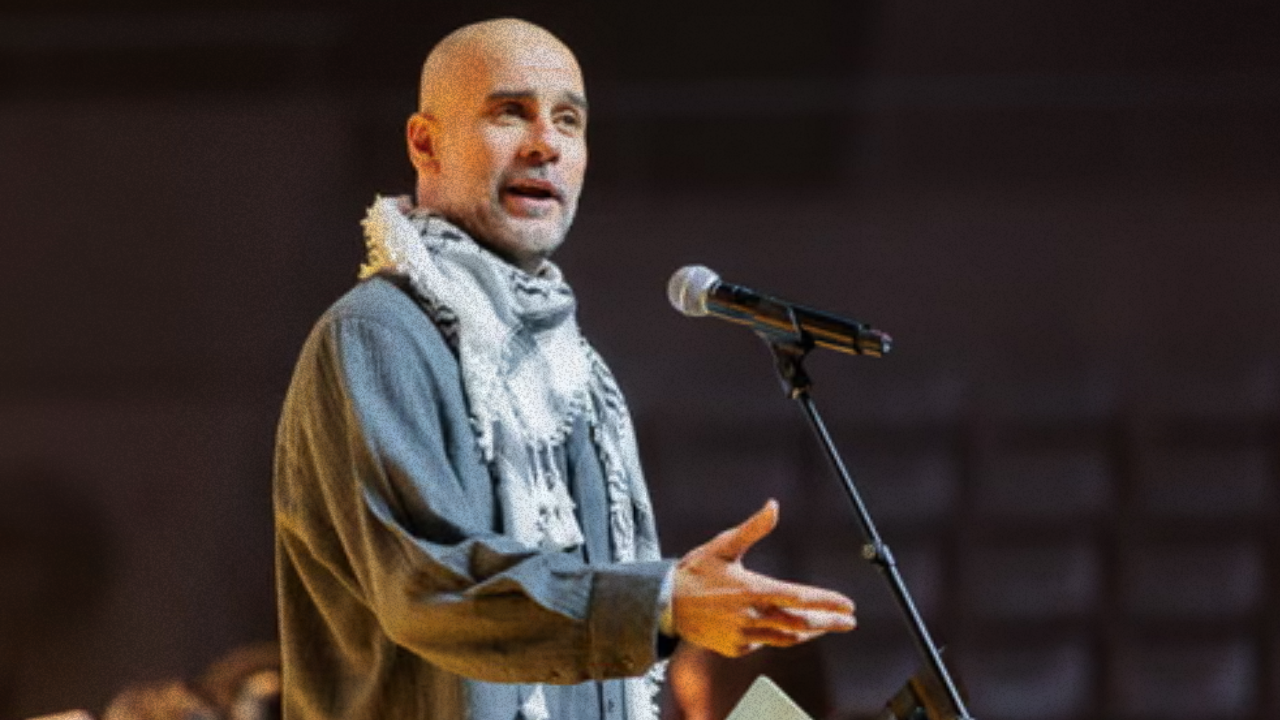
Pep Guardiola did not scandalize football by defending Palestinians. He scandalized the people who want Palestinian suffering kept outside the frame.
Pep Guardiola did not cross a line. His critics did.
The Manchester City manager spoke about Gaza’s abandoned children, mass killing, and the moral failure of a world that has watched destruction unfold in real time. He wore a Palestinian keffiyeh at a charity event in Barcelona. He later defended his right to speak about the killing of innocent people in Palestine, Ukraine, Sudan, and elsewhere. His critics responded by making the story about Israeli discomfort, communal anxiety, and whether a football manager had the right to speak at all.
That reaction said more than Guardiola did. It showed how Palestine is treated inside mainstream football culture: not as a human reality, not as a people enduring siege, bombardment, displacement, starvation, grief, and erasure, but as a subject that becomes controversial the moment someone powerful refuses to look away.
Guardiola did not bring politics into football. Politics was already there. It is there in ownership, sponsorship, state branding, broadcast deals, league campaigns, patriotic rituals, anti-racism messaging, Ukraine solidarity, and every selective moral posture football’s institutions decide to authorize. Guardiola’s offense was not that he broke football’s neutrality. Football is not neutral. His offense was that he stood with Palestinians in public language that could not be comfortably managed.
Pep Said What Others Avoid
Guardiola’s comments were not reckless. They were direct, humane, and proportionate to the scale of what Palestinians have endured in Gaza.
In the speech that first drew outrage, Guardiola spoke about Gaza’s children being abandoned. He described children asking where help was, where their mothers were, where the adults were, where the world was. The account republished by Jewish Voice for Liberation from Haaretz noted that Guardiola did not need to name Israel in order for Israeli sports media to treat his words as an attack. He spoke about children left alone. That alone was enough.
Israeli sports media reacted as if compassion itself had become aggression. Coverage fixated on Guardiola wearing a Palestinian keffiyeh. His words about abandoned children were treated as an anti-Israeli display. The scandal was not a specific factual error. The scandal was identification. Guardiola made Palestinian suffering visible, and visibility is exactly what defenders of Israel’s war on Gaza have worked to police.
He later spoke even more plainly. Reuters reported that Guardiola said he would keep using his platform to speak for victims of global conflicts, and quoted him naming “the genocide in Palestine,” Ukraine, Russia, Sudan, and other violence. The Guardian reported the same defiance after he was told to “focus on football.” He did not retreat into vague sorrow. He said the suffering of innocent people hurt him. He said that, from his position, he would try to speak up.
That is not hatred. That is the minimum moral response to mass death.
Guardiola’s critics want to make that response seem extreme. It is not extreme to be horrified by children killed, orphaned, displaced, starved, injured, and buried under rubble. It is extreme to demand silence from those who can see it.
The Backlash Was the Story
Israeli sports coverage of Guardiola’s Gaza stance is useful because it reveals how the backlash works. The framing presents Israeli Manchester City fans as conflicted figures, torn between admiration for Guardiola the football genius and disappointment in Guardiola the political speaker. They praise what he did for Manchester City. They call him transformative. They recognize his role in turning the club into a European power. Then they separate “Pep the coach” from “Pep the person.”
That separation is the emotional architecture of the backlash. Guardiola’s football is allowed to remain brilliant. His conscience becomes the problem.
The criticism does not always become a direct accusation of antisemitism. Sometimes it stops short of that. Sometimes it calls him ignorant. Sometimes it calls him arrogant. Sometimes it says he does not understand the Middle East. Sometimes it suggests he absorbed a pro-Palestinian narrative common in Catalonia. The accusation shifts depending on the speaker, but the function stays the same. Guardiola’s claim is not answered. It is pathologized.
That is the move. Do not deal with the substance of what he said. Do not deal with the scale of Palestinian death. Do not deal with the destruction of Gaza. Turn the speaker into the issue. Make his tone, his knowledge, his symbols, his supposed arrogance, and his alleged failure to show the correct solidarity the center of the story.
Once that happens, the dead disappear behind the feelings of those offended by their mention.
The Smear Does Not Need to Land
The phrase “not sure if antisemitism” does political work. It does not prove anything. It does not even fully accuse. It leaves the charge suspended in the air, close enough to stain Guardiola but vague enough to avoid scrutiny.
That is how the smear often functions. It does not need to land. It only needs to hover. Once the accusation is introduced, even as uncertainty, the discussion changes. Guardiola’s comments are no longer treated primarily as statements about Palestinians. They become a potential threat to Jewish safety, a possible expression of prejudice, a controversy that must be managed.
This is not a serious standard. Criticizing Israel’s war on Gaza is not antisemitism. Mourning Palestinian children is not antisemitism. Wearing a keffiyeh is not antisemitism. Saying that mass killing should hurt any decent person is not antisemitism.
There is real antisemitism in the world, and it should be opposed seriously. That seriousness is weakened, not strengthened, when criticism of Israel’s violence is folded into vague insinuations about Jewish hatred. The effect is not protection. The effect is discipline. It warns public figures that even basic solidarity with Palestinians may be treated as suspect.
Guardiola did not target Jews. He did not blame Jewish people. He did not call for harm against Jewish communities. He spoke about Palestinians being killed and abandoned. The attempt to turn that into a cloud of suspicion exposes how aggressively Palestinian grief is policed.
Stick to Football Means Stay Silent
The demand that Guardiola “focus on football” is one of the weakest arguments against him because football has never been sealed off from politics. It is one of the major stages on which politics is performed.
The Premier League did not “stick to football” when it organized public support for Ukraine after Russia’s invasion. The league announced that all 20 captains would wear armbands in Ukrainian colours, that stadium screens would display “Football Stands Together,” and that the message would appear across broadcasts and digital channels. FIFA and UEFA did not “stick to football” when they suspended Russian clubs and national teams from their competitions.
Those choices may be defended on their own terms. The point is that football’s institutions know how to make political decisions when the politics are approved. They know how to organize gestures. They know how to suspend teams. They know how to turn solidarity into ceremony.
That is why the Guardiola backlash is so revealing. The issue is not politics entering football. The issue is Palestine entering football.
When the cause is Ukraine, institutional football understands solidarity. When the cause is anti-racism, it understands symbolic gestures. When the cause is Remembrance, national mourning, royal death, police tribute, military commemoration, or corporate social responsibility, football understands ceremony. But when the cause is Palestine, suddenly the language changes. Suddenly football must be pure. Suddenly managers must stay in their lane. Suddenly grief is dangerous.
This is not neutrality. It is selective permission. As the collapse of Olympic neutrality showed in another institutional setting, sport does not remove politics. It curates which politics can appear without being named as politics.
Guardiola’s critics are not protecting football from politics. They are protecting football from the wrong politics, meaning politics that disrupt Western alliances, Israeli impunity, and the controlled humanitarian language that allows Palestinian suffering to be mourned only when nobody is held responsible.
Israeli Fan Pain Is Not the Center
Israeli Manchester City supporters are allowed to feel whatever they feel. Football fandom is personal. Clubs become family inheritances, daily rituals, emotional anchors, and private languages passed through generations. A supporter can admire Guardiola’s football and dislike his politics. That contradiction is real.
But Israeli fan discomfort cannot become the moral center of a story about Gaza.
That is what the backlash framing tries to do. It asks the reader to sit with the pain of fans who heard a famous manager condemn Israel’s violence. Guardiola was asking the world to sit with the pain of Palestinians whose families, homes, hospitals, schools, neighborhoods, and futures have been destroyed. Those are not equivalent injuries.
A fan’s disappointment matters to that fan. It does not outweigh the mass suffering Guardiola was naming.
The framing humanizes Israeli discomfort in granular detail. It gives supporters names, hometowns, family histories, memories, and emotional nuance. Palestinian suffering appears mostly as the thing that caused the controversy. That imbalance is not accidental. It is how media framing shifts sympathy away from the people under bombardment and toward the people offended by condemnation of the bombardment.
There is a larger pattern here. Palestinian death is often treated as a tragic abstraction. Israeli discomfort is individualized, narrated, and protected. Guardiola disrupted that imbalance by insisting that Palestinians be seen as human beings whose suffering demands a response.
The Keffiyeh Panic Exposes the Fear
The fixation on Guardiola’s keffiyeh matters because his critics understood the symbol immediately. That is why they reacted so strongly.
The keffiyeh made his solidarity visible before he finished speaking. It connected him to Palestinians not as an abstract humanitarian category, but as a people with a history, a culture, a struggle, and a political identity. That is what made it intolerable.
Palestinians are often permitted into mainstream discourse only as victims without politics. They can be hungry, wounded, displaced, or dead, but they must not be represented as a people resisting erasure. The keffiyeh breaks that rule. It says Palestine is not just a disaster zone. It is a nation, a memory, a cause, and a people still present despite every attempt to make them disappear.
That is why a scarf can become a scandal. The problem was not fabric. The problem was recognition.
Guardiola’s critics wanted to treat Palestinian visibility as provocation. He treated it as solidarity. That difference is the whole argument.
Football’s Double Standard Is Material
The double standard is not just rhetorical. It lives inside football’s institutions.
FIFA declined in March 2026 to take action against Israeli clubs accused by the Palestine Football Association of competing while allegedly based in Palestinian territory. Reuters reported that FIFA cited the unresolved legal status of the West Bank under public international law. In the same broader process, FIFA sanctioned the Israel Football Association over systemic breaches of anti-discrimination and fair-play rules, including failures related to persistent racist behaviour by supporters and inflammatory public statements by clubs and officials.
That is football’s neutrality in practice. Russia could be suspended by FIFA and UEFA after the invasion of Ukraine. Israel could remain inside the football system while Palestinian claims over settlement clubs were deferred into legal complexity, and while the Israel FA was fined rather than structurally isolated over discrimination breaches.
The comparison does not require pretending every case is identical. It requires noticing that football’s institutions are fully capable of political judgment when power permits it, and suddenly procedural when judgment would implicate Israel. That is not absence of politics. It is politics expressed through selective enforcement.
Neutrality curates politics rather than banning it. Guardiola’s case shows the same mechanism at club-football scale. Approved grief becomes ceremony. Palestinian grief becomes controversy.
Pep Deserves Praise
Guardiola deserves praise because he used a platform most public figures spend their careers protecting.
He did not hide behind empty language about “all sides” when the reality demanded more. He did not reduce Gaza to vague sadness. He did not pretend that silence was wisdom. He said the killing of innocent people hurt him. He said abandonment was a moral failure. He said he would speak.
That matters because Guardiola is not easy to dismiss. He is not a marginal activist. He is one of the defining managers in football history. His Manchester City reign transformed English football, produced domestic dominance, brought the club the Champions League, and made him one of the central figures of the modern game. Reuters reported in June 2026 that chairman Khaldoon Al Mubarak described Guardiola’s decade at City as exceptional, credited him with changing English football, and said he left his thumbprint on the league.
When someone with that level of cultural power speaks about Palestine, the usual machinery of silence has to work harder.
That is why the backlash came so quickly. Powerful speech creates pressure. Guardiola did not end the destruction of Gaza by speaking. No single manager, athlete, actor, artist, or public figure can do that. But he broke the expectation that people with something to lose should remain vague, cautious, and obedient.
He showed that the real risk is not saying too much. The real risk is allowing the powerful to define compassion as controversy.
The Critics Should Be Condemned
The critics who tried to turn Guardiola’s solidarity into a scandal deserve condemnation. Not because every person upset by his comments is identical. Not because Jewish opinion is monolithic. It is not. Jewish anti-Zionist and pro-Palestinian voices have repeatedly rejected the claim that Israel’s violence should be protected from criticism in the name of Jewish safety.
The problem is institutional pro-Israel pressure that claims to speak for communal security while treating Palestinian grief as a threat. That politics does not protect Jewish people. It protects Israel from accountability. It takes real fear of antisemitism and redirects it against those who oppose mass violence in Gaza.
There is no moral courage in telling Guardiola to focus on football. There is no moral seriousness in implying that a speech about Palestinian children fuels antisemitism simply because it refuses to center Israel’s self-justification. There is no integrity in praising political speech when it serves approved causes and condemning it when it names Palestinians.
The critics are not angry because Guardiola misunderstood football’s role. They are angry because he understood his own role too well. He has a voice. He used it. He refused to pretend that the suffering of Palestinians becomes less real because powerful institutions would prefer silence.
Football’s Silence Is the Scandal
The scandal is not that Pep Guardiola spoke. The scandal is that so many others did not.
Football’s institutions have shown they know how to act when they choose to. They know how to organize gestures. They know how to suspend teams. They know how to condemn states. They know how to make moral language visible across stadiums, broadcasts, armbands, ceremonies, and campaigns. The silence on Palestine is not incapacity. It is choice.
That choice has consequences. It tells Palestinian supporters that their grief is too political. It tells players and managers that solidarity may cost them. It tells fans that some victims can be publicly mourned while others must be abstracted into silence. It tells the world that football’s universal language has borders after all.
The politics of silence around Israel in global sport is not confined to football. It appears wherever institutions celebrate representation, neutrality, and inclusion while refusing to treat Palestinians as fully visible human beings inside the same sporting world.
Guardiola stepped outside that arrangement. He did not say anything hateful. He did not say anything complicated. He said Palestinians had been abandoned. He said the killing of innocent people hurt him. He said he would speak.
For that, he was accused of ignorance, arrogance, provocation, and possible antisemitism. Those accusations should not intimidate him. They should indict the people making them.
Pep Guardiola did not betray football. He reminded it that the people outside the stadium are human beings too. If that is controversial, the shame belongs to his critics.
Sources
- The Guardian – People are dying, you have to help: Guardiola decries wars in Sudan, Ukraine and Palestine, February 3, 2026
- Reuters – Guardiola vows to speak up for victims of global conflicts, February 4, 2026
- The Guardian / PA Media – Focus on football: Guardiola criticised by Manchester Jewish group over Palestine comments, February 4, 2026
- The Guardian – Guardiola refuses to be silenced, February 6, 2026
- Jewish Voice for Liberation – Outrage when Pep Guardiola spoke about Gaza’s children, republishing Kobi Niv / Haaretz commentary, February 10, 2026
- Israeli sports-media coverage of Manchester City fan reaction to Guardiola’s Gaza stance, February 21, 2026
- Premier League – Premier League and clubs stand together in support of Ukraine, March 2, 2022
- FIFA / UEFA – FIFA and UEFA suspend Russian clubs and national teams from all competitions, February 28, 2022
- Reuters – FIFA clears Israeli settlement clubs but fines Israel FA over discrimination breaches, March 19, 2026
- Reuters – Israeli strikes kill 10 people in Gaza, medics say, June 4, 2026
- Reuters – Guardiola quit 100 times before final exit, says Man City chairman, June 4, 2026
- Sparked Sports – The Olympics and the Collapse of Neutrality, February 7, 2026
- Sparked Sports – How Olympic Neutrality Silences Dissent and Protects Power, February 13, 2026
- Sparked Sports – Team Israel, World Baseball, and the Politics of Silence, February 6, 2026