
Olympic neutrality curates politics rather than banning it, suppressing messages that expose power while protecting the spectacle of alignment and sponsors.
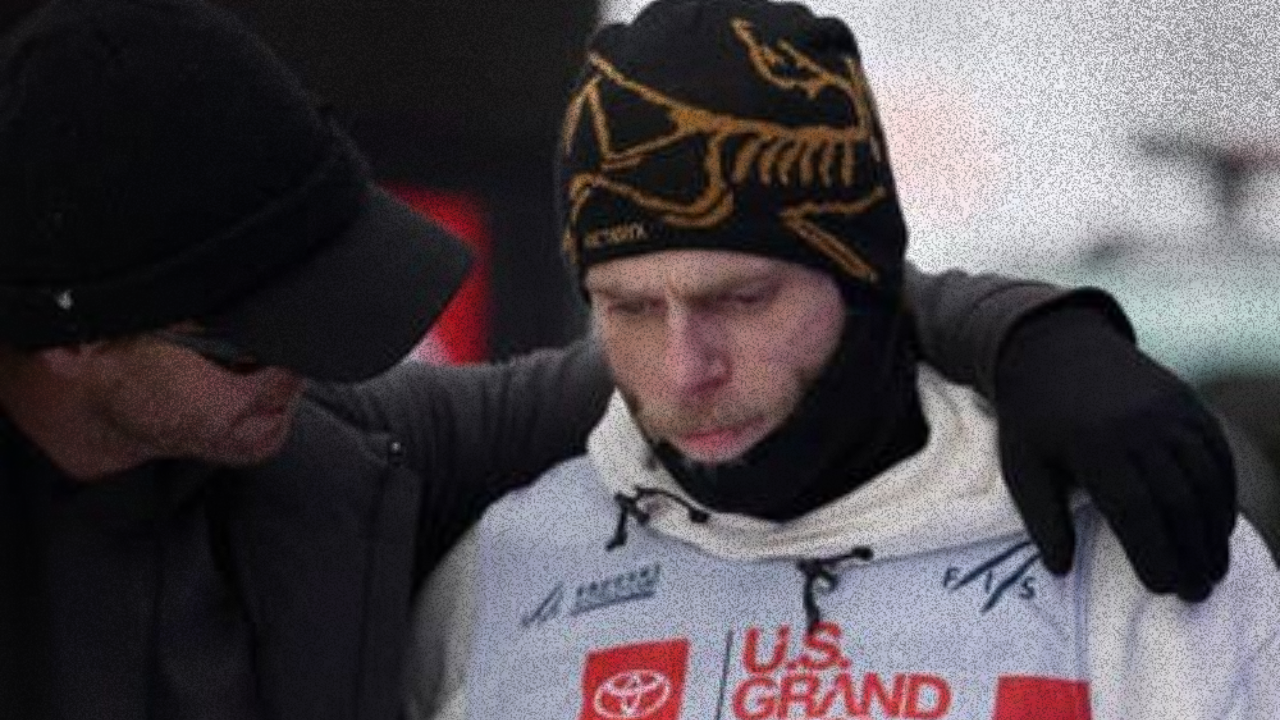
On February 12, 2026, at the Cortina sliding center, Ukrainian skeleton racer Vladyslav Heraskevych arrived for competition wearing a helmet painted with the faces of twenty-four Ukrainian athletes and coaches killed since Russia’s full-scale invasion in 2022. He was a medal contender. He was also his country’s flag bearer. The IOC had warned him. He wore it anyway. Forty-five minutes before his event, his accreditation was withdrawn and he was removed from the Games.
A week earlier, British skier Gus Kenworthy had written “Fuck ICE” in the snow using his own urine, posted it on Instagram, and competed the following day without incident. No meetings with IOC officials. No warnings. No sanctions.
The IOC’s explanation for the Heraskevych decision was precise: “It’s not the message,” said IOC president Kirsty Coventry, tears rolling down her face. “It’s the place that counts.” IOC spokesperson Mark Adams expanded: “There are 130 conflicts going on in the world. We cannot have 130 different conflicts featured during the field of play.”
These two cases, running simultaneously at the same Games, reveal more about how Olympic neutrality actually functions than any policy document ever could.
What Rule 50 Says and What It Does
Rule 50 of the Olympic Charter states that “no kind of demonstration or political, religious or racial propaganda is permitted in any Olympic sites, venues or other areas.” The IOC frames this as a protective principle — keeping athletics above the world’s conflicts, giving all nations a shared stage, insulating athletes from political pressure. In its 2021 athlete consultation, the IOC argued that neutrality “protects athletes from being placed in a position where they may be forced to take a public position.”
The basic framework has been in the Charter since 1975, when it was tightened in the years following the 1968 Mexico City Games, where US sprinters Tommie Smith and John Carlos raised their fists on the podium. The rule was refined, not created, in response to racial justice protest.
The stated principle is neutrality. But neutrality is not a description of the Olympics — it is a management tool for them.
A Structure That Was Never Neutral
The Olympic Games are built from the world’s political architecture. They are hosted by nation-states. They are secured by militarized police forces and intelligence coordination. They are funded by multinational sponsors and sustained by billion-dollar broadcast contracts. Every medal ceremony is organized around flags, anthems, and national rankings. The nation-state is the core unit of the spectacle.
That is not neutral. It is structural. Neutrality is the language used to make that structure feel natural rather than political. It reframes competitive nationalism as tradition. It converts geopolitical alignment into ceremony. It turns security infrastructure into background scenery.
The Olympics do not transcend the global order. They stage it. And Rule 50 is the aesthetic that makes the staging feel like harmony rather than power.
The broader argument for why sports spectacle functions as political infrastructure rather than escape from it — and how that infrastructure is built and maintained — is examined in the analysis of sports as infrastructure of ideology.
Politics That Integrate vs. Politics That Expose
The rule does not eliminate politics from the Games. It distinguishes between two kinds of politics: those that integrate seamlessly into the existing global order, and those that reveal its scaffolding.
The IOC banned all Russian national teams from Milan. As examined in the analysis of the Russian ban, that decision reflected a geopolitical consensus among Western sponsor nations and host states — a consensus the IOC absorbed without difficulty. Russian exclusion aligned with the dominant framework. It required no rule change. It created no sponsor discomfort. It passed through the spectacle cleanly.
Kenworthy’s anti-ICE message also passed through cleanly. It pointed at US immigration enforcement — a domestic controversy that generated significant media coverage and sponsor neutrality, posed no threat to the Games’ geopolitical structure, and dissipated quickly. The IOC could allow it without consequence because it could not concentrate into anything.
Heraskevych’s helmet was different in kind. It bore the specific faces of specific dead people killed in a specific ongoing war — a war in which Russia, whose athletes were competing under a neutral flag at the same Games, was the aggressor. Permitting it would have made the contradiction visible at the field of play. It would have required the IOC to hold, simultaneously, the image of a Russian athlete competing as “neutral” and the image of the people that state had killed. The structure could not absorb both without fracturing.
The IOC president said she agreed with the message. She said nobody was disagreeing with it. She said it was “powerful” and “a message of memory.” And then she disqualified the athlete carrying it.
That is not a contradiction. That is the mechanism working as designed.
The specific machinery through which allegiance and national identity are embedded invisibly into sports ritual — so that only the protests become visible as political while the structure itself reads as natural — is examined in the analysis of sports ritual and the hidden machinery of allegiance.
Selective and Documented
Heraskevych himself identified the inconsistency: “U.S. figure skater, Canadian freeskier, Israeli skeleton athlete — they didn’t face the same things.” At the 2022 Beijing Games, the IOC had declined to find him in violation when he held up a “No War in Ukraine” sign after his race, ruling he was “simply calling for peace.” At Milan 2026, faces of the dead constituted political propaganda.
The inconsistency across Games is well-documented. At Tokyo 2020, US athletes Gwen Berry and Raven Saunders made gestures of racial justice protest on the podium and were not sanctioned. At Paris 2024, Afghan refugee Manizha Talash was disqualified for wearing a cape reading “free Afghan women” during competition. The pattern is not random. Messages that embarrass allies, expose ongoing contradictions, or force the structure to acknowledge what it is managing — those are the messages that trigger enforcement.
Sponsor Comfort and Broadcast Stability
The logic is economic as well as political. The Olympics require sponsor comfort and broadcast stability. Companies pay the IOC billions for the rights to attach their brands to an image of universal harmony. Broadcasters pay for a narrative that can be packaged and sold globally. Host states commit enormous security resources to stage an event that reinforces their national prestige.
Neutrality is what assures all of these actors that the spectacle will not become open geopolitical confrontation. It is risk management presented as principle.
When Kenworthy posts a message on Instagram, the risk is manageable — a news cycle, a social media conversation, a familiar American controversy that US broadcasters can contextualise and move past. When a Ukrainian flag bearer stands at the field of play wearing the faces of his country’s dead while Russian athletes compete as “neutrals” fifty meters away, the risk is something else. It cannot be contextualised. It cannot be smoothed. It exposes exactly what the neutrality framework was built to conceal.
The IOC president cried. The IOC said it was a powerful message. The IOC banned the athlete. These three things are not in tension. They are the same thing.
The same curation logic at work in a different register — how the Bad Bunny Super Bowl halftime show was permitted precisely because it posed no threat to the spectacle’s geopolitical structure while appearing to expand its boundaries — is examined in the analysis of Bad Bunny’s Super Bowl show and empire’s new strategy.
The Scaffolding
Olympic neutrality does not ban politics from the Games. It curates politics. It permits the politics embedded in flags, anthems, national rankings, and sponsor relationships — the politics that constitute the spectacle’s foundation. It suppresses the politics that would make that foundation visible.
The IOC spokesperson said there are 130 conflicts in the world and the field of play cannot feature all of them. That is true, and it is also not the argument anyone was making. The argument Heraskevych was making — and that his helmet was making without words — is that when an institution decides which of those 130 conflicts is acceptable to acknowledge and which is not, the decision is political. The claim that it is not political is itself the politics.
Neutrality is the aesthetic that makes a deeply political structure feel like it exists above the mess. When that aesthetic holds, the flags read as tradition and the medals table reads as friendly competition. When a 27-year-old Ukrainian skeleton racer refuses to take his helmet off, the aesthetic breaks — not because he broke the rules, but because he made the scaffolding visible.
They could not let him race wearing those faces. The Games had to go on.