
With Russia absent and U.S. tensions higher than ever, the 2026 Olympic gold medal game carries the weight of a rivalry reshaped by politics, identity, and proximity.
On Sunday morning, alarm clocks will go off before sunrise across Canada, not for work or church but for hockey.
Bars will unlock their doors early, with liquor laws across Canada having been adjusted just enough to accommodate the ritual of a gold medal hockey game.
Televisions will already be glowing before the coffee is poured, jerseys will come out of closets, and group chats will begin to fill with predictions and arguments long before the puck drops.
Canada will face the United States for Olympic gold in a best-on-best tournament featuring NHL players for the first time in more than a decade.
Media coverage has already framed the game as historic and emotionally charged, and even players have used the word “hatred” to describe the rivalry.
Some observers will insist that this is nothing more than a hockey game. However, it does not feel that simple, because the world that last saw this matchup in its current form no longer exists.
The last time NHL players competed for Olympic gold, the global order felt more stable, Russia was still a central figure in international hockey, and the rivalry between Canada and the United States carried a different emotional tone.
In 2026, one of the key rivals that once structured international hockey is absent, and that absence changes the meaning of the tournament.
The Collapse of the Old Script
For decades, in Canada, the emotional architecture of international hockey revolved around Canada and Russia. The Summit Series of 1972 established a template that framed hockey as a symbolic extension of the Cold War.
It was widely understood at the time as democracy versus communism, the West versus what was portrayed as totalitarianism.
Regardless of how that narrow framing captured the complexity of geopolitical reality, it provided a clear narrative structure that shaped how fans experienced the games.
That structure depended on the presence of a defined external adversary. Russia, and before it the Soviet Union, functioned as that adversary. However, Russia has not competed under its own flag at the Olympics since 2014 following findings of state-sponsored doping.
In 2018 and 2022, Russian athletes participated under neutral designations, and shortly after the 2022 Beijing Games concluded, Russia invaded Ukraine.
The International Ice Hockey Federation suspended Russia and Belarus from international competition, and they remain excluded from major tournaments.
Russia was not defeated in a dramatic gold medal game; it was removed from the tournament by geopolitical events.
The NHL also skipped the 2018 and 2022 Olympics, which means that the 2026 Games mark the first best-on-best Olympic hockey tournament in twelve years.
The emotional and political context surrounding the sport has shifted dramatically during that time.
With Russia absent, the old Cold War script no longer organizes the rivalry. The only superpower left across the ice from Canada is the United States.
Identity in Relation to the United States
Canada’s national identity has rarely been defined through revolution, constitutional rupture, or ideological struggle. Instead, much of its self-understanding has developed in relation to the United States.
A significant part of Canadian identity is built around contrast, and the phrase “we are not America” has functioned as a quiet but persistent element of national self-definition.
Hockey becomes the ritual space in which that contrast is performed rather than debated. When Canada defeats the United States in hockey, the result can feel like a symbolic reversal of broader asymmetries that exist culturally, economically, and politically.
The victory does not alter trade agreements, military alliances, or economic integration, but it offers a moment in which the usual hierarchy appears inverted.
This dynamic helps explain why the emotional response to Canada–U.S. games often exceeds what would be expected from sport alone.
The reaction is not simply about athletic performance; it reflects a deeper anxiety about proximity to power and a desire for moments of psychological autonomy within an unequal relationship.
From Unity to Strain
There was a time when that proximity felt less fraught. Many Canadians remember where they were on September 11, 2001, when classroom televisions flickered to life and adults spoke in hushed tones about an attack that seemed to alter the world overnight.
Only months later, in February 2002, Canada defeated the United States to win Olympic gold in Salt Lake City. The celebration that followed felt like release, and rivalry coexisted with a sense of North American unity.
At that moment, it seemed possible to cheer Canada’s victory over the United States while still believing that the two countries were aligned in a shared moral project.
Over time, that sense of uncomplicated solidarity eroded. The war in Afghanistan stretched on, Canadian soldiers were killed, and the justifications for continued conflict became more ambiguous.
The 2008 financial crisis, which originated in American housing markets and financial institutions, rippled through Canada and reshaped economic expectations for an entire generation.
Housing affordability tightened, job security weakened, and many young Canadians entered adulthood under conditions of precarity rather than prosperity.
The opioid epidemic further exposed the consequences of deeply integrated cross-border economic systems. Pharmaceutical practices and regulatory failures that spanned North America left communities hollowed out on both sides of the border.
The relationship between Canada and the United States remained intimate, but it no longer felt emotionally simple.
Prosperity, Politics, and the Hardening Rivalry
In 2010, when Sidney Crosby scored the golden goal in Vancouver, the country experienced a moment of collective release.
Although global instability was already present, a sense of relative prosperity still provided a cushion.
The rivalry with the United States felt intense but buffered.
In the years that followed, that buffer thinned. Trade tensions resurfaced, tariffs entered mainstream political discourse, and rhetorical provocations about Canada’s status circulated in ways that would have seemed implausible decades earlier.
Political polarization within the United States intensified, and global geopolitics grew more volatile following the invasion of Ukraine.
The absence of Russia from international hockey removed the old ideological antagonist, and the emotional energy that once flowed into that rivalry began to concentrate elsewhere.
With Russia no longer present, the Canada–U.S. rivalry stands alone at the center of international hockey.
The old East–West narrative is gone, and what remains is a more intimate confrontation between a middle power and the superpower it lives beside.
A Familiar Foe
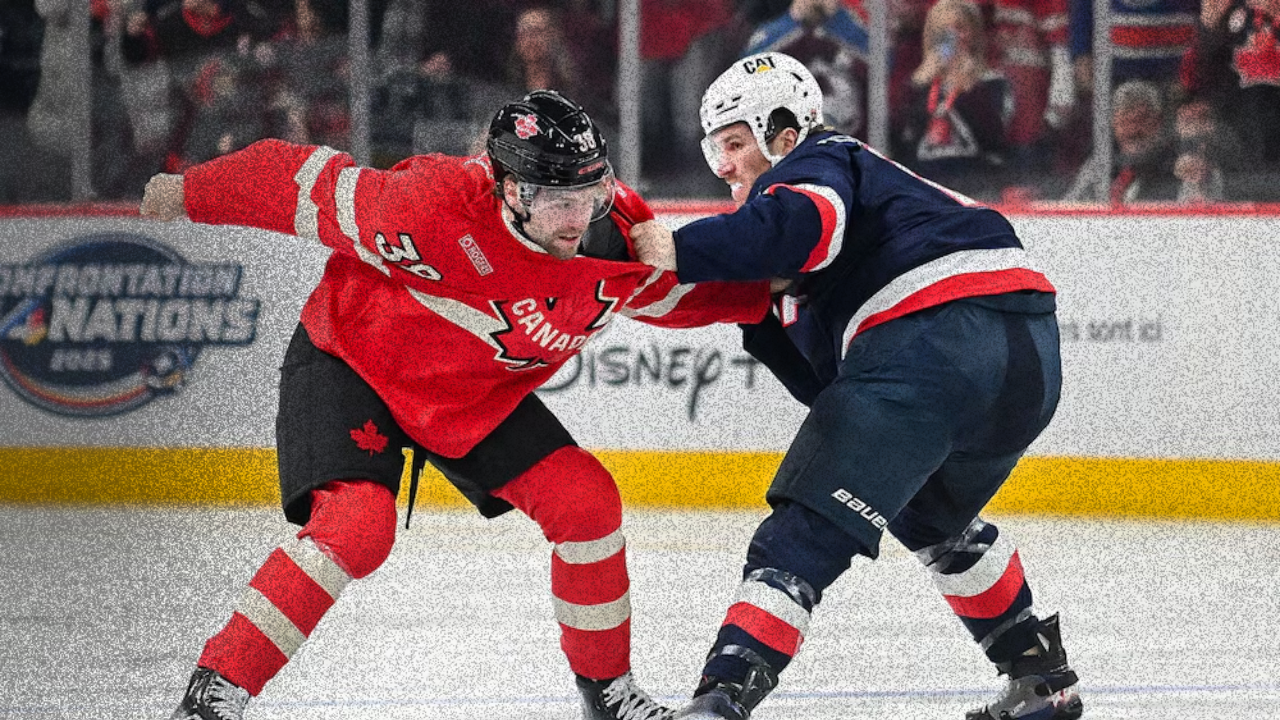
At the NHL’s 4 Nations tournament, the national anthem ceased to function as a neutral ceremony and instead became a flashpoint. In Montreal, fans booed the American anthem, and in Boston, some fans returned the gesture by booing Canada’s anthem.
Commentators on both sides condemned the behaviour as embarrassing and beneath the sport, focusing on the breach of decorum rather than the tensions that produced it.
Booing can be crude and misdirected, but the intensity of the moral reaction suggested a deeper discomfort.
The outrage centred on etiquette, while the broader political and economic strains shaping the rivalry received less attention.
Whatever motivated those fans has not disappeared.
If anything, it has intensified as Russia’s absence and heightened political turmoil in the United States have concentrated symbolic meaning in the only major rivalry left on the ice.
A Convergence in 2026
The 2026 gold medal game does not fit the old ideological template of democracy versus communism, nor does it resemble the relatively buffered rivalry of 2002 or 2010.
The Cold War script has collapsed, the prosperity cushion feels thinner, and the geopolitical landscape is more unstable.
Russia’s removal from the tournament eliminates the external adversary that once structured international hockey, and in its place stands the United States as the sole superpower presence in the bracket.
This moment represents a convergence of factors that have been building for years. Canada’s relational identity, its economic integration with the United States, its skepticism toward overt nationalism, and its reliance on sport as a site of symbolic affirmation all come together in this matchup.
The emotional charge surrounding the game is not solely about hockey. It reflects a broader uncertainty about place, power, and proximity.
When the puck drops on Sunday, it will do so in a world that no longer offers the clarity of past rivalries.
The game will carry weight not because hockey itself has fundamentally changed, but because the context in which it is played has shifted.
Russia is absent, political strain is visible, and the only superpower left across the ice is the one Canada measures itself against every day.
That is why this final feels different, and why its meaning extends beyond the boards of the hockey rink.