
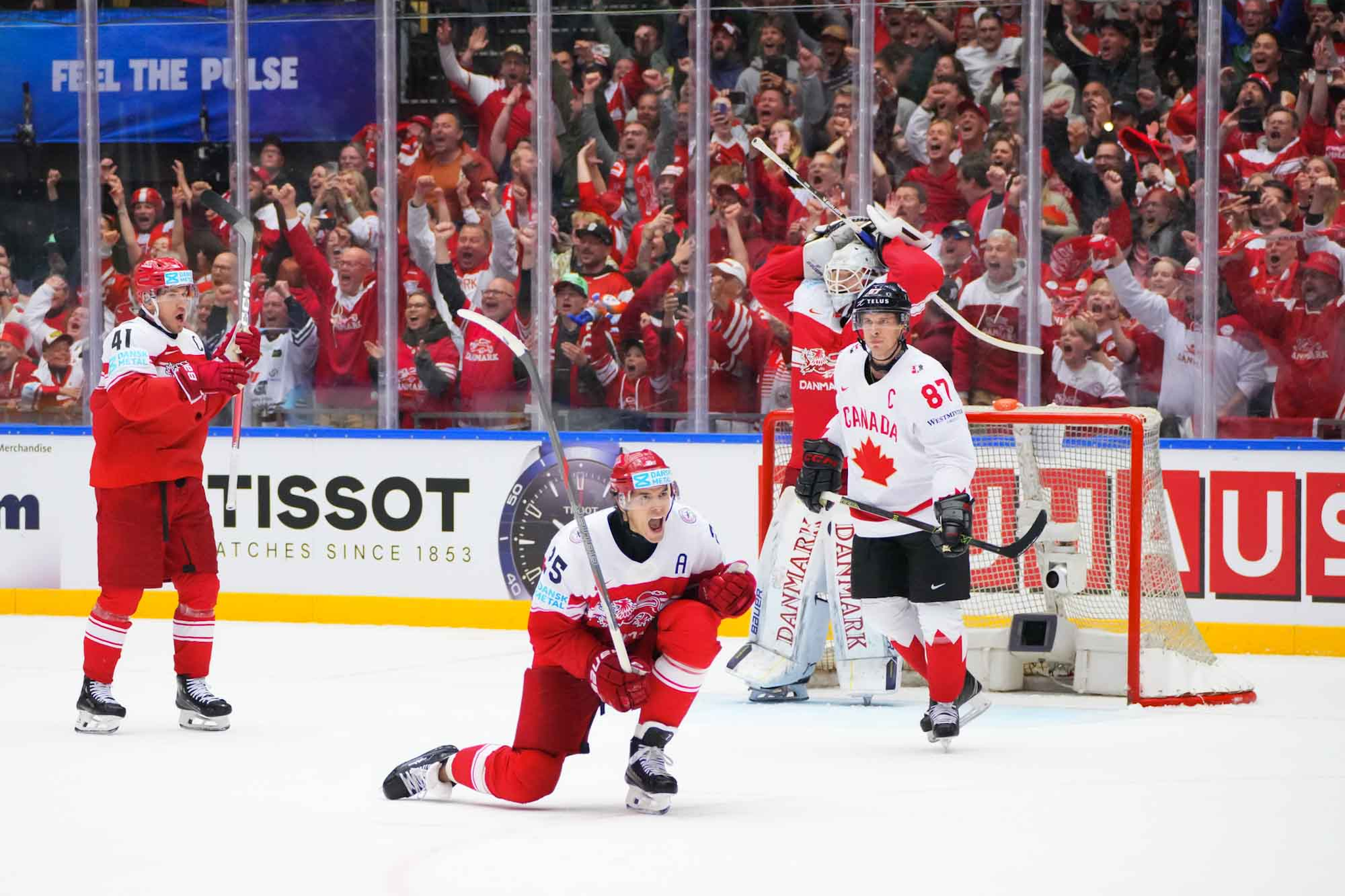
Canada dominated for 50 minutes before unraveling in a shocking 2–1 defeat to Denmark, blowing a likely USA showdown and delivering one of their worst upsets ever.
For forty minutes, it looked like Canada was doing everything but scoring. They outshot Denmark 25–13, controlled nearly 60 percent of the puck possession, and generated enough chances to suggest that a breakthrough was inevitable. But hockey has a special way of turning dominance into desperation, and what unfolded in the third period became one of the most shocking collapses Canada has experienced in recent international play. What began as a tight defensive stalemate spiraled into a 2–1 loss that stunned the team, the fans, and anyone who had penciled in a Canada–USA semifinal.
This is how it happened, and why almost none of it should have been possible.
A Cautious, Low-Event Start
The game opened with the kind of cagey, low-scoring pattern that felt strange for a Canadian team used to dictating pace early in tournaments. Through two scoreless periods, Denmark played smart, disciplined hockey: blocking shooting lanes, staying tight in the slot, and relying on stellar goaltending to keep the score deadlocked. Canada’s frustration grew as the clock wound down. Rather than sticking to structure—pushing pucks deep, sustaining pressure, and forcing turnovers—they increasingly tried to force plays and found themselves skating into Danish traps.
Denmark, for their part, committed a pair of sloppy penalties early but survived both. They even briefly thought they had opened the scoring before a hand-pass overturned the goal. That reversal alone foreshadowed a night where tiny moments would hold massive consequences.
Despite controlling most of the game, Canada entered the third period with nothing to show for it but tension, impatience, and the anxiety of knowing the longer an underdog survives, the more dangerous it becomes.
Historical Trends Pointed to Chaos
On paper, this matchup shouldn’t have been close. Even the historical trends in medal-round play suggested Canada was due for a high-scoring third period. Since 2022, eight of their last nine medal-round games had produced two or more goals in the final frame. Low-scoring first periods almost always gave way to frantic, high-event finishes. The betting numbers reflected this too: the over 1.5 goals in the third period was heavily juiced, sitting around –250. Denmark’s win odds, at +525, looked absurdly long considering how well they were surviving.
Canada’s past performance also showed they were only 2–2 in medal-round games where the first period had fewer than two goals. When Canada didn’t break through early, they often struggled to impose their rhythm late. Even so, nothing about those trends suggested they were in danger of a regulation loss—especially not with an elite roster featuring Sidney Crosby, who had lost just once in 14 years wearing Team Canada colors.
But statistical fragility isn’t destiny. It’s only a warning. And Canada ignored every one of them.
The Expected Breakthrough… and the Unexpected Collapse
Ten minutes into the third period, the breakthrough finally came. Canada scored to take a 1–0 lead, seemingly validating the pressure they’d built all night. With Denmark chasing and Sweden pulling ahead comfortably in their own game, the bracket was lining up perfectly for a blockbuster Canada–USA semifinal.
At that moment, the script felt almost predetermined. The expectation was simple: Denmark would push, take a desperate penalty, and Canada’s talent would finish the job, maybe even with an empty-netter.
But hockey scripts do not follow Hollywood structure.
Denmark pushed harder than anyone expected, and Canadian goaltender Jordan Binnington—brilliant in some stretches but unpredictable in many others—began to wobble. His reputation for letting in soft goals became an uncomfortable reality. With just minutes remaining, a harmless-looking play turned dangerous. Binnington bobbled the puck, Denmark dug in, sustained pressure, and finally shoved the equalizer past him.
Suddenly, everything tightened. Canada looked rattled. Denmark looked liberated.
And then the unthinkable happened: Denmark struck again.
What had been a scoreless game after forty minutes flipped into a 2–1 Danish lead with less than a minute to go. Canadian defenders scrambled. The bench panicked. They pulled the goalie but couldn’t muster clean possession, let alone a high-quality chance. The clock bled out. The building went silent. And that was that.
A Loss That Makes No Sense
Canada did not just lose a hockey game. They lost a game they controlled for 50 of the 60 minutes. They lost despite outshooting Denmark, despite having more zone time, despite owning the puck, despite having arguably the best player of his generation on the ice, and despite every pregame indicator pointing toward a routine win.
This wasn’t Finland beating Canada in overtime. This wasn’t the United States catching fire. This was Denmark, a team with heart, grit, and structure, but not the depth or firepower to match the Canadian lineup. And yet they won because they stayed disciplined, waited for mistakes, capitalized late, and got the kind of goaltending that turns underdogs into legends.
Canada lost because they abandoned their structure, let frustration creep in, depended too heavily on late magic, and—most painfully—because Binnington let in the kind of soft goals that sink nations in international play.
There is no way to dress this up: Canada should not lose that game. But they did. And the fallout is enormous.
Ripple Effects for the Tournament
With the loss, the dream matchup between Canada and the United States evaporated. Switzerland and the USA did their jobs. Sweden overpowered the Czechs. The bracket was perfectly aligned for a heavyweight showdown that would have captivated the hockey world. Instead, Canada crashed out early, handing Denmark one of the most significant upsets in its hockey history.
For Crosby, the defeat is particularly jarring. His loss to Finland earlier in the tournament marked his first in 14 years. This second one—against Denmark—will sting far more. No legend wants that added to their legacy.
And for Canada, the result is more than a disappointment. It’s a referendum on their consistency, their mental game, and their ability to handle pressure even when control is theirs.
A Night That Will Be Remembered for All the Wrong Reasons
In the end, the game will be remembered not for Canada’s pressure or Denmark’s discipline, but for the collapse. For the two late goals. For the stunned silence. For the way a medal-round matchup that looked inevitable slipped through their fingers.
Canada outplayed Denmark for most of the night. They still lost.
On nights like this, hockey reminds us why it’s unpredictable, cruel, and endlessly captivating. And why, sometimes, even giants fall.
One response to “Canada Collapses Late in Stunning Loss to Denmark”
[…] game also carries emotional weight that goes beyond the junior level. Last spring, Denmark stunned Canada at the 2025 Men’s World Championship, eliminating them in the quarterfinals with a late comeback […]