
The boos at the Milan opening ceremony did not politicize the Olympics. They exposed the politics the Olympic ceremony already performs.
The flags rose as they always do. Delegations marched. Anthems swelled across San Siro. The lighting was immaculate, the choreography precise, the message familiar: for a few weeks, the world would set aside its conflicts and gather in the name of sport.
Then came the boos.
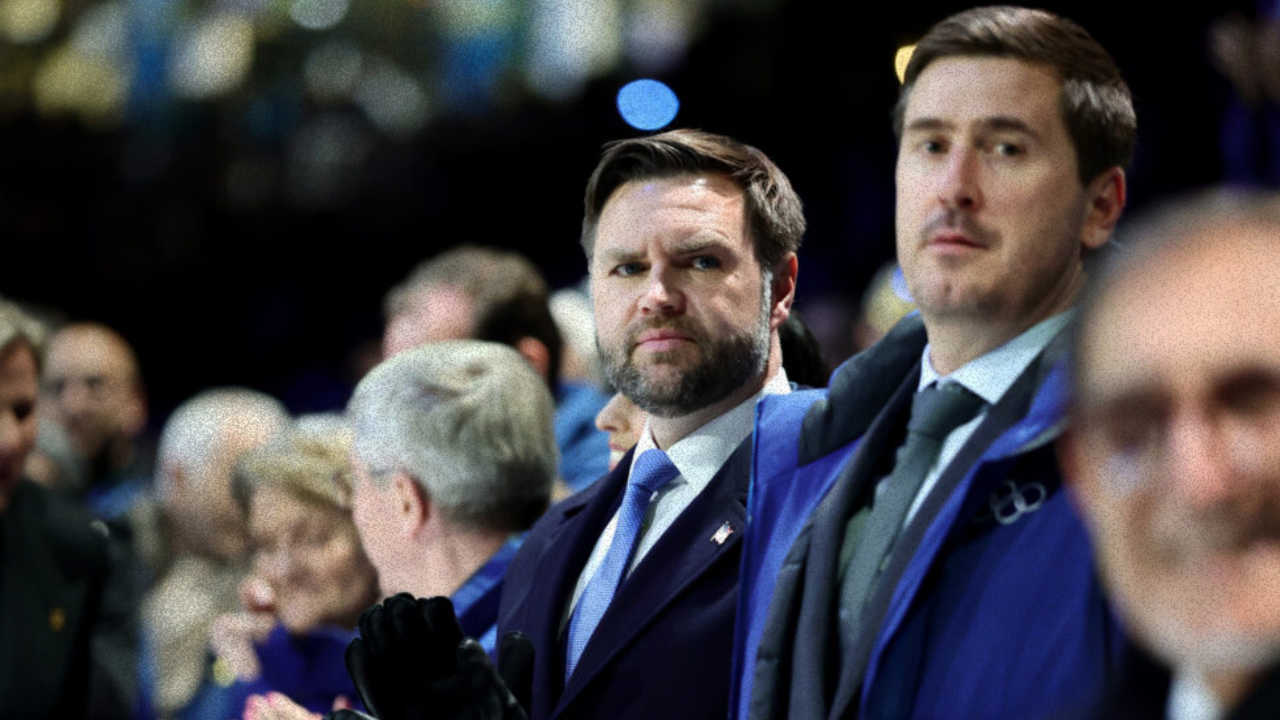
They were not universal. They were not constant. They did not stop the ceremony. But they were audible. When Israel’s delegation entered the stadium, parts of the crowd reacted sharply. When U.S. Vice President JD Vance appeared on the big screen, the reaction resurfaced. Outside the venue, demonstrators protested the presence of ICE-linked personnel around the U.S. delegation, Israel’s participation, and the broader political economy of the Games.
The 2026 Winter Olympics did not suddenly become political in Milan. They exposed something more useful: the long-running fiction that the Olympics were ever apolitical at all.
The Ceremony Is the Politics
Olympic neutrality has always been sold as a feeling before it is defended as a rule.
The ceremony is the purest expression of that feeling. Countries enter in order. Flags are carried. Athletes wave. Broadcasters narrate unity. The small delegation and the superpower receive the same formal place inside the ritual, at least for the length of the parade. The host promises harmony, peace, respect, and the best of humanity.
That is not the absence of politics. It is politics made ceremonial.
A nation’s presence in the parade is not a neutral fact. It is recognition. It tells the world that this state belongs inside the Olympic order. Its flag may be carried. Its athletes may be named. Its anthem may be played. Its national story may be folded into a global broadcast watched by millions.
The ceremony does not create state legitimacy by itself, but it reinforces it. That is why states care. That is why sanctions matter. That is why flags matter. That is why an anthem is not just a song once it enters the Olympic frame.
When the crowd booed, it did not introduce politics into the ceremony. It interrupted the ceremony’s preferred politics.
Neutrality Is Conditional
The IOC knows how to act when it decides action is required.
After Russia’s 2022 invasion of Ukraine, Russia and Belarus were not allowed to appear at the Olympics as ordinary national delegations. For Milano Cortina, Russian and Belarusian athletes who qualified and passed vetting could compete only as Individual Neutral Athletes. They could not use their national flags or anthems. Russian teams remained banned. Athletes with links to the Russian military or public support for the war could be excluded.
That precedent matters because it punctures the claim that the Olympics are structurally incapable of political judgment. The IOC can decide that a state’s conduct affects its status inside international sport. It can decide that symbols must be removed. It can decide that athletes may compete only after political vetting. It can decide that a national team cannot appear as a national team.
The issue is not whether the Russia and Israel cases are identical in every legal detail. They are not. The issue is that Olympic neutrality is not a universal principle applied mechanically. It is a managed policy, and managed policies reveal power through their exceptions.
Israel marched under its flag. Russian and Belarusian athletes did not. That contrast was already present before anyone booed.
The myth of neutral sport has always collapsed fastest around the Russia-Israel comparison. One war produces exile from the national frame. Another produces statements about dialogue, safety, and athletes not being responsible for governments.
Israel’s Flag Carried the Contradiction
Israel’s participation at the 2026 Winter Olympics proceeded without the symbolic restrictions imposed on Russia and Belarus. Its athletes marched under the national flag. The ceremony recognized them through the ordinary grammar of Olympic inclusion.
That is what critics objected to.
The objection was not that individual Israeli winter athletes personally caused the devastation in Gaza. That would be too simple, and it is not necessary. The stronger claim is structural. The Olympic ceremony does not only recognize athletes. It recognizes states through athletes.
When a state is accused of mass killing, displacement, starvation, and the destruction of civilian infrastructure, its untroubled participation in the ceremony becomes part of the political argument whether the IOC admits it or not.
That is why the boos mattered. They refused the smooth conversion of national representation into harmless pageantry. They said the flag did not arrive empty. It arrived carrying Gaza, whether the ceremony wanted that burden or not.
The IOC position is familiar: athletes should not be punished for the actions of governments. That principle sounds clean until it is applied unevenly. Russian and Belarusian athletes were subjected to national-symbol bans, political vetting, and team exclusion precisely because of the actions of states. Israel’s athletes were protected by the opposite principle.
That is not neutral. It is selective mercy.
Palestinian Sport Was Already Missing
The Olympic stage does not only show who is present. It also hides who has been made absent.
Palestinian sport has not been damaged in the abstract. The Palestinian Olympic Committee said in February 2026 that at least 1,007 Palestinian sportspeople had been killed since October 2023 and that 265 sports facilities in Gaza had been destroyed or damaged, including 184 completely destroyed and 81 partially damaged. Those numbers describe more than a humanitarian disaster. They describe the destruction of the conditions under which sport can exist.
Sport requires infrastructure. Fields, gyms, clubs, coaches, travel, funding, recovery time, stable institutions, and living athletes. When those things are destroyed, absence from the Olympic stage is not just a matter of qualification. It is the political economy of survival.
That is the part Olympic neutrality works hardest to miss. The Games can welcome Israel under its flag and say the ceremony is about athletes. But the athletes killed in Gaza are athletes too. The destroyed sports facilities are sports infrastructure too. The shattered development pipeline is part of international sport too.
Neutrality does not become neutral because it refuses to name the imbalance. It becomes one of the ways the imbalance is managed.
The U.S. Reaction Spread the Crack
The boos for JD Vance added another layer because dissent did not remain fixed on Israel alone.
Team USA was cheered. Vance was not. That distinction matters. The crowd did not simply reject American athletes. It rejected the political figure inserted into the Olympic image. Like the Israel reaction, the Vance reaction separated the athlete ritual from the state power trying to occupy it.
The context was already charged. Reports ahead of and around the opening ceremony described protests in Milan over the presence of ICE-linked personnel connected to the U.S. delegation’s security arrangements. The Guardian reported that hundreds protested before the ceremony, while Reuters reported “ICE OUT” demonstrations in the city.
That matters because it shows how quickly Olympic unity collapses when spectators are asked to applaud state power rather than athletes. The U.S. team could still receive cheers. Vance could still receive boos. The crowd made the distinction in real time.
The Olympics prefer these figures to appear as dignitaries, not as representatives of contested policy. The crowd did not cooperate. It treated Vance as a political actor, because he is one.
That is the crack spreading. Dissent moved from one delegation to a broader structure of Western power, policing, migration control, and imperial management. The ceremony wanted harmony. The audience heard the state.
NBC Showed How Control Works
The secondary controversy around broadcast handling made the point even clearer.
The Guardian reported that NBC’s U.S. broadcast appeared to cut or smooth over the boos when Vance appeared on screen, while CBC’s broadcast captured and commented on the reaction. That difference matters because a global spectacle is not only staged in the stadium. It is also edited into national memory by broadcasters.
Olympic ceremonies rely on narrative cohesion. The host produces the ritual. The IOC supplies the language of unity. Broadcasters package the images for domestic audiences. Disruption threatens the product because the product depends on the impression that everyone has agreed to the same emotional script.
Booing breaks that script. Editing can repair it for viewers who were not there.
That does not require a conspiracy theory. Broadcasts make editorial decisions constantly. Microphones are mixed. Crowd sound is balanced. Shots are selected. Commentary frames what matters. But those technical choices are also political choices when the thing being softened is public dissent against state power.
The stadium heard the rupture. Some viewers were given a cleaner ceremony.
That is how spectacle survives. Not by preventing every interruption, but by managing which interruptions become part of the official story.
Rule 50 Reveals the Real Fear
The IOC’s rules around political expression make the contradiction even sharper.
Rule 50.2 of the Olympic Charter bars demonstrations or political, religious, or racial propaganda in Olympic sites, venues, and other areas. Reuters’ explainer during the 2026 Games noted that athletes could express views in press conferences, mixed zones, interviews, team meetings, and social media, but not inside the field of play, medal podiums, Olympic Village, or opening and closing ceremonies.
That rule is presented as a shield for the Games. It is supposed to keep attention on sport and protect coexistence among athletes from more than 200 nations.
In practice, it protects the politics already built into the event. Flags are allowed. Anthems are allowed. Heads of state and vice presidents are allowed. Military and police security architecture is allowed. Corporate sponsors tied to state power are allowed. The host state’s legitimacy is allowed. National delegations are allowed to perform belonging.
The banned politics are the ones that interrupt the approved politics.
This is why Olympic neutrality silences dissent while protecting power. The Games do not remove politics from the venue. They decide which politics get to look like ceremony and which politics must be treated as disruption.
The boos were not permitted by the script. That is why they mattered.
The Spell Requires Cooperation
It would be wrong to pretend the boos ended Olympic legitimacy.
They did not. Billions still watch. Sponsors still pay. Athletes still train for years. The medal table still organizes national pride into a neat daily hierarchy. The ceremony still produces moments of beauty. The Games still offer real athletic meaning to people whose lives are built around them.
But the neutrality myth depends on public cooperation. It requires spectators to suspend geopolitical awareness long enough for the ritual to function as advertised. It asks the crowd to applaud flags as symbols of athletes rather than as symbols of states. It asks viewers to accept that war, occupation, sanctions, migration policing, and destroyed sports infrastructure can be left outside the stadium for a few hours.
In Milan, that cooperation became incomplete.
The crowd did not produce a revolution. It produced a refusal. That refusal was small, audible, and impossible to fully absorb into the choreography.
The Olympics’ neutrality problem is not that politics keep invading sport. The problem is that sport keeps pretending its own political architecture is invisible. Milan made the architecture visible for a few seconds.
The Boos Were the Honest Part
The useful way to read the opening ceremony is not as a breakdown of Olympic ideals. It is as a brief moment when the ceremony told the truth against itself.
The flags were political. The delegations were political. The sanctions were political. The exemptions were political. The broadcast edits were political. The ICE protests were political. The destroyed Palestinian sports infrastructure was political. The IOC’s call for unity was political.
The boos were political too.
The difference is that the boos did not pretend otherwise.
That is why they cut through the ceremony. They did not stop the Olympics. They did not change participation rules. They did not restore destroyed fields or revive killed athletes. They did not remove Vance from the screen or Israel from the parade.
They did something smaller and more precise. They refused automatic applause.
That refusal matters because Olympic legitimacy is not only built by institutions. It is completed by audiences. The crowd is supposed to supply consent on cue. When it withholds that consent, even briefly, the ritual keeps moving but the illusion weakens.
The 2026 Winter Olympics still distributed medals. They still produced spectacle. They still gave athletes the stage of their lives.
But Milan proved the stage is not outside the world. It never was.
The ceremony asked for unity. The crowd answered with reality.
Sources
- Reuters – Israel team, U.S. Vice President Vance booed at Milan Games opening ceremony, February 6, 2026
- The Guardian – NBC appears to cut crowd’s booing of JD Vance from Winter Olympics broadcast, February 6, 2026
- The Guardian – We are all connected: Winter Olympics opening ceremony stresses harmony and showcases Italy, February 6, 2026
- Reuters – Russians, Belarusians will compete as neutral athletes at 2026 Winter Olympics, says IOC, September 19, 2025
- Reuters – Games must bolster peace role amid worsening global conflicts, September 19, 2025
- Reuters – Rules on athletes expressing themselves at the Winter Games, February 12, 2026
- People’s Dispatch – Milan’s Winter Olympics met with protests against ICE and Israel, February 10, 2026
- Anadolu Agency – Over 1,000 sports people killed, 265 facilities destroyed in Israeli war on Gaza, official says, February 16, 2026
- Sparked Sports – The Olympics and the Collapse of Neutrality, February 7, 2026
- Sparked Sports – How Olympic Neutrality Silences Dissent and Protects Power, February 13, 2026
- Sparked Sports – The Myth of Neutral Sport: Exile for Russia, Impunity for Israel, May 24, 2025