
How modern sports act as ritual theaters that shape identity, loyalty, and political emotion, revealing the symbolic power behind our most familiar games.
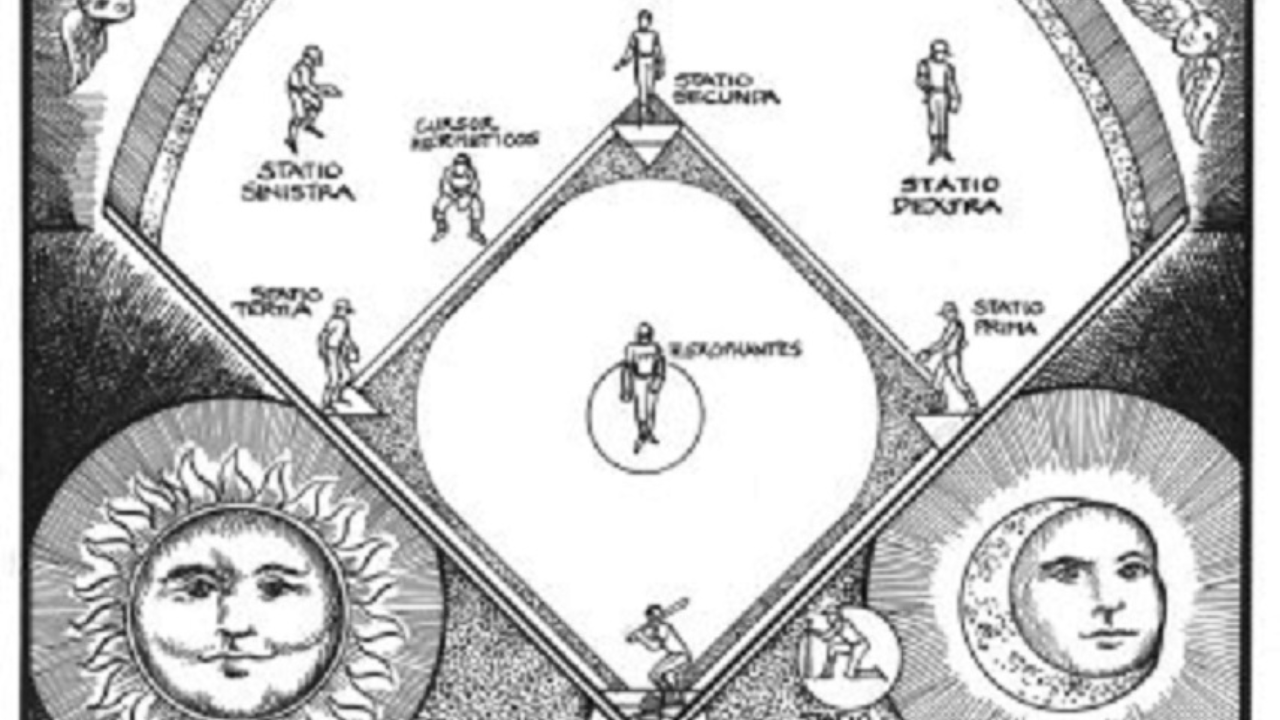
There is a familiar internet meme that jokes about baseball being a Masonic ritual. It is funny at first glance because it combines two things most people do not normally put in the same sentence. Yet the humor works because the comparison carries a grain of anthropological truth.
Most of us take part in symbolic systems far more often than we realize, and modern sports are among the most important of these systems. They are rituals that shape how we experience identity, conflict, and belonging.
They also serve the interests of states, nations, and institutions that understand how collective emotion can be guided through spectacle.
This essay explores that idea by examining three layers of the modern sports experience.
First, sports function as rituals in the classical sense. Second, they train people in the emotional mechanics of loyalty and allegiance.
Third, they rely on a moral grammar that mirrors the logic of politics and nationalism.
From there, the article looks at the historical connection between baseball and Freemasonry, as well as similar ties found in the origins of basketball and soccer.
These connections are not proof that sports were designed as secret rituals, but they help explain why the symbolic dimension of sports feels so powerful.
The combination of ritual, competition, pageantry, and communal tension allows sports to shape the way people see the world.
Sports as Modern Ritual
When anthropologists describe a ritual, they mean a structured pattern of repeated actions that give meaning to collective life. Rituals create order, reinforce hierarchy, and connect individuals to something larger than themselves. They do not require supernatural belief in order to function. A graduation ceremony works the same way as a religious rite of passage. A courtroom proceeding can have as much symbolic weight as a temple service.
Sports contain all the elements of ritual. Every game follows precise rules. These rules do more than regulate play. They define what counts as fairness, justice, and legitimacy. This is why controversial calls provoke such intense reactions. They are not just mistakes. They are seen as violations of the moral universe that the game is meant to uphold.
Sports also rely on ceremonial gestures that are instantly recognizable. The anthem, the uniforms, the pregame lineups, and the handshake rituals are all part of the choreography. These actions signal that participants are entering a symbolic space where normal life is suspended. The field or court becomes a sacred zone. Within its boundaries, chance and chaos are shaped into narrative. A routine regular season game can produce a story that feels mythic because it follows the same emotional arcs found in older rituals: struggle, sacrifice, and triumph.
Players themselves become archetypes. The star athlete becomes a hero whose performance contains echoes of warriors and champions from older traditions. The player who suffers an injury takes on the role of the wounded figure whose pain carries meaning for the collective. Even villains exist. The hated rival who provokes boos plays the part of the antagonist who must be overcome in order for the ritual to achieve resolution.
Fans participate emotionally in this structure. They ride the waves of hope, fear, frustration, and catharsis. Even when spectators know the outcome is uncertain and often trivial, the emotions feel real because rituals are designed to make emotional investment possible.
The key point is simple. Sports are not simply games. They are ritual theaters where collective identity is performed and renewed.
Allegiance, Conditioning, and the Training of Emotion
Ritual is not neutral. It shapes the way people feel and think. In the case of sports, the emotional training is subtle but powerful. Fandom teaches people how to attach themselves to symbols, colors, and abstract collectives. A person may feel completely apolitical, yet when their team reaches a championship final, the intensity of their pride or anger reveals something deeper.
Cheering for a team is practice for allegiance. It is practice for attachment to a group identity, even when that identity is imaginary. It is practice for drawing boundaries between us and them. It is practice for interpreting conflict through a moral frame where our side is righteous and the other side is suspect or corrupt. The exact details do not matter. The emotional infrastructure is what gets built.
This emotional infrastructure resembles nationalism. The rituals are similar. The flags, colors, chants, mascots, and logos serve the same symbolic functions as national emblems. When fans defend their team against criticism, the response mirrors patriotic defensiveness. When fans celebrate victory, it echoes the collective pride of national triumphs. When fans justify the actions of a star player despite evidence of wrongdoing, the logic replicates the justifications used to defend political leaders, military actions, or national myths.
People often claim that sports provide an escape from politics. In practice, they create a training ground for political emotion. They teach people to identify with an abstract collective, defend its honor, and internalize its victories and defeats as personal experiences. This conditioning shapes the way people respond to political events, media narratives, and national crises. The emotional patterns are already familiar because they have been rehearsed through fandom.
The Shared Moral Grammar of Sports and Politics
Sports and politics operate through the same symbolic and moral grammar. Both rely on stories about loyalty, betrayal, heroism, sacrifice, and redemption. Both punish defectors and reward faithful supporters. Both elevate symbols to the level of sacred objects. A jersey or flag is not just a piece of fabric. It is a container of meaning.
The rules of moral judgment also resemble each other. A political scandal is interpreted the same way as a sports controversy. Was the rule broken. Was the punishment fair. Was the outcome legitimate. Did someone cheat. Was justice served. These are the same questions fans ask during heated games. They are also the questions citizens ask during elections or national debates. The moral grammar is shared across both domains.
This similarity explains why governments invest so heavily in sports. They recognize the political value of emotional unity. International tournaments become arenas for national pride. Diplomatic strategies often revolve around sports events, from the Olympics to symbolic matches between rival states. Sports provide soft power because they offer a familiar emotional script that people already know how to read. Leaders who appear at stadiums or national celebrations intuitively understand that the public already grasps the moral syntax of spectacle, victory, and allegiance.
States use sports not because they are trivial, but because they are effective ritual tools for shaping collective identity.
Baseball, Freemasonry, and Symbolic Foundations
The connection between baseball and Freemasonry has attracted attention for decades. The facts are interesting, although they do not confirm the idea that baseball was created as a Masonic ritual. Instead, they reveal how deep the cultural entanglement between fraternal societies and early athletics really was.
Several early baseball legends, including Cy Young, Ty Cobb, and Alexander Cartwright, were Freemasons. Masonic lodges organized baseball teams in the early twentieth century, and lodge halls often hosted organizational meetings. Many community baseball leagues were run by Masonic networks that sponsored teams, funded youth programs, and provided facilities.
Cartwright, often credited with formalizing early baseball rules, was a member of Hawaiian Lodge. His involvement has encouraged speculation about Masonic influence on the symbolic shape of the baseball diamond.
Some writers point to the square geometry, the fourfold progression around the bases, and the centrality of home as suggestive of ritual symbolism. Others note the ceremonial structure of the sport: the opening pitch, the fixed roles, and the cyclical movement around the field.
These comparisons are intriguing but not definitive. They demonstrate that baseball developed within a cultural environment where fraternal rituals and symbolic thinking were common.
Many American institutions in the nineteenth century were shaped by Masonic values of order, discipline, fraternity, and civic unity. Baseball absorbed these cultural influences, but that does not mean it was designed as a Masonic rite. The connection is historical and symbolic rather than intentional and secretive.
Other Sports with Masonic Connections
Baseball is not unique in this regard. Several major sports have origins that intersect with Freemasonry, either through founders or organizational spaces.
Basketball was created by Dr. James Naismith, a prominent Freemason who served as Worshipful Master in Kansas. His vision for basketball emphasized fellowship, cooperation, and personal discipline, values closely aligned with Masonic ethics. Contemporary figures, such as Shaquille O’Neal, continue this tradition, although their membership does not transform the sport into a ritual. Instead, it reflects the historical connection between fraternal networks and athletic culture.
Soccer has its own Masonic link. The Football Association, responsible for codifying the rules of modern soccer, was founded at the Freemasons Tavern in London in 1863. This venue was not a coincidence. It served as a central meeting space in Victorian society where clubs, associations, and civic groups held formal discussions. The fact that modern soccer’s foundational meeting occurred in a Masonic venue highlights the overlap between fraternal spaces and early sporting institutions.
These connections suggest a broader historical pattern. Masonic lodges and similar fraternal organizations played significant roles in community life. They provided meeting halls, social networks, and ethical frameworks that influenced the formation of early sports leagues. The link is more about cultural context than ritual design.
Why These Parallels Matter
Understanding sports as ritual is not a way to diminish them. On the contrary, it helps explain their profound influence over modern societies. Sports shape collective perception because they give people a structured environment where emotion, identity, and narrative can flourish. They rehearse the emotional mechanics of loyalty and belonging that later appear in political life. They teach people how to feel part of something larger, how to defend abstract symbols, how to interpret conflict through moral frameworks, and how to perform collective unity.
The Masonic connections in baseball, basketball, and soccer demonstrate how sports emerged from a cultural world already steeped in ritual and symbolic thinking. They reflect how fraternal networks helped shape the social institutions that still define everyday life. These historical overlaps do not mean that sports are secret Masonic rites. Rather, they show how deeply symbolic modern sports already are.
In the end, the emotional power of sports does not come from hidden meaning, but from the visible rituals that millions of people willingly participate in. The stadium, the anthem, the team colors, and the drama of competition all work together to create a communal experience that feels sacred even when it is secular. This is why sports can unify nations during moments of crisis, heal communities after tragedy, and give shape to civic identity in ways that few other institutions can match.