
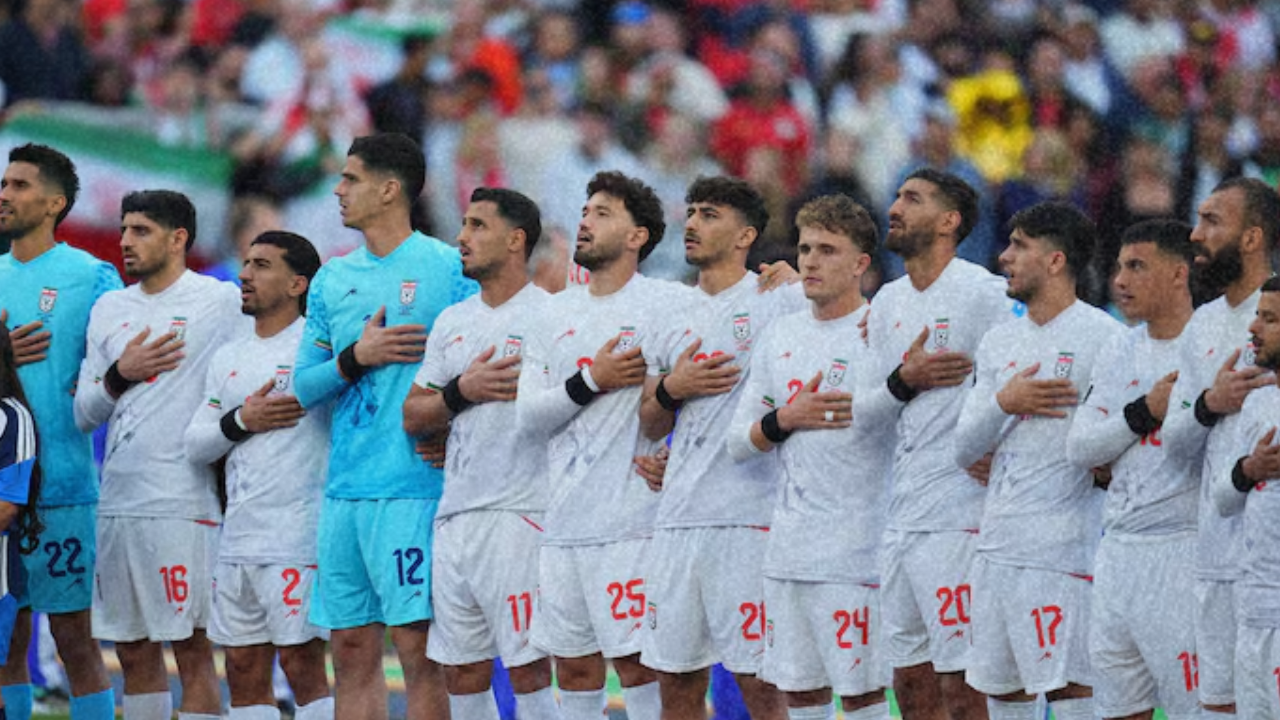
Iran qualified in March 2025. The US killed its supreme leader in February. FIFA sent the team to Inglewood anyway, and it played under escort.
The 2026 World Cup ends today. Across five weeks in the United States, Canada and Mexico, the tournament did what tournaments do: produced upsets, exhausted broadcasters, sold an enormous quantity of merchandise. It also hosted a national team from a country the host state was at war with, in stadiums forty minutes from where that war’s supporters and opponents were protesting each other, under travel restrictions written by the government of the country doing the bombing.
Iran played three matches on American soil. It drew all three and went out by one place.
The Displacement Story
There is a standard account of what international sport does, and it goes like this: competition gives nations somewhere to put the aggression, so that strength gets performed rather than exercised. The tribalism is real but the stakes are symbolic. Pride is contested through goals. It is the theory that made the Cold War tournaments legible, and it survives because it describes something true about how states use athletes when they are not shooting at each other.
The last five months tested it. The war did not get sublimated into the tournament. The tournament processed the war into administrative form and carried out its instructions.
The Sequence
Iran qualified in March 2025, among the first nations through, on a Mehdi Taremi brace against Uzbekistan. In December 2025 the United States denied visas to several senior members of Iran’s federation delegation, including its president Mehdi Taj, ahead of the draw in Washington. Iran boycotted the draw. It asked that its group matches be relocated to Mexico. FIFA declined, and the draw proceeded without Iranian representation.
That was before the war. On February 28, 2026, the United States and Israel began coordinated strikes on Iran and killed Ayatollah Ali Khamenei. Iran retaliated against US bases across the Gulf. By March, Iran’s sports minister Ahmad Donyamali was telling state television that a regime which had assassinated their leader had made participation impossible, that their children were not safe, and that the conditions for participating did not exist.
Taj, the federation president, drew the distinction his ministry would not. The team would not withdraw. It would boycott America, he said, but it would not boycott the World Cup. The federation renewed its request to move the matches to Mexico. FIFA said it was in regular contact with all participating associations and looked forward to all teams competing as per the schedule announced on December 6.
The schedule stood. Iran versus New Zealand at Inglewood on June 15. Iran versus Belgium at Inglewood on June 21. Iran versus Egypt in Seattle on June 26.
Playing Under Escort
For the two matches near Los Angeles, the Iranian squad was not permitted to enter the United States until the day before each fixture, and was required to return to Mexico immediately after the final whistle. The restrictions were eased only for the Seattle match, where the team was allowed to arrive two days early. Had Iran advanced, its round of thirty-two match would have been in Vancouver.
A pre-revolutionary Iranian flag was unfurled outside the stadium in Inglewood before the New Zealand match, by protesters who had their own reasons for being there. The team stood for its anthem in Seattle eleven days later. Amir Ghalenoei, the head coach, said after the Egypt draw that his team had been treated very, very badly, and that he hoped the world would become aware of these issues. He also said what those young players had done should be recorded in history.
Iran finished third in Group G on three points from three draws. Belgium beat New Zealand five-one in the simultaneous fixture and took the group. Egypt went through second on goal difference. On June 27 the other groups resolved against Iran and it went out, one place short of the knockout round it has never reached.
The Peace Prize
Two months before the war started, at the draw Iran was boycotting, Gianni Infantino presented Donald Trump with the first FIFA Peace Prize ever awarded. The ceremony was held at Trump National Golf Club in Doral, at Trump’s insistence. In the weeks that followed, Infantino appeared repeatedly at the Oval Office alongside Marco Rubio, Kristi Noem and JD Vance.
None of that was a decision to endorse a war that had not yet started. Taken in sequence with what followed — the refused relocation, the schedule held, the confirmation in May that Iran would play on US soil while the ceasefire’s military consequences were still running — it produced something else. A governing body that had spent the winter demonstrating its alignment with an administration then spent the spring declining to move three football matches out of that administration’s jurisdiction.
FIFA did not need to take a position on the war to function within it. Its commercial dependency on the United States was sufficient. Silence and schedule adherence did the work that an endorsement would have done, without the liability an endorsement carries.
Sport Did Not Stand In for the War
Sport did not substitute for the war. It supplied the war with instruments — visa adjudication at the draw, jurisdiction over venue assignment, control of the calendar, authority over who travels and when and for how long — and those instruments were used.
The mechanism is familiar from the domestic version, where the stadium delivers policy alongside the spectacle and the emotional legitimacy of the game is what makes the delivery feel like logistics. A day-before travel permit is not a political statement. It is a scheduling detail. It is also the state deciding how long a foreign national team may stand on its soil, executed through a sporting body that describes itself as apolitical.
Iran’s federation said it plainly at the time. The World Cup is governed by FIFA and not by any individual country, and no one can exclude Iran’s team — the only country that could be excluded is the one that carries the title of host yet cannot provide security for the teams participating.
That statement was made in defence of Iran’s participation. It also happens to describe what the tournament turned out to be: a competition administered by a body that could not or would not distinguish its own authority from the host state’s, in a year when the host state was at war with one of the teams.
Sources
- AP via Times of Israel — Iran eliminated from Group G; the day-before travel restriction and immediate return to Mexico for the Inglewood matches; eased restrictions for Seattle; Ghalenoei’s remarks (June 2026)
- Iran International — the 1-1 draw with Egypt in Seattle; Iran third in Group G on three points from three draws; Belgium 5-1 over New Zealand (June 27, 2026)
- Yahoo Sports — Iran’s elimination confirmed after the Austria-Algeria draw; missed the knockout stage by one spot for the first time in its history
- Al Jazeera — Mehdi Taj on boycotting America but not the World Cup; the federation’s request to move matches to Mexico (March 19, 2026)
- Gulf News — sports minister Ahmad Donyamali on the impossibility of participation following the assassination of Iran’s supreme leader
- Fox Sports — FIFA rejects the relocation request; matches to proceed per the December 6 schedule; Iran’s federation statement on FIFA’s authority versus the host’s
- E-International Relations — the December 2025 visa denials and Iranian draw boycott; the FIFA Peace Prize at Doral; Infantino’s Oval Office visits with Rubio, Noem and Vance; the May confirmation of Iran playing on US soil (June 10, 2026)