
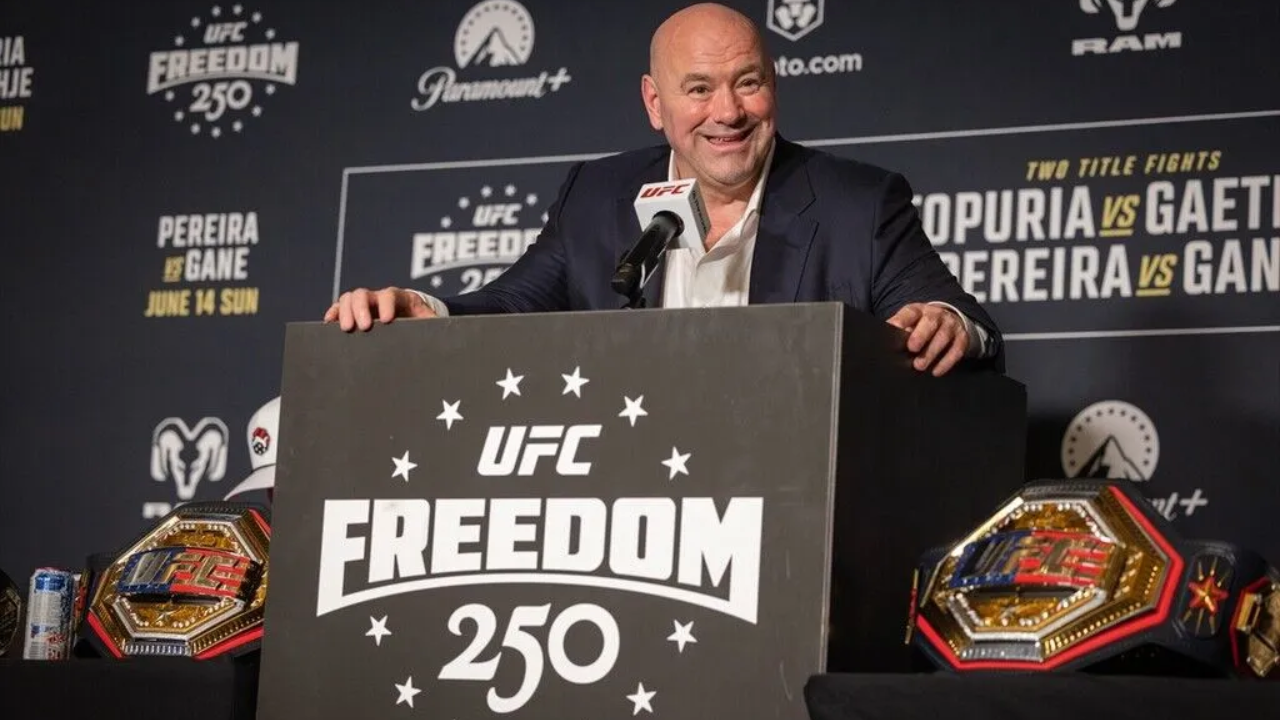
Seven finishes, a Trump family stablecoin in the bonus pool, and a president collecting dividends on stock he bought three months ago. UFC Freedom 250 confirmed every line of the pre-fight argument.
Between the fourth and fifth rounds of the main event, Ilia Topuria’s corner stopped the fight.
The corner stoppage is the rarest finish in the sport. It is not a knockout, a submission, or a doctor’s intervention. It is the team around the fighter deciding the fighter cannot continue and electing to take the loss themselves before the round bell rings to send him out again. Topuria — Spanish-Georgian, Vox-aligned, the most globally celebrated athlete on the European far right, the undefeated lightweight champion who had publicly maintained that “sports have no flags” for the entire fight week — had been broken down across four rounds by Justin Gaethje. His team would not send him out to be broken down further. The American challenger took the belt by TKO at the bell ending the fourth.
That is how UFC Freedom 250 finished its headline act. Around it, six other fights also ended in knockout. Every fight on the card ended by finish. The event is now the only UFC card in the company’s history to end with all fights stopped by KO or TKO across seven bouts. It joins two prior events — Fight Night: Rockhold vs. Bisping and Santos vs. Hill — for “all fights end by finish,” but those events had 11 and 10 fights respectively. UFC Freedom 250 had seven and finished all seven. The card delivered exactly what the production required.
There is a reading available in which that is the part of the night worth examining first.
The Card in Order
Diego Lopes finished Steve Garcia by knockout in the second round. Clean fight, minimal political surface area, opens the broadcast.
Bo Nickal finished Kyle Daukaus by TKO in the first round. Nickal — three-time NCAA Division I wrestling champion, openly Trump-aligned, one of three fighters Rolling Stone named as politically pre-selected for the card — opened his contender push at the White House by finishing Daukaus in under five minutes.
Maurício Ruffy finished Michael Chandler by TKO in the first round, via spinning wheel kick and follow-up punches at 4:29. This is the result worth holding in mind. Chandler — the fighter who had been auditioning for the White House card since 2020, who joined Tito Ortiz and Colby Covington in amplifying election fraud claims after Biden’s win, who posted get-out-the-vote videos with Vivek Ramaswamy and Trump, who delivered the post-assassination-attempt show of support, who fought the post-election victory lap at Madison Square Garden in November 2024, who was personally hosted in the Oval Office in May 2026 to announce this card — gets knocked out by a spinning wheel kick by a 28-year-old Brazilian. The most explicit Trump endorser on the card is the most spectacularly finished. Six years of political labour, four minutes of fight.
Josh Hokit finished Derrick Lewis by TKO in the second round. Hokit — recruited into the UFC ten months ago with a “liberal snowflake NFL” promo, fast-tracked from unranked Contender Series winner to a top-five heavyweight slot in seven weeks, publicly declared by Trump as his “new favourite fighter” — finishes Lewis in the second round. Per Time’s post-fight reporting, Hokit was added to the card because Trump asked Dana White at UFC 327 in April why Lewis wasn’t on the original lineup. White then matched Hokit despite reservations about his behaviour. Trump configured the matchup. Hokit completed the configuration. What he did with his post-fight microphone is its own section below.
Sean O’Malley finished Aiemann Zahabi by TKO in the second round. Zahabi — son of Lebanese civil-war refugees, the only fighter publicly walking back a Trump endorsement on the night of the card — is finished in the second round on the lawn of a president actively escalating a trade war against his country.
Ciryl Gane finished Alex Pereira by TKO in 81 seconds of the second round, taking the interim heavyweight title. Pereira — attempting to become the first fighter in UFC history to win titles in three divisions — is knocked out quickly by the French heavyweight. The story arc the company spent eight months building ends faster than most fights get to the first exchange.
Justin Gaethje defeated Ilia Topuria by TKO via corner stoppage at the end of the fourth round for the UFC Lightweight Championship. The American won. The fighter whose manager was recruited into the CIA-built NYPD post-9/11 Demographics Unit in 2002 won. The fighter who endorsed Trump at the Conservative Middle Eastern PAC rally in Warren, Michigan in October 2024 won. The fighter whose roster-mates ran a social media campaign in support of Kash Patel’s FBI confirmation won. The fighter who was Oval Office’d by the President in May won. Gaethje walked out from the Oval Office, accompanied by the United States Marine Band performing live. He walked back to the Oval Office with the belt.
Trump on Every Line of the Transaction
The single most important thing to know about UFC Freedom 250, which most of the post-fight coverage will not foreground, was filed in court documents on June 6, 2026.
In March 2026, three months before the event, Donald Trump purchased between $15,001 and $50,000 worth of common stock in TKO Group Holdings, the publicly traded parent company of the Ultimate Fighting Championship. The disclosure appeared on the periodic transaction reports federal officeholders are required to file. The Citizens for Responsibility and Ethics in Washington called it one of the worst conflicts of interest imaginable. The President of the United States used the South Lawn of the White House to host a corporate event by a publicly traded company in which he personally owned stock he had purchased three months earlier.
That is the surface layer. The deeper layer arrived through the bonus pool.
The standard UFC fight-night awards — Performance of the Night and Fight of the Night — were sponsored at this event by two outside companies. Crypto.com put up $1 million in CRO tokens. World Liberty Financial put up $250,000 in USD1, its branded stablecoin. World Liberty Financial is the cryptocurrency venture launched in September 2024 by the Trump family and associates. Donald Trump holds the title “Chief Crypto Advocate,” Barron Trump is listed as “DeFi Visionary,” and Eric Trump and Donald Trump Jr. serve as “Web3 Ambassadors.” The project was co-founded by the Witkoff brothers — sons of Trump Middle East envoy Steven Witkoff — along with other associates. In early 2025, the Trump family consolidated control through a new holding company, replacing the original founding partners as sole controlling parties. The family receives 75% of net proceeds from WLFI token sales and a cut of stablecoin profits.
USD1 launched in March 2025 and has grown to a market cap of more than $5 billion. Trump’s personal earnings from World Liberty Financial in the 12 months ending December 2024, per a financial disclosure released exactly one year before this event, were $57.4 million. Bloomberg has projected the USD1 stablecoin alone will generate close to $150 million in profits in 2026. The ownership structure is where the parapolitical reading becomes documentation. A UAE firm linked to Sheikh Tahnoon bin Zayed Al Nahyan — the UAE’s national security adviser and brother of the UAE president — acquired a 49% stake in World Liberty Financial for a reported $500 million. A separate Tahnoon-linked firm then used USD1 to settle a $2 billion investment in Binance. That transaction — the May 2025 MGX investment in Binance settled in USD1 — took the stablecoin from a small Trump-family project to one of the five largest stablecoins in the world. Binance now holds approximately 87% of USD1’s total supply.
Performance of the Night recipients Justin Gaethje and Ciryl Gane each received $100,000 from the UFC plus $125,000 in USD1 from World Liberty Financial plus $200,000 in CRO from Crypto.com — $425,000 per Performance of the Night recipient. Fight of the Night recipients received $400,000. The fighters’ bonus envelopes contained crypto tokens issued by a company majority-owned by the U.S. president’s family and minority-owned by the United Arab Emirates’ national security state. The walkout for the main event began inside the Oval Office. The walkout music was performed live by the United States Marine Band, funded by the Department of Defense. 1,200 of the 4,300 seats were allocated to active-duty military personnel, instructed to wear short-sleeve dress uniforms, to meet current physical fitness standards, and to pay their own travel costs to attend.
The cage on the South Lawn was not a corporate spectacle that the federal government provided a venue for. It was a transaction in which the corporation, the executive branch, the president personally, the president’s family business, and a Gulf sovereign sponsor were all on the same side of the table, with the fighters and the spectators on the other.
The Broadcaster
UFC Freedom 250 streamed exclusively on Paramount+. Paramount Skydance Corporation is the surviving entity from the August 2025 merger of Paramount Global and Skydance Media. The merger required Trump administration regulatory approval. The sequence in which it received that approval is worth laying out.
In July 2025, with the merger pending and the Trump administration in possession of the decision, Paramount Global agreed to pay Donald Trump $16 million to settle a lawsuit Trump had filed over the editing of a 60 Minutes interview with Kamala Harris. Less than a month later, the merger was approved by the Trump DOJ. Critics characterized the settlement as a veiled bribe to appease Trump. CBS announced the cancellation of The Late Show with Stephen Colbert days after Colbert criticized the parent company’s settlement on air. Paramount cited financial reasons.
Within weeks of the merger closing, David Ellison — son of Oracle co-founder Larry Ellison and now CEO of the merged company — announced a seven-year, $7.7 billion deal making Paramount+ the exclusive U.S. home for TKO Group’s UFC events starting in 2026. The agreement ended the pay-per-view model and brought UFC events into Paramount+ subscriptions, with select cards simulcast on CBS. The deal was nearly as expensive as the $8 billion Paramount-Skydance merger itself. Ellison has installed Bari Weiss as editor-in-chief of CBS News. Three days before UFC Freedom 250, the Trump DOJ approved Paramount’s pending merger with Warner Bros. Discovery. Ellison sat with the President at the South Lawn cage throughout the event.
The corporate stack of the broadcast: the streaming home of the UFC is Paramount+. Paramount is now controlled by David Ellison. Ellison’s father, Larry Ellison, is part of the Oracle-led consortium taking control of TikTok’s U.S. operations under a deal blessed by the Trump White House. The settlement that cleared the path for the Paramount-Skydance merger was a $16 million payment from a corporation directly to the sitting president. The first thing the new ownership did after closing was sign the largest media rights agreement in UFC history. The second was put the most politically loaded card in the company’s history on its platform. The third was sit ringside with the president at that card while the president’s own DOJ approved the next merger up the consolidation chain. The broadcast of UFC Freedom 250 was sponsored by the same configuration of capital, executive branch favour, and post-settlement compliance as the event itself.
The Regulatory Void
The District of Columbia Combat Sports Commission, which would normally regulate any MMA event held inside the District, did not regulate this one.
In a March 2026 statement, the commission noted that because the White House grounds are federal property, the District’s regulatory authority did not extend to the venue. The commission then went further. On March 16, it announced that the outcomes of the fights at UFC Freedom 250 could not be recognized on the athletes’ official professional records — because the UFC had refused to pay the $100 permit fee that would have triggered the DC commission’s involvement. A $100 permit. A $60 million event. The UFC declined to pay $100 to make the event regulated by the local combat sports authority, and the local authority responded by saying it would not allow the fights to count on the fighters’ official records.
The UFC’s solution was to bring in the Association of Boxing Commissions, the national umbrella body for state and tribal athletic commissions, as an “independent third party to advise on regulatory operations.” The ABC’s substantive authority is limited; it is a coordinating body rather than a regulator. Its presence is the equivalent of asking the trade association for a class of state agencies to stand in for a state agency. The UFC self-regulated. The ABC provided cover. The cage on the South Lawn was the most expensive UFC event in history and the only one that did not produce results on the official athletic records of the fighters who fought it.
The Public Did Not Endorse It
Reuters/Ipsos polling conducted in the lead-up to the event found that 16% of Americans considered it appropriate to hold a UFC card on the South Lawn of the White House. Among Republican respondents, approximately one in three approved — meaning two-thirds of the president’s own electoral base did not endorse the event. The polling was conducted before the actual fights took place, when the framing was still entirely promotional.
The major news organizations’ reaction made the same point in their own register. The New York Times described it as a mass-media spectacle unlike any in the history of the presidency, characterized the use of the White House for violent cage fighting as astonishing, and named the eruptions of casual cruelty in the broadcast specifically. The Associated Press reached for “bread and circuses” and interviewed historians who compared it directly to gladiatorial games held in Imperial Rome.
The two responses — the polling and the editorial reaction — converged on the same finding. The event was unpopular and historically illegible. Even the audience the event was configured for did not approve of it. The corporation and the executive branch did it anyway. This connects to a system the pre-fight analysis described: monopoly power decouples the corporation from audience approval. Guaranteed media revenue reduces the importance of satisfying every consumer. The UFC was not asking permission. It was demonstrating capacity.
The After-Hours
The most-discussed moment of the post-fight coverage was not a result. It was a Joe Rogan interview.
Josh Hokit, fresh off his second-round TKO of Derrick Lewis, took the microphone from Rogan in the cage and delivered, in order: a profanity-laced thanks to Trump for hosting the event, a Jesus Christ shoutout, a call-out of Alex Pereira including a crude reference to Pereira’s mother, and a closing line. The closing line, per multiple outlets, was a demeaning and false conspiracy-driven remark about Michelle Obama’s gender — a talking point with a documented history of being used to demean prominent Black women. Rogan responded only by saying, “Ladies and gentlemen, Josh Hokit.” He did not address the comment. Hokit then stepped down from the cage and placed a chain around the neck of Donald Trump, sitting in the front row.
Hokit has not backed down since. In a follow-up interview on The Ariel Helwani Show days later, he declined to apologize, said he had “no regrets,” and framed the remark as a demonstration of American free speech. Dana White called the comment “nasty” and “nonsense” the morning after the event and repeated his disapproval days later, while also declining to take any disciplinary action and reiterating that he believes in free speech. Neither White nor UFC’s chief business officer contacted Hokit directly about the remarks. Even the White House declined to distance itself when given the opening: asked directly by a reporter on June 15, White House spokesman Steven Cheung praised Hokit’s performance in the cage and did not address the comment at all.
The configuration deserves to be named. The post-fight interview was conducted by Rogan, the largest podcaster in the world, whose audience constitutes a major node of the right-wing media ecosystem that helped re-elect Donald Trump. The fighter being interviewed was one Trump personally configured for the card. The fighter made a derogatory comment about Michelle Obama on a broadcast on Paramount+, owned by David Ellison, whose company paid Trump $16 million in settlement money two months before its Trump-DOJ merger approval. The ring carried Bud Light signage. The CEO of the company hosting the event — sitting on the board of Meta, whose Ray-Ban smart glasses had the same week been distributed to 130,000 blind veterans in a coordinated PR rollout — said by text that he disagreed with the comments and took no action. This is not the conduct of a private sports promotion operating independently of the political moment. It is the conduct of a political-cultural institution operating in coordination with the executive branch, the largest right-wing media platforms in the country, and a publicly traded broadcaster whose CEO sat next to the president throughout the broadcast.
The Lawsuit
On June 6, 2026, the Public Integrity Project filed suit in the U.S. District Court for the District of Columbia against the National Park Service and other federal defendants, seeking to block UFC Freedom 250. The suit described the event as a deeply corrupt, private, for-profit sports event, challenged the transformation of the White House grounds without congressional approval, and identified the financial benefits flowing to the UFC, Dana White, Donald Trump, and what the filing described as their allies. The suit named Trump’s March 2026 TKO Group Holdings stock purchase as the central conflict.
The case was assigned to U.S. District Judge Amit P. Mehta — an Obama appointee who upheld the House Oversight Committee subpoena seeking Trump’s financial records from Mazars in 2019, presided over multiple January 6 cases including the criminal prosecution of Oath Keepers founder Stewart Rhodes, rejected Trump’s attempt to dismiss civil lawsuits over the Capitol attack in 2022, ruled in August 2024 that Google had unlawfully maintained a monopoly in internet search, and sits on the United States Foreign Intelligence Surveillance Court. On June 12, two days before the card, Mehta refused to issue a preliminary injunction. The event proceeded as planned.
This is the structural shape of the legal challenge. A watchdog group filed. The executive branch’s lawyers responded. A federal judge with no history of Trump partisanship — and considerable history of ruling against Trump on the merits — declined to halt the event on TRO grounds. The Trump stock purchase remained in the public record. The bonus pool sponsored by the Trump family’s crypto company was paid out. The card was televised on Paramount+. The legal system documented the conflict and let the event happen anyway. The relevant question now is whether the merits proceed past the preliminary stage.
What the Night Confirmed
The pre-fight structural analysis was that the UFC at the White House would reveal the structure that had organized the company all along — that the cage on the South Lawn would be an unusually honest monument to the merger of monopoly sports capital and political authority. The night confirmed the argument and added three facts the pre-fight piece could not have known with the same documentary weight.
The first new fact is the Trump stock purchase. The corporation hosting the event was one in which the host was personally invested, three months before the event, through a disclosed transaction in TKO Group Holdings common stock. This is not parapolitical reading. It is on a federal disclosure form. The President of the United States held an equity position in the publicly traded parent company of the corporation he was using federal property to promote. The lawsuit cited it. The judge let the event proceed regardless. The fact is now in the documentary record.
The second new fact is World Liberty Financial. The bonus pool of the most expensive UFC event in history was sponsored, in part, by the Trump family’s own cryptocurrency company, with $125,000 in USD1 stablecoin paid to each Performance of the Night recipient. The Trump family’s revenue from World Liberty Financial flows from transactions involving the USD1 token. The token was distributed, at the President’s federal residence, on the President’s eightieth birthday, by the corporation in which the President owned stock, to the fighters performing at his event. The stablecoin involved is 49% owned by the national security adviser of the United Arab Emirates, was launched on the back of a $2 billion Binance transaction, and is the subject of a formal House investigation into national security and conflict-of-interest risk. Every layer of the transaction touched the same family.
The third new fact is the broadcaster. Paramount+ streamed the event. Paramount paid Trump $16 million in 2025 to settle a lawsuit over a 60 Minutes edit. Trump’s DOJ then approved Paramount’s merger with Skydance. The new owner cancelled The Late Show with Stephen Colbert days later. Within weeks of merger close, the new owner signed a $7.7 billion exclusive UFC streaming rights deal with TKO. Three days before this event, Trump’s DOJ approved the new owner’s next merger. The new owner sat with the President at the South Lawn cage as the bonus envelopes were paid out.
The labour share did not move. Justin Gaethje, the new lightweight champion, will have his Le v. Zuffa class settlement money already paid out — Le v. Zuffa being the federal antitrust class action in which Judge Richard Boulware certified the class, found Zuffa had willfully engaged in anticompetitive conduct, and approved a $375 million settlement after rejecting an initial $335 million figure as insufficient. The Reebok asymmetry that captured roughly $30 million of the $70 million outfitting deal was reproduced at the bonus level — the fighters did not negotiate the World Liberty Financial figure or the Crypto.com figure. Those were arranged between the sponsor and the promotion. The fighters received what was delivered to them. The wage-share line that traced 16–17% through the federal class action period remains where it has been.
The corporation succeeded institutionally regardless of which fighters won. Michael Chandler’s spinning-wheel-kick finish does nothing to dim the UFC’s evening; the event archive now contains it as one of 7 consecutive knockouts, the most aesthetically satisfying possible outcome from a television production standpoint. Ilia Topuria’s corner stoppage did not derail the night either; the foreign challenger’s defeat by the American Oval Office’d fighter is, if anything, the more useful outcome for the political project the event was configured around. The Reuters/Ipsos polling showed 16% public approval. Two-thirds of Republicans disapproved. Major newspapers reached for bread and circuses and gladiatorial comparisons. The historical legibility of the event, even to mainstream coverage, was that it was a regression to a pre-republican form of public spectacle. None of that interfered with the event’s institutional success. This is the system the pre-fight piece described, now operating in front of cameras on federal property, with the President’s stock position in the parent company on file, with his family’s stablecoin in the bonus envelopes, with the UAE’s national security adviser holding a 49% stake in that company, with the broadcaster having paid $16 million into Trump’s pocket weeks before its merger was approved by his DOJ, and with the United States Marine Band playing the walkout music.
Monday: the Architecture, Priced In
The market opened on June 15 with two pieces of evidence already on the tape before a single share traded.
The first was a dividend declaration TKO had made in advance of the event. The company’s board had declared a quarterly cash dividend of $0.79 per share on its Class A common stock, payable June 30, with the record date set at the close of business on June 15, 2026 — the day after the event. The aggregate distribution: approximately $150 million. Donald Trump, whose March 2026 purchase of between $15,001 and $50,000 worth of TKO common stock has been on his federal periodic transaction report for three months, is a shareholder of record at the close of business today. He will receive the dividend payment from the company whose event he hosted on federal property yesterday. The principle is the entire architecture in a single transfer.
The second piece of evidence was already months old. In September 2025, Seaport Research analyst David Joyce downgraded TKO from Buy to Neutral. His rationale was that the White House event was already priced in. The stock had run past his base case valuation of $188 toward his upside case of $209 well before the fights took place. By the close of trading on June 11, the last full session before the event, TKO sat at $212.82, near its 52-week high of $226.94. The market had absorbed the deal months earlier. The cage on the South Lawn was not a catalyst for investors. It was a confirmation.
A third piece — not on the tape but on the wire — came through The Hill in the days before the event. The Trump administration is signing a formal memorandum of understanding with the UFC to create a public-private partnership. A formal partnership document between the federal government and the corporation hosting events on federal property in which the President holds stock would be, in any prior administration, a scandal of structural significance. In this one it appears as a logistical footnote.
There is no Monday market story to be written. That is the Monday market story. The corporation hosting the event is trading near its all-time highs, paying its President-shareholder a dividend on the day after he hosted its event, broadcast by a corporation that paid him $16 million in 2025 and signed a $7.7 billion deal with the host corporation weeks later, with a memorandum of understanding between the federal government and the host corporation being formalized in the days around the event itself. None of this moves the stock because the stock was where it was going to be. The architecture had been priced in long before Sunday night.
The audience watched 7 knockouts. The labour share did not change. The corporation paid out a dividend. The President received it.
The architecture is now legible and settled.
Sources
- Josh Hokit’s UFC White House Win Overshadowed by Controversial Michelle Obama Remark — Yahoo Sports
- UFC fighter Josh Hokit facing backlash after Michelle Obama comments at White House event — The Hill
- Trump Bought UFC Parent Stock While Promoting White House Fight — HuffPost
- Josh Hokit addresses controversial Michelle Obama comments — Yahoo Sports