
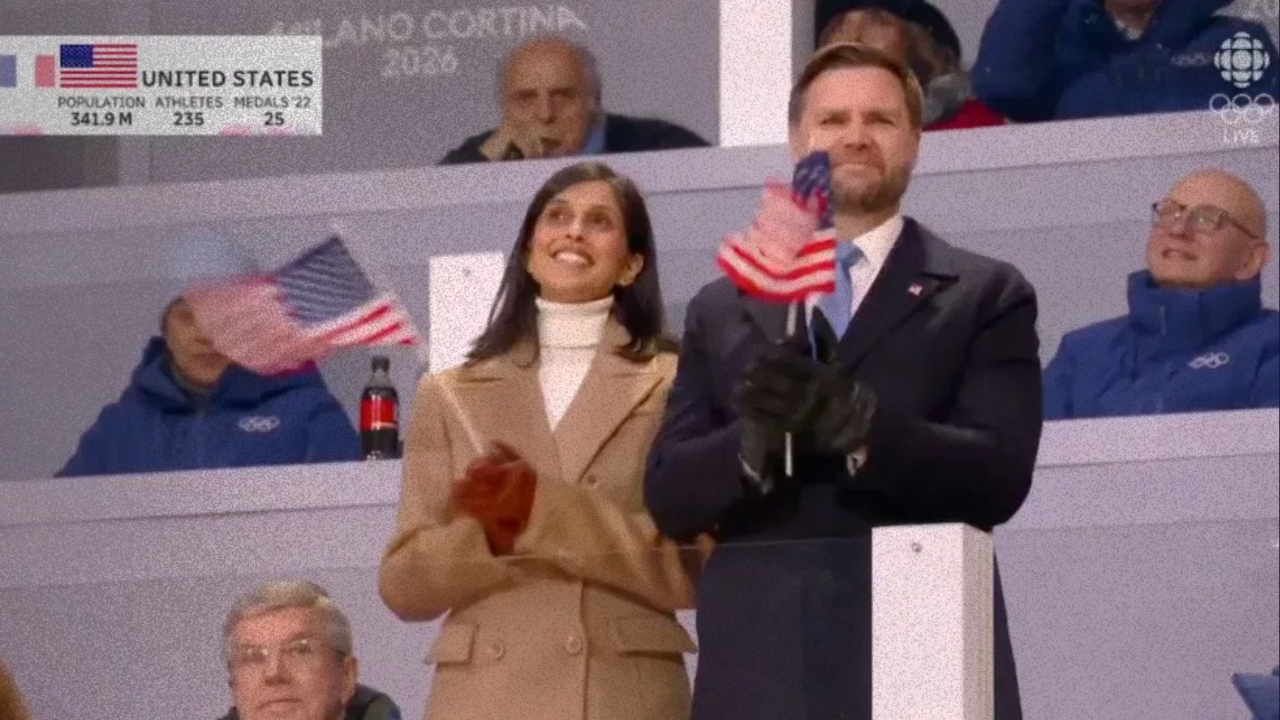
JD Vance being booed at the 2026 Winter Olympics mattered less than what happened next: the U.S. broadcast tried to make the sound disappear.
The most important thing about JD Vance being booed at the Winter Olympics was not the booing.
Sports crowds boo politicians all the time. They boo commissioners, owners, referees, rival stars, anthem singers, mascots, replay reviews, and the general experience of being trapped inside a billion-dollar building that somehow still has bad food. Noise is not new.
The important part came after the sound.
At the 2026 Winter Olympics opening ceremony in Milan, Team USA entered the stadium and received cheers. Then Vance appeared on the big screen. The reaction changed. The crowd booed and jeered. CBC’s broadcast caught it. Reporters in the stadium heard it. Clips moved online. But on NBC’s U.S. broadcast, American viewers were given a cleaner version of the moment, one where the vice president appeared without the same audible rejection attached to him.
That is the story.
Not because NBC alone explains American power. It does not. Not because every broadcast mix is a conspiracy. It is not. The point is simpler and more structural: U.S. prestige does not only depend on aircraft carriers, reserve currency, weapons transfers, corporate platforms, and diplomatic pressure. It also depends on image maintenance. It depends on the ability to convert public hostility into a manageable picture for domestic consumption.
In Milan, the stadium produced one sound. The U.S. broadcast delivered another atmosphere.
That gap is where the article lives.
The Crowd Made a Distinction
The reaction was not a clean rejection of American athletes. That distinction matters.
Team USA entered the ceremony as athletes inside the Olympic ritual. The crowd cheered. Vance appeared as a political official inside that same image. The crowd booed. That sequence is sharper than a generic “America got booed” headline because it shows the audience separating the team from the state representative trying to borrow its glow.
The Olympic opening ceremony is built to collapse those distinctions. The athlete, the flag, the official delegation, the dignitary, the anthem, the broadcaster, and the national story are all folded into one clean unit. The ceremony wants the country to appear coherent. It wants the athlete’s discipline to soften the state’s power. It wants the smile of the speed skater to travel through the same frame as the politician in the VIP section.
The crowd did not cooperate.
It cheered the athletes and booed the official. That is not anti-Americanism in the crude sense. It is political literacy. The people in the stadium understood that a vice president is not a snowboarder. They understood that state power does not become innocent because it sits near athletes. They understood that the Olympic camera was asking them to treat Vance as part of a harmless national celebration, and they declined.
That made the moment dangerous to the broadcast image. The crowd did not ruin Team USA. It ruined the merger.
NBC Repaired the Image
The U.S. broadcast response mattered because it showed how spectacle protects power without needing to announce that protection.
NBC did not need to deliver a speech defending Vance. It did not need to argue with the crowd. It did not need to explain the boos away. It only needed to give American viewers a cleaner version of the ceremony, one where the visible representative of U.S. power appeared without the full sound of public rejection attached to him.
That is how image repair works at this level. It is quiet. It is technical. It lives in the mix, the camera cut, the commentary choice, the volume of the room, the decision about whether a reaction becomes part of the event or just background noise that never reaches the audience at home.
This does not require imagining a secret meeting in a dark room where executives whisper about empire under Olympic-branded lanyards. Broadcasts always manage sound. Producers always choose shots. Commentators always decide what to acknowledge. The politics are embedded in those ordinary decisions.
A crowd can boo in Milan, but millions of U.S. viewers can still receive a ceremony where the vice president appears basically intact. The rupture happens in the stadium. The repair happens in the feed.
That is the function of domestic sports broadcasting inside state spectacle. It does not merely show the event. It translates the event back into a form the national audience can absorb without fully confronting what happened.
The camera is not just a witness. It is a cleanup crew.
Prestige Needs a Home Audience
Prestige is often described as a foreign-policy asset, but it also has a domestic maintenance problem.
A state can be hated abroad and still remain symbolically powerful at home if the home audience is protected from the texture of that hatred. Citizens do not need to believe everyone loves them. They only need to believe their country still commands respect where respect matters.
The Olympic opening ceremony is one of those spaces. It is designed to manufacture respect on a global scale. The ceremony tells viewers that every country has a place, that the world still knows how to applaud, that the flag still enters the room with dignity, that politics can be suspended long enough for the pageant to work.
When a senior U.S. official is booed inside that ritual, it threatens more than one politician’s ego. It threatens the domestic story that American power remains socially natural in elite global spaces.
That is why smoothing matters. The American viewer does not have to be lied to in some grand dramatic way. They only have to be spared the full atmosphere. The rough edge gets sanded down. The room noise gets managed. The image survives.
Prestige does not require universal admiration. It requires enough people to keep acting as if admiration is still the default. NBC’s cleaner presentation helped preserve that default for the audience most invested in it.
The boos said the default was cracking. The broadcast tried to keep the crack from traveling home.
ICE Was Already in the Frame
The reaction to Vance did not come from nowhere.
Before and around the opening ceremony, protests in Milan targeted the presence of U.S. Immigration and Customs Enforcement-linked personnel connected to security around the American delegation. Italian officials insisted the controversy was overblown and that the relevant personnel were not operating as street enforcement agents. That distinction may matter legally. Politically, it did not neutralize the image.
The United States did not arrive in Milan as pure sport. It arrived with a vice president, security personnel, diplomatic infrastructure, and the political baggage of a state whose border regime is one of its most visible forms of domestic violence.
That is what the ceremony tries to hide. The Olympic ritual presents delegations as athletes and flags. The security architecture brings the state back into view. When protesters saw ICE-linked personnel around the Games, they were not reading too much into sport. They were noticing what the event required in order to run.
Sporting innocence always has a back end: police, borders, credentials, surveillance, transport routes, diplomatic agreements, security protocols, and personnel who make sure the dignitaries move safely through a city whose residents are expected to absorb the disruption.
Vance’s appearance on the screen brought that back end into the ceremony’s front image. The crowd responded to the whole apparatus, not just the man waving from the VIP area.
Modern sport works as infrastructure for capital and state power because the event never ends at the field of play. It extends through streets, cops, borders, broadcast trucks, sponsors, local governments, and security partnerships. Milan made that extension audible.
The Ceremony Needed Him to Look Normal
Vance’s role at the ceremony was simple: appear as normal state presence.
He was not there to compete. He was not there to coach. He was not there to make the luge team faster. He was there because states send important people to major rituals, and the Olympics give those people a soft-focus stage where national power can look dignified, friendly, and unavoidable.
That is what dignitaries do at sport events. They occupy the image. They borrow the emotional legitimacy of athletes. They sit inside a ceremony that asks viewers to read their presence as normal rather than coercive. The athlete supplies effort. The state official supplies authority. The broadcast stitches them together.
The boos broke the stitch.
They made Vance appear not as the natural face of a respected state, but as a contested political figure in a room that did not owe him reverence. That is a small distinction in material terms. It does not change policy. It does not close detention centers. It does not withdraw weapons from allies. It does not alter the structure of U.S. power.
But spectacle is built from small distinctions. The entire point is to make power look seamless. A few seconds of public rejection can be enough to show the seam.
Trump’s sports appearances use the same grammar of political absorption: enter the arena, borrow the crowd, merge the official body with the spectacle, then let the clip circulate as proof that power still owns the room. Vance got the same setup in Milan. The room refused to complete it.
The U.S. Broadcast Had Different Needs
CBC could let the moment breathe because CBC was not managing American prestige for an American audience.
That does not make Canadian broadcasting innocent. It only means the domestic function was different. For CBC viewers, the boos could appear as international news, awkward spectacle, or evidence of tension at the ceremony. For NBC, the same sound had a different weight. NBC was not simply broadcasting the Olympics to the United States. It was broadcasting the United States back to itself through the Olympics.
That is a different job.
The Olympics are one of the last mass broadcast rituals where American viewers are still invited to experience the country as morally uncomplicated: athletes overcoming adversity, families crying in the stands, flags draped around shoulders, medal counts, sacrifice, discipline, anthem tears, and the old fantasy that national greatness can be measured without asking what the nation does.
A vice president getting booed interrupts that product. It introduces foreign contempt into a domestic ceremony of self-recognition. It reminds viewers that the country being sold back to them as inspiration is also received elsewhere as a force people resent.
NBC’s cleaner version protected the product. It kept the ceremony closer to what the U.S. audience is trained to expect: the flag enters, the team is cheered, the dignitary appears, the machine moves on.
The real version was messier. The broadcast version was more useful.
This Was Not About One Boo
The mistake would be treating this as a single awkward crowd reaction.
The Vance moment belongs to a wider pattern of sports institutions trying to manage visible dissent against U.S. political figures. At the 2025 U.S. Open, broadcasters were reportedly instructed not to dwell on negative reactions to Donald Trump when he attended the men’s final. The logic was the same: the powerful figure can appear inside the sports image, but the crowd’s rejection of that figure must be contained.
The issue is not whether a broadcast should turn every event into a referendum on a politician. The issue is that politicians enter these events precisely because the image has political value. They want the crowd, the arena, the flag, the ceremony, the athletes, and the institutional glow. They want the legitimacy of sport without the risk of public judgment inside the same frame.
That is the bargain sports media often helps enforce. Power gets visibility. The public gets managed audibility.
Sometimes the audience is allowed to be seen cheering. Sometimes it is allowed to be seen waving flags. Sometimes it is allowed to be shown crying during an anthem or chanting for the home team. But when the same public uses the same space to reject a powerful official, suddenly the reaction becomes a production problem.
That is not neutrality. It is curation.
Olympic neutrality protects approved politics by treating dissent as disruption. The broadcast version of that logic is even cleaner. It does not have to discipline the crowd directly. It only has to decide how much of the crowd the audience at home gets to hear.
The Image Was the Battlefield
This is why the article should not be about whether Vance’s feelings were hurt.
It should not be about whether booing is rude. It should not be about whether Olympic spectators should behave with decorum. It should not be about whether individual American athletes deserved a better atmosphere. The athletes were cheered. The politician was booed. The public knew what it was doing.
The real fight was over the image.
The stadium image said U.S. political power was contested. The NBC image softened that contest. The online image restored it. That sequence matters because modern legitimacy moves through competing edits. The event happens once, but its political meaning is fought over through feeds, clips, commentary, captions, and what each audience is allowed to hear.
In the stadium, Vance was booed. On U.S. television, the moment was cleaned. Online, the boos returned as evidence that the cleanup had happened.
That is the current media structure in miniature: power appears, the public reacts, the broadcast manages, the clip escapes, and the argument shifts from what happened to who tried to control what could be heard.
The Olympics did not create that structure. They offered it a perfect stage.
Prestige Now Requires Editing
The United States did not lose global power because JD Vance got booed in Milan.
That would be childish. States do not fall because a stadium gets noisy. Material power remains material: bases, banks, sanctions, technology firms, weapons systems, intelligence networks, media platforms, shipping lanes, diplomatic leverage, and institutions built over generations.
But symbolic power has a different weakness. It depends on performance. It needs the room to behave. It needs the audience to complete the ritual. It needs applause, or at least the absence of visible refusal. And when refusal appears, it needs mediation.
That is what Milan showed. U.S. prestige is still powerful, but it is no longer automatic enough to go unmanaged. It requires editing. It requires cleaner feeds. It requires commentators moving along. It requires the domestic audience to be protected from the raw sound of how the country’s officials are received abroad.
The old model of prestige assumed that elite spaces would do the work on their own. The flag enters. The dignitary appears. The applause follows. The ceremony absorbs the state and sends the image home.
Milan showed the newer model. The flag enters. The team is cheered. The dignitary appears. The crowd turns. The broadcaster repairs the scene.
That is not collapse. It is maintenance under stress.
The boos mattered because they revealed the stress. The NBC broadcast mattered because it revealed the maintenance.
Together, they showed the real condition of American prestige inside sport: still immense, still institutionally protected, still globally central, but no longer seamless enough to trust the room without a cleanup plan.
JD Vance did not get booed because the Olympics suddenly became political.
He got booed because the politics were already there, and for once, the crowd noise made it through before the broadcast could fully bury it.
Sources
- Reuters – Israel team, U.S. Vice President Vance booed at Milan Games opening ceremony, February 6, 2026
- The Guardian – NBC appears to cut crowd’s booing of JD Vance from Winter Olympics broadcast, February 6, 2026
- Reuters – Anti-ICE protesters rally in Milan ahead of opening ceremony, February 6, 2026
- Reuters – Italy’s Meloni plays down ICE agent furore as she meets Vance, February 6, 2026
- Reuters – Political tensions surface at slick Milano Cortina opening ceremony, February 7, 2026
- Reuters – Rules on athletes expressing themselves at the Winter Games, February 12, 2026
- Sparked Sports – Trump at UFC 327 and the Collapse of Political Deliberation, April 13, 2026
- Sparked Sports – Sports as Infrastructure: How Games Power Capital and State, February 6, 2026
- Sparked Sports – How Olympic Neutrality Silences Dissent and Protects Power, February 13, 2026
“`