
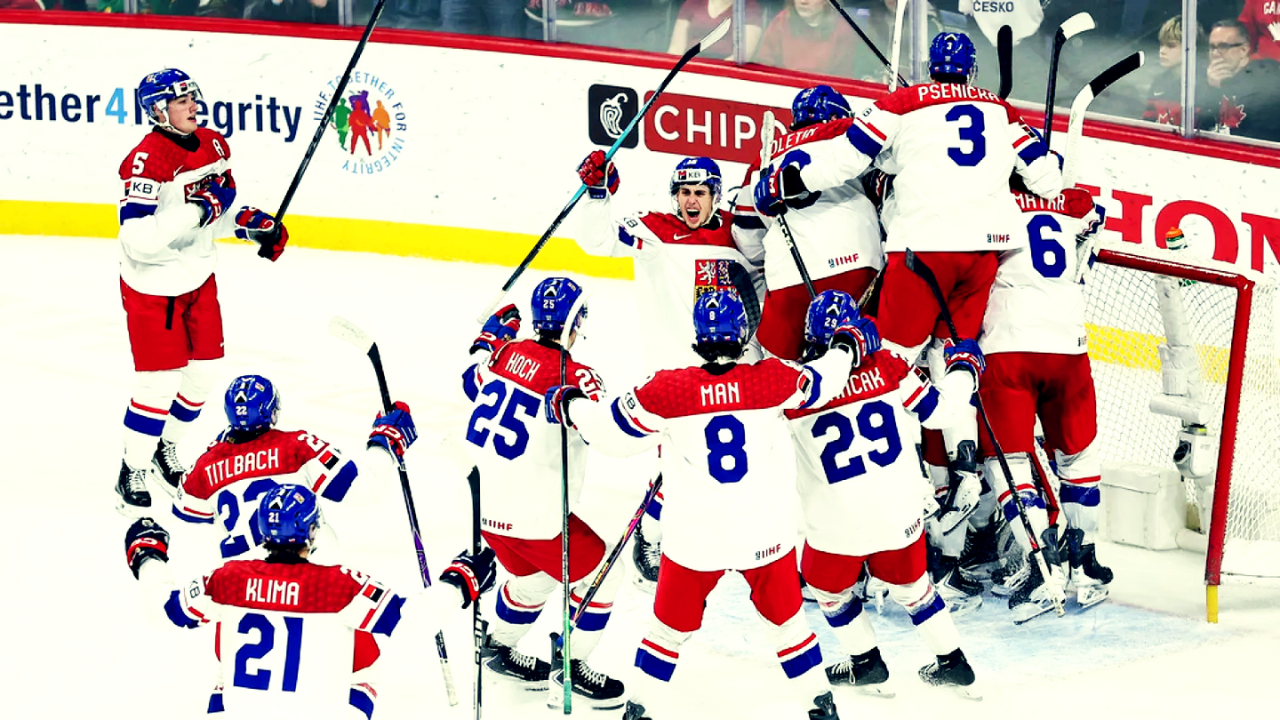
A tight semifinal shaped by patience, compressed space, and late execution for Czechia, where the thinnest of margins are what told the story.
Canada’s 6–4 loss to Czechia in the World Junior semifinal will be remembered by many as another painful exit, another late goal, another missed chance at gold. But stripped of emotion and expectation, the game itself tells a much clearer story. This was not a collapse. It was not chaos. It was not decided by a single bounce or moment of bad luck.
It was a tight, increasingly compressed hockey game decided by structure, patience, and late-game execution.
From the opening faceoff to the final minute, this semifinal followed a pattern that has become familiar when these two teams meet at the sharp end of the tournament. Canada brought pace, creativity, and offensive depth. Czechia brought clarity, restraint, and a willingness to wait for the game to come to them. As the stakes rose and the margins narrowed, that difference mattered.
A Game That Tightened by Design
The early stages of the semifinal were volatile. Both teams played with speed, and the game moved quickly from end to end. Goals came from transitions, rebounds, and special teams rather than extended five-on-five dominance. That early looseness made the scoreline feel open, but it never felt uncontrolled.
As the game progressed, the rhythm changed. Space disappeared. The neutral zone thickened. Possessions became shorter, and entries required more work. This wasn’t the product of fatigue or nerves. It was the natural consequence of a playoff game where both teams understood what was at stake.
Canada continued to push the pace, looking to create through movement and skill. Czechia began to slow the game deliberately. They were comfortable allowing Canada to hold the puck in low-danger areas, confident that they could collapse when the play moved inward. The game didn’t spiral. It condensed.
By the third period, things had gotten to exactly where Czechia wanted: a one-goal game with every decision carrying weight, and where every mistake can and would be punished.
The Illusion of Control
One of the most persistent postgame refrains was that Canada “had chances.” On paper, that’s true. Canada generated looks, created moments, and forced responses. But the distribution of those chances matters more than their existence.
At even strength, sustained control was hard to come by. Canada’s offense often came in bursts rather than waves. Entries were contested. Second chances were limited. Shots came under pressure rather than from established interior positioning. Much of Canada’s success came when the game opened up or when special teams created artificial space.
Czechia, by contrast, was comfortable letting the game live in these narrow margins. Their defensive posture was not aggressive, but it was precise. They denied the middle of the ice, kept sticks in lanes, and forced Canada to move the puck laterally instead of downhill. When rebounds appeared, they were quickly cleared. When Canada chased offense, Czechia let them.
This wasn’t a failure of effort or talent. It was the natural result of two teams with different priorities. Canada wanted to create. Czechia wanted to constrain. As the game wore on, constraint proved easier to sustain than creation.
Czechia’s Defensive Shape and Patience
Czechia did not beat Canada by overwhelming them. They beat Canada by refusing to give them what they wanted.
In the neutral zone, Czechia stayed layered and compact. They didn’t overcommit to pressure. They didn’t chase hits. They closed gaps early and trusted support behind the puck. Canada was rarely able to attack with speed through the middle, forcing entries wide and increasing the cost of every zone entry.
In their own end, Czechia collapsed quickly once the puck moved below the dots. Defensemen stayed home. Forwards tracked back with purpose. The priority was never possession for its own sake. It was position.
Perhaps most importantly, Czechia never appeared rushed. Even when trailing, they did not abandon their structure. Even when Canada pushed late, they didn’t panic. That patience is what allowed them to survive extended pressure and remain dangerous when the opportunity finally appeared.
This approach doesn’t always produce highlight reels. But in elimination games, it produces outcomes.
Transition Moments and Margin Errors
The decisive moments of the semifinal did not come from sustained dominance by either team. They came from transitions, specifically from moments when Canada’s aggression didn’t connect cleanly.
Canada’s style requires defensemen to be involved offensively. That involvement creates pressure, but it also creates exposure. When pinches succeed, the puck stays alive and the offense continues. When they fail, the game flips instantly.
Czechia was built to exploit that flip. Their forwards recognized when Canadian defensemen stepped up and immediately attacked the space left behind. These weren’t reckless rushes. They were measured counters, often involving quick support and simple decisions.
The late goals that decided the game followed this pattern. Not breakdowns, but narrow failures. Not chaos, but precision on one side and impatience on the other. In a compressed game, that’s often all it takes.
Psychology of the Rematch, On the Ice
Without drifting into narrative or speculation, it’s still impossible to ignore how the dynamic between these teams played out on the ice.
Canada played with urgency. Czechia played with clarity.
Urgency drove Canada forward. They pressed for separation. They looked to impose themselves. Czechia didn’t resist that pressure head-on. They absorbed it, trusted their shape, and waited for the moment when urgency turned into overextension.
That shift doesn’t show up on a stat sheet, but it shows up in decision-making. It shows up in when teams choose to force a play versus when they choose to live for the next shift. In the semifinal, Czechia consistently chose the latter.
This wasn’t about nerves or confidence. It was about comfort. Czechia was comfortable playing a game where the margin stayed thin. Canada was trying to break the game open. In regulation, thin margins favor the team willing to wait.
Why This Game Didn’t Go to Overtime
Given how close the semifinal was, it would have been easy for this game to drift into overtime. Many games like it do. This one didn’t, and that matters.
Late in regulation, Czechia did not retreat into survival mode. They continued to manage the puck, take safe exits, and apply pressure when opportunities arose. They trusted their structure enough to play forward without exposing themselves.
Canada, needing a decisive moment, had to open up. That opening didn’t guarantee failure, but it increased risk. Czechia needed only one clean look to capitalize.
That look came, and it was finished.
Games don’t end in regulation because one team wants it more. They end in regulation because one team is more comfortable executing inside shrinking space. On this night, that team was Czechia.
What This Game Actually Says
This semifinal does not say that Canada is broken. It does not say that Czechia is unbeatable. It says something simpler and more important.
At this level, games are decided by structure, patience, and execution when the margins collapse.
Canada competed. Czechia prepared. When the game slowed and the space disappeared, preparation won.
There was no humiliation here. No embarrassment. No mystery. Just a playoff game between two strong programs, decided by who could live most comfortably inside uncertainty.
That’s not a referendum on identity. It’s hockey.
And in this semifinal, Czechia played it better when it mattered most.