
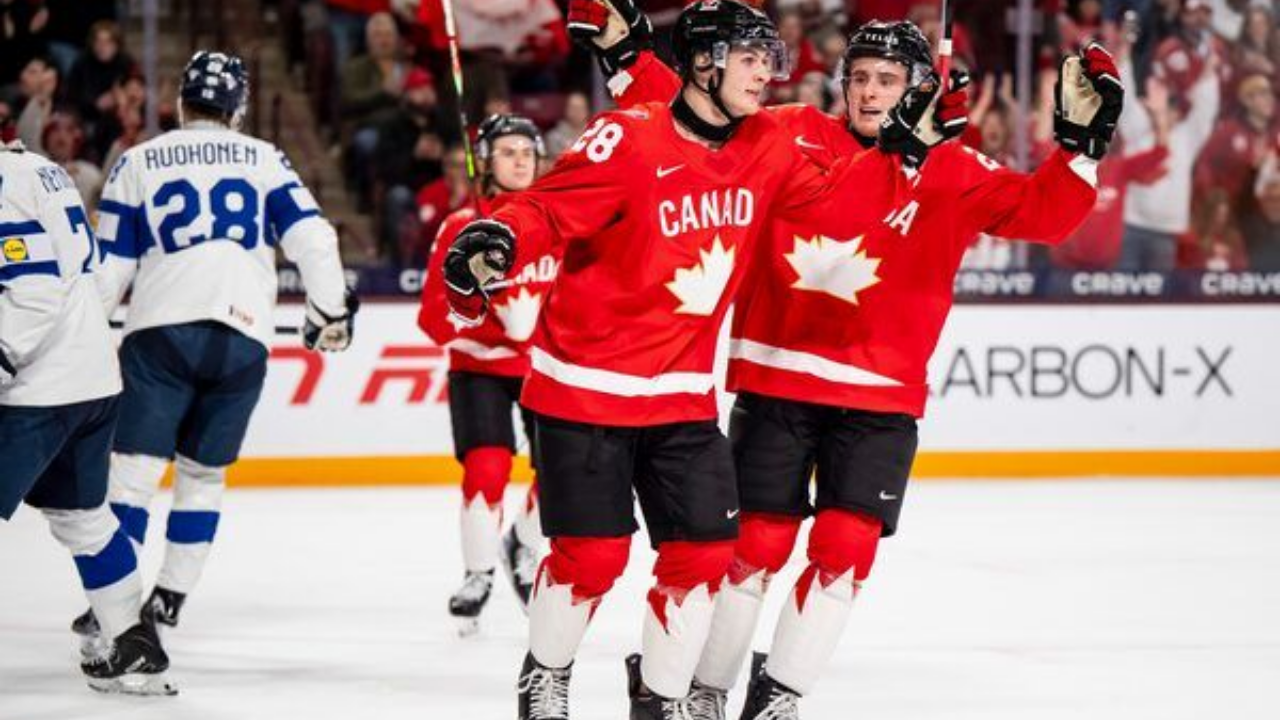
Why Canada vs Finland on New Year’s Eve defined the group, shaped the bracket, and quietly exposed the margins that would decide everything.
On paper, Canada vs Finland on New Year’s Eve at the IIHF World Junior Championship looked like a celebration game. A spotlight matchup. Two medal contenders meeting with both already safely through to the quarterfinals. The kind of night where narratives get loud and consequences feel distant.
In reality, it was the opposite.
Canada’s 7–4 win over Finland was not a comfort performance or a statement of dominance. It was a hinge game. One that decided the group, set the playoff path, and hinted at the exact pressures that would resurface later in the tournament.
This game mattered because it wasn’t optional.
The Group Came Down to This
Group B had narrowed quickly. Canada entered New Year’s Eve needing a regulation win to finish first. Finland arrived with the leverage. They had controlled earlier games, built a healthy points cushion, and only needed to avoid losing in regulation to keep top spot.
There was no math trick left. No scoreboard watching. Canada either took the group here or surrendered control of its path.
That alone gave the game weight. But how it unfolded mattered just as much as the result.
A Game That Refused to Settle
Canada jumped early. Finland answered. Canada surged again. Finland refused to go away.
The scoreline says seven goals, but the feel of the game was never loose. Every time Canada created separation, Finland pulled it back to a single mistake’s distance. Defensive gaps were punished immediately. Momentum never stabilized.
This wasn’t Canada overwhelming Finland. It was Canada surviving a game that kept resetting itself.
That distinction matters.
Canada’s offense was undeniable. Depth showed. Transition speed caused problems. But structurally, the game stayed fragile. Finland stayed organized, waited for breakdowns, and forced Canada to keep pushing rather than protecting.
By the third period, it was less about style and more about execution under noise.
Canada got it done. But it wasn’t clean.
What the Win Actually Bought Canada
The immediate reward was obvious: first place in Group B.
That meant a quarterfinal matchup Canada preferred and a bracket that, at least on paper, avoided the tournament’s heaviest collision points until later. In a single-elimination format, that matters more than almost anything else.
But the deeper value of the win was control.
Canada didn’t just win a game. It reclaimed agency. It didn’t need help. It didn’t need tiebreakers. It didn’t need other results to fall its way. For one night, the tournament bent back toward them.
That psychological shift is real, especially on New Year’s Eve, when narratives calcify fast.
What Finland Took From the Loss
For Finland, the loss changed positioning, not identity.
They didn’t get exposed. They didn’t collapse. They proved, again, that they are comfortable in tight, high-pressure games where structure and patience matter more than spectacle. They left knowing they could trade punches with Canada without blinking.
In some ways, Finland gained clarity. They would enter the knockout round as a team nobody wanted to face, even without the group crown.
That kind of loss doesn’t weaken a program. It sharpens it.
Why This Game Echoed Later
In hindsight, this game told the truth early.
Canada could score with anyone. Canada could answer runs. Canada could win when the game got chaotic. But Canada also struggled to close space, manage leads, and simplify when the margin tightened.
Those themes didn’t appear later by accident. They were present here, just masked by goals and momentum.
New Year’s Eve didn’t decide the medal. It decided the terms.
Canada left the group on top. Finland left dangerous. And the tournament moved forward knowing that talent alone wouldn’t separate anyone when the games stopped being loud and started being small.
That’s what this game meant.