
Toronto’s Game 4 win turns from tension to revelation as Guerrero’s blast, a chaotic strike zone, and a seventh-inning surge expose a team sportsbooks can’t model.
Game 4 begins with an atmosphere so tight it feels engineered into the air at Dodger Stadium. The broadcast immediately leans into its favorite form of mythmaking, treating Shohei Ohtani as something slightly beyond human, a physics-defying anomaly squeezed into a baseball uniform.
Shane Bieber, in contrast, carries a different kind of mortality: steady, deliberate, and radiating the quiet panic that defines postseason survival.
The Dodgers strike first in the second inning when Muncy walks, Edman moves him to third with a single, and Kiké Hernández delivers a clinical sacrifice fly. It’s unflashy but effective, and suddenly the Jays are forced to chase the game.
The Emotional Flip
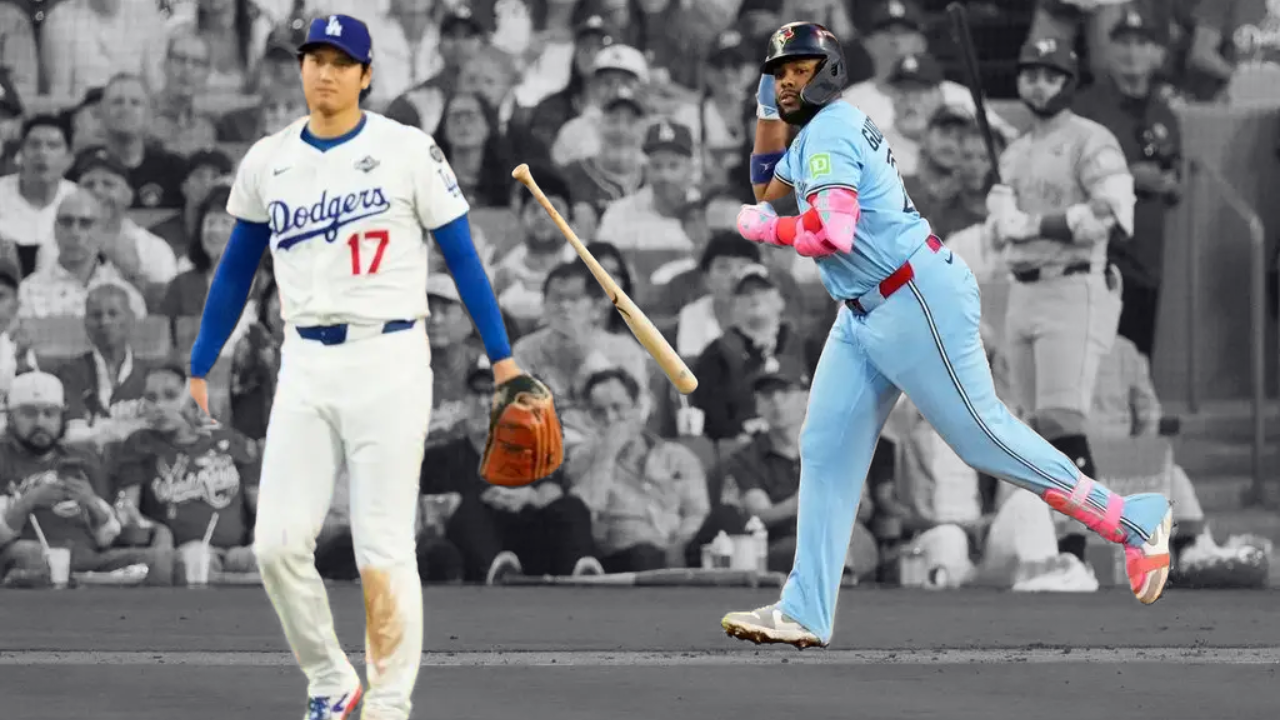
Everything shifts in the third inning. Ohtani, untouchable early, makes one glaring mistake — a pitch that drifts directly into Vladimir Guerrero Jr.’s annihilation zone. Guerrero vaporizes it, sending a 395-foot missile into left-center that also scores Lukes.
The lead flips from 0–1 to 2–1, and every emotional register flips with it. The Guerrero home run prop cashes, once again. Ohtani looks mortal for the first time all series, and with that, Dodgers’ stadium begins to deflate.
The broadcast responds as if Canada itself briefly tilted on its axis. It is the instant the game’s narrative fractures into something stranger, louder, and unmistakably October.
The Strike Zone as a Subplot
The middle innings become a test of psychological endurance rather than dominance. Bieber isn’t overpowering the Dodgers so much as outlasting them, stitching together outs through sequencing, discipline, and the kind of stubborn calm that survives postseason turbulence.
His brief flashes of frustration with the strike zone — especially after a low pitch that should’ve been ball four — flare and fade without derailing him, and he keeps Ohtani in check with two key strikeouts.
Each inning feels like its own riddle, and the strike zone only deepens the puzzle: pitches skimming the front of the plate or dying in the dirt get called strikes, while high heaters over the edge are inexplicably ruled balls.
Every questionable call becomes its own tiny theology, a moment where players, fans, and even the broadcast search upward for a logic that never arrives.
The makeup calls that follow don’t correct anything so much as perform a ritual of pacification — a soft officiating incense meant to soothe tempers and maintain the fantasy that the strike zone is a stable, governable universe rather than a shape-shifting October deity with moods of its own.
October Postseason Weirdos
Around all of this, the night’s characters grow larger than baseball action alone. Ohtani, usually invulnerable, shows strain after Guerrero’s blast but still manages to conjure six strikeouts with the desperation of a magician trying to maintain composure.
Alejandro Kirk — the cult favorite whose physique defies every stereotype of the modern athlete — goes 0-for-4 with two strikeouts, yet every plate appearance feels gravitational, like the pitcher is confronting a cosmic anomaly rather than a hitter.
The Jays as a whole feel like postseason weirdos, misfits who sharpen in October and become stranger, funnier, and more fearsome than their regular-season statistics would ever imply.
The Seventh-Inning Detonation
The Dodgers threaten in the sixth with back-to-back singles and a rising murmur rolling through Dodger Stadium, but Toronto’s bullpen closes the door before the moment can swell into anything real. The true turning point arrives an inning later, and it comes not through chaos but through pure, methodical precision.
Dalton Varsho opens the seventh with a clean single to right, and Ernie Clement follows by ripping a decisive double into the gap. Andrés Giménez then singles Varsho home, setting the inning into motion. Ty France, pinch-hitting, plates Clement with a routine groundout. The Dodgers respond by intentionally walking Guerrero Jr., an unmistakable admission of fear. Bo Bichette answers with a sharp RBI single, and Addison Barger tacks on another with a well-timed hit.
In the span of minutes, the Blue Jays produce four runs on five disciplined swings — another postseason inning built on attrition, pressure, and execution rather than luck. The rally dismantles both Ohtani’s night and the Dodgers’ composure in a single sweep.
As the scoreboard tilts decisively toward Toronto, the emotional instability of Blue Jays fandom briefly transformed into the feeling of ritualized victory.
Cosmetic Resistance and the Final Score
The Dodgers scrape together a cosmetic run in the ninth — Teoscar Hernández draws a walk, Max Muncy drives him to third with a double, and Tommy Edman brings him home with a routine groundout — but the outcome is already sealed.
Toronto closes out the 6–2 win with little drama, pulling the World Series level at 2–2. One more game remains in Los Angeles before the series returns to Toronto, but momentum has already shifted northward.
It doesn’t wait for flights, itineraries, or time zones; it moves with the weight of the performance itself, and the Jays now carry it.
Emergence of a Playoff Organism
Beneath the final score, a deeper truth begins to surface. The Blue Jays are not the team their regular-season numbers insist they are. In October, they become something stranger, sharper, and far less predictable — a postseason organism that opponents misread and sportsbooks chronically undervalue.
And the emotional whiplash of that transformation is immediate. The disappointment of Game 3 — that heavy, sinking dread that maybe the magic had flickered out — evaporates in a heartbeat.
The anxiety that clung to every pitch only 24 hours earlier is washed away the moment Guerrero turns on Ohtani’s mistake.
In an instant, the dread is gone, replaced by the same electric certainty that defined the ecstatic high of Game 1. It feels as if the series has snapped back into its original frequency, the one where Toronto plays like a team built for the moment rather than built for the spreadsheet.
Markets still don’t see it. They keep pricing the Jays as if they’re frozen in their July version of themselves, failing to grasp that their postseason identity is stitched together from volatility, pressure engineering, and a form of tactical attrition that makes no sense to models. But tonight brings clarity.
The emotional breakthrough comes paired with an analytical one: the Jays are not misbehaving outliers — they’re a playoff design. The sportsbooks don’t understand this team, but their fans sure do.
Emotional Arc and the Hope It Creates
The emotional arc of the night is impossible to miss. It begins with panic as Toronto falls behind, shifts into clarity the moment Guerrero detonates Ohtani’s mistake, and swells into joy during the seventh-inning dismantling.
As the Blue Jays start to land heavy shots, the broader narrative finally snaps into focus, that joy becomes validation — a sense that both the eye test and the numbers are suddenly speaking in the same language.
And by the final out, what’s left is hope, not the naive kind but the sharp, earned version that October hands out sparingly. You can already picture Games 6 and 7 unfolding in Toronto because the Blue Jays have revealed themselves as a fully formed playoff organism, a team whose postseason identity remains misunderstood by opponents and unaccounted for in models.
Game 4 stops being just a win and becomes a revelation, evidence that October doesn’t merely test teams; it transforms them. And this team has become something neither rivals nor sportsbooks can map.