
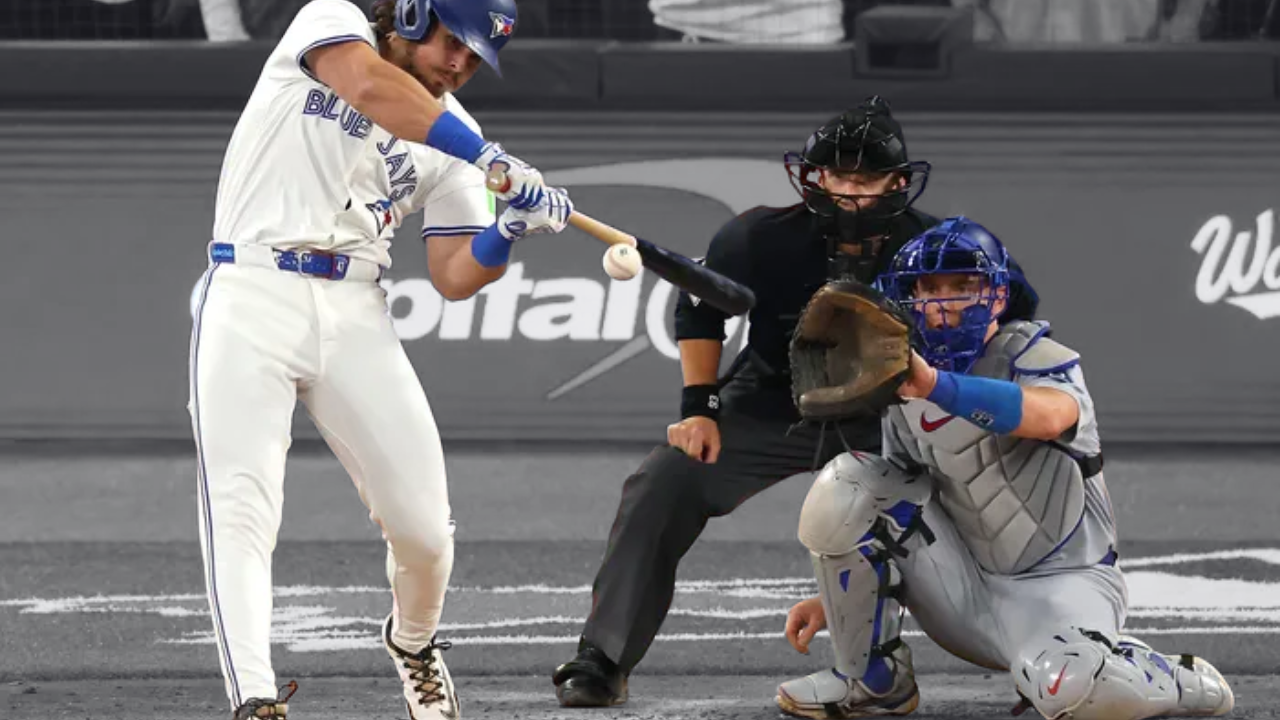
A nine-run inning, a cascade of historic swings, and a fan base living on the edge turned Game One of the 2025 World Series into a cathartic release for a city carrying decades of October tension.
Toronto’s 11–4 victory over the Los Angeles Dodgers wasn’t just a win. It was a cultural moment, the kind of shared experience that shakes loose years of fear, superstition, and pent-up hope.
Early Tension and Familiar Toronto Fear
The Dodgers struck first, scoring a run in the second inning on an Enrique Hernández single, then adding another in the third when Will Smith drove in Mookie Betts. With Los Angeles leading 2–0, the atmosphere inside Rogers Centre tightened. No home runs, no dramatic swings — just steady pressure that fed into Toronto’s well-earned October neurosis. Jays fans, fluent in gallows humour, felt the early unease seep in. Even Blake Snell’s mere presence on the mound reactivated the ghost of previous October scars.
Varsho Ignites the Shift
Toronto’s breakthrough arrived in the bottom of the fourth. Alejandro Kirk opened the inning with a single, stirring the crowd, and Daulton Varsho followed by demolishing a 423-foot home run to center field. In a single swing, the Jays erased the deficit and tied the game 2–2. It wasn’t the lead, but it was enough to jolt the stadium awake. Relief began to mix with belief, and for the first time all night, the momentum shifted.
The Sixth Inning: A Full-Scale Detonation
The bottom of the sixth inning will be recited in Toronto for generations. What unfolded was not a rally but a nine-run detonation that instantly altered the trajectory of the game and the emotional state of an entire fan base. The inning began with patient, grinding at-bats: Bo Bichette walked, Kirk singled, and Varsho was hit by a pitch. Ernie Clement’s RBI single made it 3–2 Toronto, and the energy in the building changed from hopeful to electric.
Nathan Lukes walked with the bases loaded to extend the lead. Giménez singled to right, bringing home another run. George Springer followed by reaching on a fielder’s choice as the Dodgers failed to contain the inning’s momentum. With the Jays up 5–2 and the stadium swelling to a breaking point, Addison Barger stepped in as a pinch hitter.
Barger Becomes a Myth in One Swing
On the first pitch he saw, Barger hammered a ball 413 feet to straightaway center for a three-run home run. It wasn’t a grand slam, but it felt like one. The explosion inside Rogers Centre was instant and seismic. A rookie who spent much of the season in Buffalo became, in that moment, a citywide myth — Toronto’s newest baseball son. Strangers hugged strangers. People screamed, sobbed, and shook. And still, the inning didn’t end.
Alejandro Kirk completed the detonation with a towering two-run homer, his second hit of the inning, placing Toronto ahead 11–2. Noise became something physical. The stadium didn’t cheer — it roared like a single organism finally released from a generational tension.
Emotional Whiplash
Even with an 11–2 lead, Toronto fans remained tense. This is a fan base conditioned by collapse, where no advantage ever feels safe until the last out is secured. When Shohei Ohtani homered in the seventh to make it 11–4, the collective flinch was visible across the ballpark. Yet as the game moved into its final innings, that tension slowly transformed into something softer, something hopeful.
The Weight of Thirty-Two Years
When the final out settled into a glove, the eruption was overwhelming. It wasn’t triumph so much as release — the unburdening of thirty-two years since their last World Series victory. The celebration carried exhaustion, relief, and the sense that this night had been waiting to happen for decades. Toronto didn’t just witness a win. It experienced something spiritual.
Why This Night Mattered
Game One resonated far beyond the score or the statistics. It captured everything that defines Toronto baseball: the nervous humour, the superstition, the fear of disaster, the refusal to quit, and finally the embrace of belief. The Blue Jays didn’t simply defeat the Dodgers. They woke up a sleeping part of the city — a shared emotional force that had been dormant since 1993.
This wasn’t just a baseball game. It was a moment that will be retold for generations, the kind that reminds a city why baseball matters as both a sport and a cultural memory. The Jays didn’t just win Game One. They reminded Toronto what it feels like to believe.