
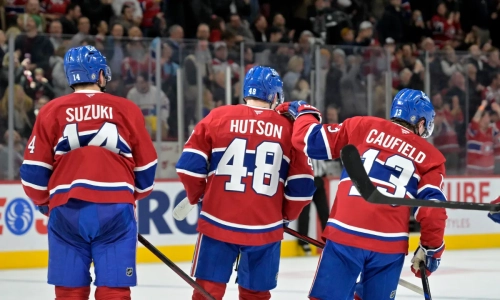
With Laval thriving, a deep prospect pool, and Martin St. Louis guiding the youth, Montreal is one goalie and a few veterans away from becoming a true contender.
The Montreal Canadiens have spent the past few seasons reshaping their identity, rebuilding their prospect pool, and trying to steady a franchise that has oscillated wildly between improbable highs and painful lows. But now, for the first time in years, there is a genuine sense of optimism—not the vague, hopeful kind that every rebuilding team claims to have, but a real, structural foundation that suggests something significant is being built in Montreal.
And perhaps surprisingly, much of that optimism begins not in Montreal, but in Laval.
The Laval Rocket Are Setting the Tone
AHL success is never a perfect predictor of NHL success, but it absolutely matters when a farm system builds a winning culture. The Laval Rocket’s strong showing in the AHL playoffs is more than a feel-good subplot; it’s a sign that Montreal’s prospects are learning how to win meaningful games, in pressure environments, against hardened professionals.
Playoff success accelerates development in a way no practice or midseason slump ever could. Young players learn resilience. They learn how to manage momentum swings, how to close out tight games, how to respond when their mistakes matter. They learn what it feels like to be the target of another team’s best effort—and to push back.
For a team as young as the Canadiens, having a prospect pipeline steeped in competitive experience is invaluable. This is how foundations get built.
A Prospect Pool That Finally Looks Like a Future
For years, Montreal’s farm system felt like a disconnected patchwork of hopeful projects and “maybe, if everything breaks right” prospects. That’s no longer the case. The Canadiens now possess one of the most impressive and balanced prospect pools in the league, filled with players who not only project as NHL contributors but have legitimate upside.
The organization has scoring talent, blue-line stability, physicality, intelligence, and—most crucially—internal competition. Positions aren’t simply handed out; they’re earned. And that competitive structure forces players to push each other, raising the floor of the entire system.
Montreal doesn’t just have prospects. Montreal has options.
And options are the currency of every successful rebuild.
The Missing Pieces: A Goalie and a Couple of Veterans
The Canadiens don’t need to overhaul their roster. They don’t need to acquire a superstar or chase an overpriced free agent. The core is already forming organically through the youth pipeline. What they do need are two ingredients that can transform a promising young team into a legitimately dangerous one: a real starting goaltender and a couple of the right veterans.
It’s remarkable how understandable the formula is. With reliable goaltending—someone who can give them stability on average nights and steal the occasional big game—the pressure on Montreal’s young core evaporates. Instead of playing tight, mistake-averse hockey in fear of a bad goal, the team gains permission to take risks, to develop confidence, to play freely.
Add to that a few proven veterans, ideally ones who can anchor special teams, support the room, and insulate the younger players from the heaviest burdens, and suddenly Montreal’s trajectory spikes upward. The talent is already present. The energy is there. The system is developing the right habits. With a couple of stabilizing forces, the Canadiens genuinely could become unbelievable—a team that jumps ahead of schedule and shocks the league with how quickly everything clicks.
Montreal’s path isn’t about transformation. It’s about acceleration.
Martin St. Louis: The Perfect Coach for This Moment
Of all the variables shaping Montreal’s future, Martin St. Louis might be the most important.
Coaches like St. Louis are rare. He’s a players’ coach—not in the cliché sense of being friendly or easygoing, but in the deeper, more meaningful sense of deeply understanding the mind of a player. He knows how to communicate, how to lift, how to challenge, and how to inspire. His players trust him, and trust is the currency that turns a development system into a true culture.
This is why the comparison to Rod Brind’Amour feels so apt. Like Brind’Amour, St. Louis blends accountability with empowerment. He teaches without condescension. He demands without alienating. He invites players to think, to adapt, to take control of their own growth.
For a team built around youth, this is a dream combination. Young players don’t just need systems; they need guidance. They need someone who remembers what it felt like to fight for a roster spot, to carve out a role, to build confidence after setbacks. St. Louis lived all of that—and he coaches through that lens.
If Montreal becomes a surprise powerhouse in a few seasons, St. Louis will be one of the main reasons.
A Rebuild Turning Into a Foundation
It’s easy to look at the Canadiens’ recent record and assume they are still deep in a rebuild. But anyone paying attention can see the outline of something much more exciting taking shape. AHL playoff success is signaling that the next wave is real. A strong prospect pool is providing the depth and dynamism a modern NHL team needs. A few targeted roster additions could reshape the entire complexion of the franchise. And Martin St. Louis is proving to be the emotional and developmental engine powering all of it.
Montreal isn’t finished building. But the Canadiens are closer than they appear—closer to turning the corner, closer to surprising the league, closer to becoming a team that no longer talks about the future, but arrives in it.
All they need are a couple of pieces, a bit of patience, and the right timing.
And if they get that? They might go from promising to unbelievable faster than anyone expects.