
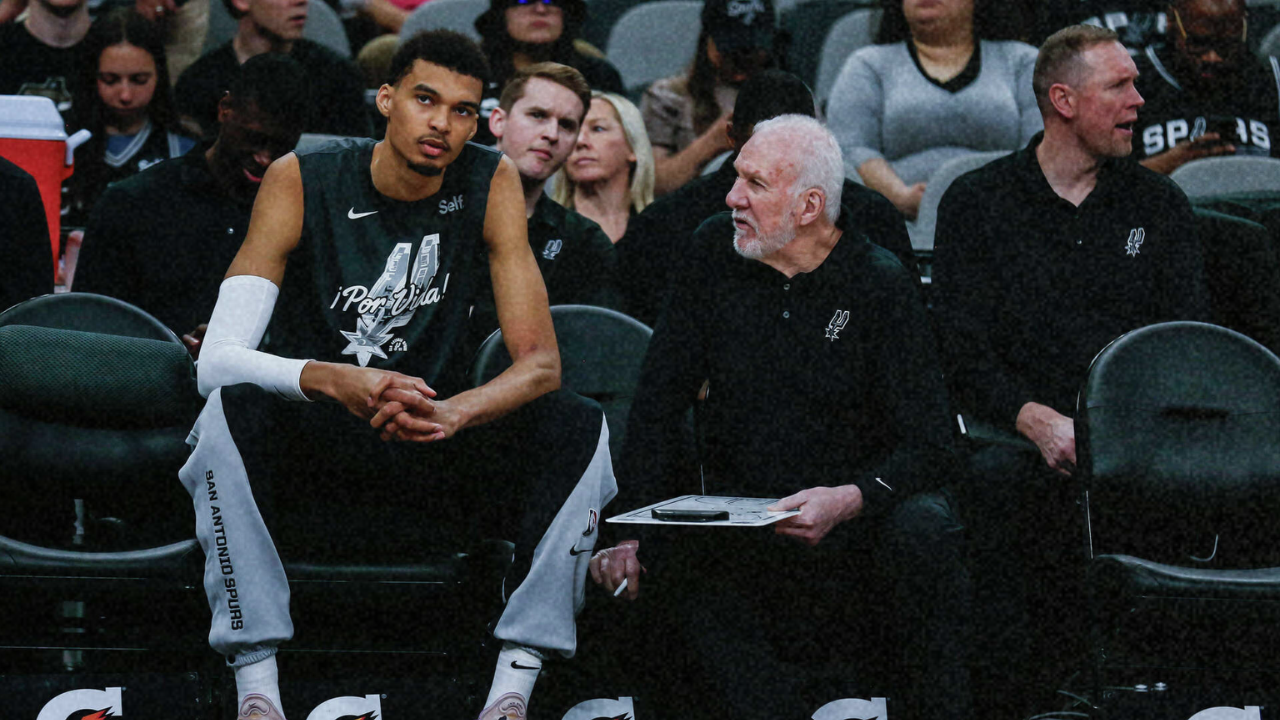
Gregg Popovich succession: San Antonio had the most attractive job in basketball and never posted it. Mitch Johnson had already done it twice before.
When the San Antonio Spurs announced on May 2 that Gregg Popovich was stepping down after twenty-nine seasons, the most consequential part of the statement was not the retirement. It was the second sentence. Mitch Johnson, who had coached seventy-seven games as interim while Popovich recovered from a stroke, was being made permanent head coach. There would be no search.
That is a remarkable thing for a franchise to do with what had just become the most desirable job in basketball. The Spurs hold the rights to Victor Wembanyama. They had a top lottery pick, cap flexibility, and the institutional prestige of five championships. Any coach in the sport would have taken a call. San Antonio did not make any calls.
Five games in
Popovich suffered a mild stroke on November 2, 2024, at the Spurs’ own arena, five games into the season. The team announced a health issue, then a leave of absence, then that the absence would be indefinite. Johnson was named acting head coach two days later. By February the organization confirmed Popovich would not return that season, and in April, still recovering, he reportedly fainted at a restaurant.
The Spurs finished 34–48, thirteenth in the Western Conference and out of the playoffs, with Johnson going 32–45 across his stretch in charge. For a franchise that had made twenty-two consecutive postseasons under Popovich, the record was less notable than the circumstance: San Antonio played an entire season without the only head coach a generation of its fans had known, and did so without any public timeline for his return.
Popovich had signed a five-year extension in 2023. He was under contract, he wanted to coach, and the organization gave him the time to decide for himself. What he decided, in a statement released on May 2, was that his love and passion for the game remained but that it was time to step away from the bench. He would stay on as president of basketball operations.
Johnson had already done the job
The decision not to run a search looks less like sentiment once you know Johnson’s history with the franchise. He joined the Spurs as an assistant in 2019 and was promoted to a full-time role in 2020, filling the vacancy Tim Duncan left when he stepped off the bench. He had also served as interim head coach twice before the stroke — in 2021 and again in 2023, when Popovich was dealing with illness.
By November 2024, in other words, Johnson had been rehearsing the job for years, in increments, under the man he was eventually going to replace. The seventy-seven games he coached in 2024-25 were not an audition so much as the final stretch of a handover that had been quietly underway for half a decade.
Understood that way, the absence of a search stops being an oddity and becomes the whole strategy. Hiring externally would have meant importing a coach with his own system, his own staff preferences, and his own ideas about how a young roster ought to be developed. San Antonio was betting instead that the thing worth preserving was not Popovich personally but the operating culture he had spent twenty-nine years installing — and that the way to preserve it was to hand it to someone already inside it.
The timing is the difficult part
What makes this genuinely uncertain rather than merely poignant is that the Spurs are attempting two hard things simultaneously. They are executing a leadership transition after three decades of continuity, and they are building a contender around a twenty-one-year-old who may be the most physically unusual player the sport has produced.
Most franchises would try to stagger those projects. San Antonio has no choice about the sequencing, because the stroke set the clock rather than the front office. Wembanyama’s development years and Johnson’s first years as head coach are now the same years, and they will be evaluated together whether or not that is fair to either man.
The assumption for most of the last two seasons was that Wembanyama would be brought along by the coach who had done the same for Duncan, Parker and Ginóbili — that the most valuable young player in basketball would spend his formative years inside the most stable developmental environment in the league. That version is gone. What remains is a bet that the environment was structural rather than personal, and that it survives the departure of the person who built it.
What the record actually says
Popovich retires with 1,422 regular-season wins, more than any coach in NBA history. He won five championships between 1999 and 2014 and reached six Finals. Only Phil Jackson and Pat Riley have more playoff wins; only Jackson and Red Auerbach have more titles. He joined the organization as an assistant in 1988 and took over as head coach in 1996, which means his association with the franchise spans five decades.
The longevity is the harder achievement. Popovich won titles with a team built around David Robinson’s interior dominance, then with Duncan as the fulcrum, then with a Parker-Ginóbili engine, and finally in 2014 with a passing offense that a good portion of the league spent the following decade trying to reverse-engineer. Coaches who win in one era are common. Coaches who win in four are not.
The coaching tree is its own argument. Becky Hammon, who spent seven seasons as his assistant before winning championships in Las Vegas, put it directly when the news broke: he is a large part of the reason she has the job she has. With Popovich off the bench, the longest-tenured active head coach in the league becomes Erik Spoelstra, who faced him in consecutive Finals and split them.
El Jefe
On May 5, at Johnson’s introductory press conference, Popovich made his first public appearance since the stroke. He moved slowly and spoke quietly. He thanked people, and noted that there were a great many thank-yous owed after twenty-five or thirty years. He said his recovery was improving daily but was not yet good enough for what the organization had planned.
Then Duncan and Ginóbili, who had been helping with his rehabilitation, took his jacket off him. Underneath was a shirt reading El Jefe. He announced that he was no longer the coach, turned around to show the back — Senor Popovich — and let the room laugh.
Professional sports do not usually end this way. Coaches get fired after bad seasons, or hang on past the point where anyone wants them to, or leave in a dispute with a front office that has stopped listening. Popovich left with a contract still running, on a decision he made himself, in a building where two of his former players were physically holding him up, handing the job to a man he had been training for it since 2019.
Whether the succession works is a question for the next several seasons, and it will be answered by Wembanyama’s knees and Johnson’s rotations rather than by anything said at a podium. But the Spurs made their position clear by declining to interview anyone. They are wagering that what Popovich built was a system rather than a personality, and that it can be inherited.
Sources
- ESPN — Popovich done coaching, Johnson takes over; Becky Hammon’s comments and the shift in longest-tenured active coach to Erik Spoelstra
- CBS Sports — the May 2 announcement, the 1,422 wins, the 2023 five-year extension, and Popovich’s statement on stepping away
- CBS Sports — the decision not to conduct a search; Johnson’s arrival in 2019, promotion in 2020, and prior interim stints in 2021 and 2023
- KSAT — Popovich’s first press conference since the stroke, including his remarks on recovery
- CBS Sports — the El Jefe moment; Duncan and Ginóbili assisting with his rehabilitation
- AOL — the shirt reveal and the “Senor Popovich” reverse
- 2024-25 San Antonio Spurs season — the November 2 timeline, Johnson’s appointment as acting coach, and the 34-48 final record
- Yahoo Sports — the health timeline including the February confirmation and the April incident during recovery
- San.com — the May 5 transition press conference and Johnson’s 32-45 interim record