
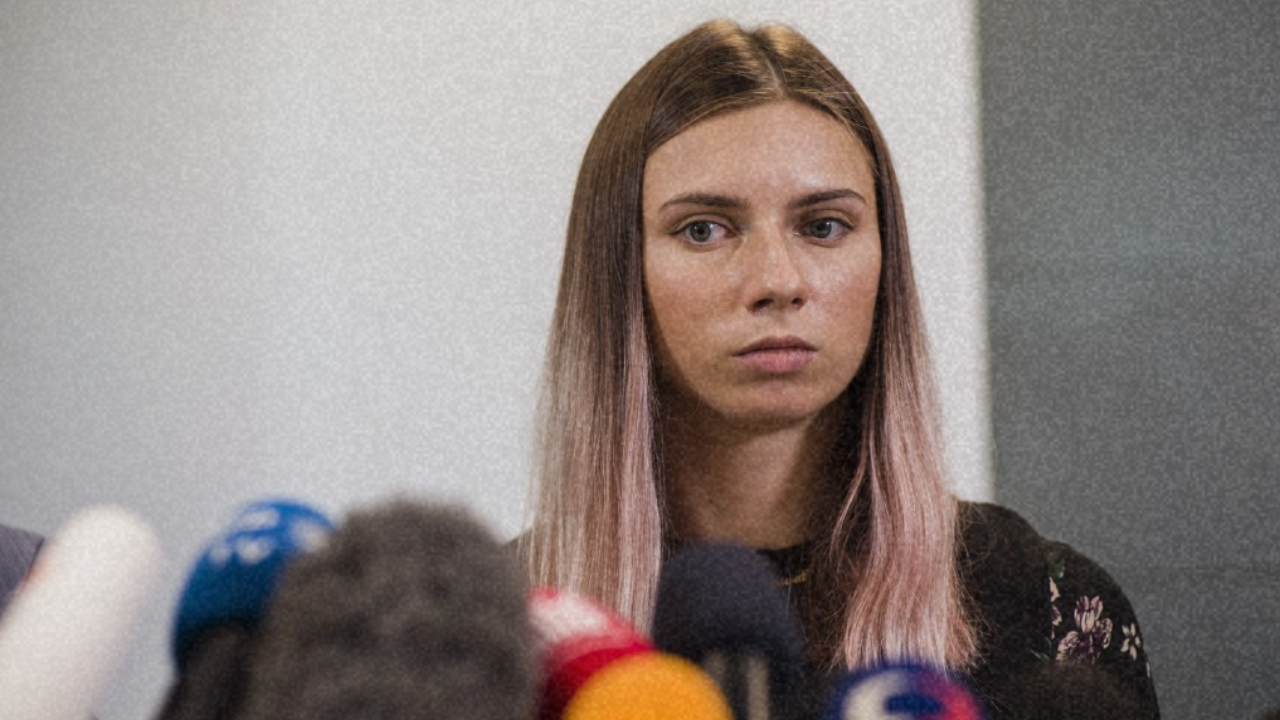
Krystsina Tsimanouskaya Tokyo: she criticised her coaches over a relay entry, not the president. Belarus tried to remove her from the Games anyway.
Krystsina Tsimanouskaya ran the 100 metres at the Tokyo Olympics on July 30, 2021. Days earlier, coaches had entered her in the 4×400 relay — an event she had never contested — after other members of the squad were found ineligible. Nobody had asked her. She posted a video to Instagram saying so.
As NPR noted then, the post did not mention Alexander Lukashenko. It did not mention the government, the election, the protests, the arrests, or the letter eight hundred athletes signed the previous autumn. It was a complaint about her coaches’ negligence in assigning her to a race she did not run. That was the entire offence.
Removed from the Games
On Sunday, August 1, before she could compete in the 200 metres — her actual event — Belarusian team officials withdrew her from the Olympics and took her to the airport. She has described what she was told in an interview with Reuters in Warsaw, including her account of the family phone call during the drive that decided her against boarding.
At the terminal she refused the flight and went to the Japanese police. She posted a second video: they were trying to remove her from the country without her permission, and she was asking the International Olympic Committee to intervene. IOC spokesperson Mark Adams confirmed the following day that she had sought police protection and was safe.
She later told the Associated Press that officials had made clear some form of punishment awaited her at home, with thinly disguised hints that more would follow. Dzmitry Dauhalionak, head of the Belarusian delegation in Tokyo, was reached by phone and declined to comment. The National Olympic Committee’s public explanation was that she had been withdrawn on medical advice concerning her emotional and psychological state. She has rejected that account consistently since.
Two nights in an embassy
On Monday she walked into the Polish Embassy in Tokyo with her luggage. Poland granted her a humanitarian visa the same day, and its deputy foreign minister Marcin Przydacz confirmed publicly that she was safe and awaiting a flight. She spent two nights inside the compound.
On Wednesday, August 4, she flew out of Narita toward Warsaw via Vienna, wearing sunglasses with the words I RUN CLEAN printed across them. Her husband, Arseni Zdanevich, had already left Belarus that week; Poland offered him a visa as well. At a press conference in Warsaw she wore a shirt reading I just want to run, which was both a statement about her career and an accurate summary of what the previous seven days had been about.
The lever, again
The response came from the same place it had come from eight months earlier. On August 6 the IOC cancelled the accreditations of athletics head coach Yury Maisevich and team official Artur Shumak, removed them from the Olympic Village, and opened a disciplinary commission to establish their roles. The measure was framed as provisional and taken in the interest of the wellbeing of the Belarusian athletes still in Tokyo. Both men would be offered an opportunity to be heard. The National Olympic Committee said they would return to Minsk immediately and might appeal.
Neither Lukashenko nor his son Viktor was in Tokyo to respond. Both had been barred from attending, a consequence of the IOC’s December 2020 finding that the Belarusian Olympic committee’s leadership had failed to protect its own athletes from political discrimination. That finding had been prompted by the reprisals against the letter signatories. Eight months later the same body was removing two more Belarusian officials from the same Games for the same category of conduct.
On September 30, World Athletics opened formal proceedings against Maisevich and Shumak through the Athletics Integrity Unit, extending the case beyond the Olympic movement into the sport’s own governance.
What the constraint had become
When the league played through COVID, Belarusian footballers understood the rule they were operating under and mostly obeyed it. Aleksandr Hleb criticised the government’s pandemic response and retracted within days. Sergey Kislyak said everything was fine. The one player who spoke bluntly, Nikolay Zolotov, was employed in Russia at the time. The rule, as everyone understood it, was not to put your name to political criticism of the state.
In August 2020, several hundred athletes tested that rule directly by demanding the annulment of an election. They were summoned, dismissed, excluded from teams, and in Yelena Leuchanka’s case jailed for fifteen days.
Tsimanouskaya did none of that. She had not signed the letter. She was not part of the athletes’ movement. Her complaint concerned an entry form. What her case established is that by the summer of 2021 the category of unacceptable speech had widened to include administrative grievances about relay assignments, and that a state which had spent a year removing athletes from teams was now prepared to remove one from a foreign country in the middle of an Olympic Games.
She was twenty-four, she was not a dissident, and she had complained that nobody asked her before entering her in a race she had never run. That turned out to be the kind of thing you defect over.
Sources
- NPR — the Polish humanitarian visa, IOC spokesperson Mark Adams confirming she was safe, and the note that she did not criticise Lukashenko or the government
- Sky Sports / Reuters — her interview in Warsaw and the IOC’s removal of the two coaches
- CBS News / AP — the punishment she was told awaited her, the delegation head’s refusal to comment, and her husband’s departure from Belarus
- Al Jazeera — the two nights in the Polish embassy and the departure from Narita via Vienna
- Al Jazeera — the IOC statement cancelling the accreditations of Maisevich and Shumak
- RFE/RL — the August 6 revocation and the IOC disciplinary commission
- Forbes — the relay entry that triggered the dispute and the terms of the interim measure
- World Athletics / Athletics Integrity Unit — formal proceedings opened September 30, 2021
- CBC Sports / Reuters — Tsimanouskaya on seeking Polish sporting citizenship