
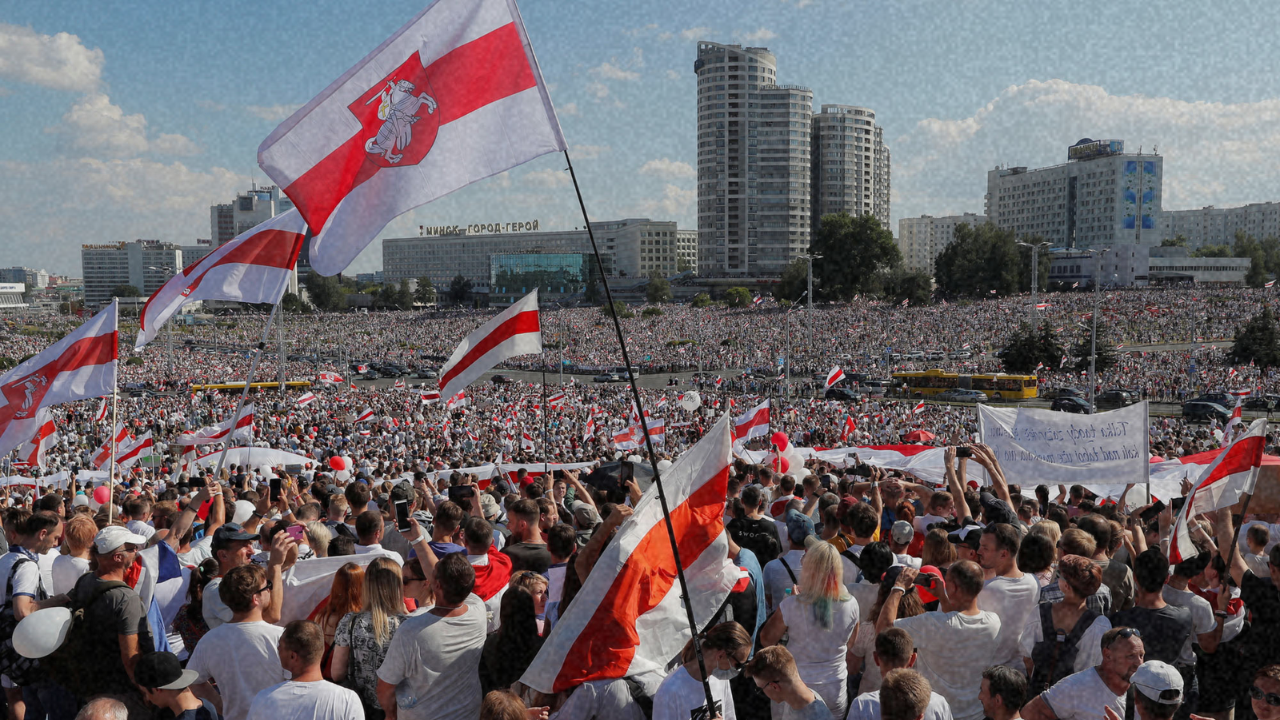
Belarus athletes protest: hundreds signed against Lukashenko in 2020, and the IOC found their own Olympic committee had failed to protect them.
In April 2020, the Vysshaya Liga was the last league playing, and the men in it said almost nothing. Sergey Kislyak told reporters his mother’s school was still open and everything was fine. Aleksandr Hleb criticised the government’s pandemic response on Instagram and retracted within days. Dissent existed, but it moved through anonymous polls and private message groups, because the cost of attaching a name to it was understood by everyone involved.
Four months later several hundred Belarusian athletes attached their names to a letter demanding the president’s election be annulled. By December the International Olympic Committee had formally concluded that Belarus’s own Olympic committee was failing to protect them.
The letter, and the letter after it
The election was held on August 9, 2020. The Central Election Commission declared Lukashenko the winner, the European Parliament later described the process as seriously flawed, and hundreds of thousands of Belarusians went into the streets. The state’s response ran through the Okrestina detention centre in Minsk, which became the period’s defining symbol of what the security forces would do.
By the Belarusian Sport Solidarity Foundation’s own published accounting, roughly 350 members of the sporting community signed an open appeal between August 16 and 21, demanding that the results not be recognised, that the violence stop, and that political prisoners be released.
By early September the count had passed 400. By late September it was over 500. In October a second letter, condemning the violence directly, drew more than 800 signatures.
The names were not marginal. Marina Arzamasova, a world champion in athletics. Andrey Kravchenko, Olympic silver in the decathlon at Beijing. Aliaksandra Herasimenia, a multiple Olympic swimming medallist. Oleg Logvin, an Olympic cycling champion from 1980. Anna Guskova, Olympic gold in freestyle skiing. Melitina Staniouta, a multiple world and European medallist in rhythmic gymnastics.
The letter contained a specific threat, and it was the only leverage available. If the demands were not met, the signatories were prepared to give up representing Belarus. If any of them faced reprisals, they would notify the International Olympic Committee and the international federations. On August 25 they formalised the arrangement, announcing the Belarusian Sport Solidarity Foundation to support anyone punished for signing.
The reprisals arrived on schedule
Signatories were summoned to meetings with senior Ministry of Sport officials and with security forces. Most were told to withdraw their signatures. By the time the Foundation published its first newsletter it had already documented around twenty dismissals on political grounds, alongside exclusions from teams, cuts to payments and withdrawn scholarships.
Aliaksandra Ramanouskaya, the reigning world champion in aerials, was dismissed from the national team in late October for truancy. Two cross-country skiers, Sviatlana Andryiuk and Darya Dolidovich, had their international federation codes revoked. Belarusian football absorbed its own share of arrests and exclusions over the same period, catalogued in detail by the investigative outlet Veridica.
Fifteen days at Okrestina
Yelena Leuchanka was the most internationally recognisable athlete jailed. A two-time Olympian, a WNBA finalist who had played for the Washington Mystics, a European Championship bronze medallist with Belarus, and named the best centre in the world in 2010, she had spent her career avoiding politics.
On September 30 she was detained at Minsk airport as she prepared to fly out for previously scheduled medical treatment. The evidence against her came from her own Instagram account: photographs placing her at demonstrations on August 23 and September 27. She was sentenced to fifteen days for violating the administrative code on the organisation and holding of mass events, and served them at Okrestina.
Her stated reason for the risk was unremarkable and precise. She wanted Belarusians to be free to express their opinions without fear of being fired, imprisoned, fined, beaten or intimidated for it — a list that reads as a description of what had already happened to people she knew.
The response inside Belarusian sport was immediate. The men’s handball club Vitsyaz sat out its fixture against Masheka Mahilyou in solidarity with her. The Belarusian Handball Federation expelled the club from its training facility and barred it from national league competition. Katsyaryna Snytsina, captain of the national women’s basketball team and the eleventh name on the letter, told RFE/RL she was worried about everyone who had signed.
The one lever that worked
The threat written into the August letter — that reprisals would be reported to international sport’s governing bodies — was the only mechanism with any purchase on the situation. The Foundation documented the cases and submitted them. The European Olympic Committees later confirmed it had received a number of complaints from Belarusian athletes about politically motivated pressure from the NOC and its member federations. On November 25 the IOC opened a formal procedure.
Its Executive Board published its findings on December 7. The conclusion was that the current NOC leadership had not appropriately protected the Belarusian athletes from political discrimination within the NOC, their member sports federations or the sports movement. This, the decision continued, was contrary to the fundamental principles of the Olympic Charter, and therefore seriously affected the reputation of the Olympic Movement.
The measures that followed were narrow and pointed. The NOC’s leadership was excluded from IOC events and the Olympic Games. Financial payments to the committee were suspended, except those tied directly to athlete preparation for Tokyo and Beijing — and Olympic scholarships were to be paid to athletes directly rather than routed through the NOC. International federations were asked to ensure eligible Belarusian athletes could contest qualification without political discrimination. Discussions about Belarus hosting future IOC events were suspended.
The president of the National Olympic Committee of the Republic of Belarus, at the time those measures were adopted, was Alexander Lukashenko. He had held the position since 1997.
What the measure actually said
It is worth being precise about the scale of it. The IOC did not suspend Belarus, and Belarusian athletes remained eligible to compete. What it did was bar the head of state from the Olympic movement’s events in his capacity as a sports administrator, on a documented finding that he had used the position against his own athletes — and then reroute the money so it could not pass through his committee on the way to them.
The NOC’s response was to call the finding biased and based on a superficial understanding of its work, and to insist that all athletes, regardless of political views, were being treated equally.
When the committee held its elective assembly the following February, Lukashenko was succeeded as president by his son Viktor. In March the IOC declined to recognise the election, declined to recognise Dmitry Baskov’s election to the executive board, maintained the exclusions, and noted with great disappointment that the committee had failed to address the finding at all.
What the spring had already established
Igor Stasevich captained the BATE Borisov side that beat Arsenal in the Europa League in 2019. After the protests he recorded a video asking the regime to forgive him. It did not work; he remained barred from the Belarusian championship regardless. Ilya Shkurin, who was playing abroad, said early on that he would not represent the national team while Lukashenko remained in power — and being outside the country was what made saying it possible.
Stasevich’s video is Hleb’s Instagram retraction from April, repeated eight months later with the penalty attached. The mechanism had not changed. In the spring the only Belarusian footballer who criticised the government in public was one who could reverse himself quickly, and the only one who spoke bluntly to the press was employed in Russia at the time.
The April piece described that arrangement as a constraint on what could be said. What August established is that it was never only about speech. The 253 people who declined to attend Neman Grodno’s match had made a calculation about a virus. The several hundred who signed in August made one about a state, using the only leverage they had — their own names, and the possibility that an institution outside the country would eventually be obliged to look at what was being done to them. In December one of them did.
Sources
- IOC — provisional measures against the NOC of Belarus, December 7 2020
- IOC — further provisional measures, March 8 2021
- European Olympic Committees — statement on the IOC measures
- NOC of Belarus — official response to the IOC decision
- Belarusian Sport Solidarity Foundation — Newsletter #1
- RFE/RL — Belarusian athletes turning against Lukashenka
- RFE/RL Belarus Service — protests spill into the sports arena
- Washington Post — former Mystics centre jailed in Belarus
- CBC Sports / Reuters — Leuchanka released after fifteen days
- Meduza — Leuchanka on conditions at Okrestina
- Charter97 — the signature count by September 3
- SwimSwam — the open letter’s demands
- insidethegames — dismissals and revoked federation codes
- Veridica — the clampdown on Belarusian footballers, catalogued
- Golden Goal — Stasevich, Shkurin and Belarusian football under Lukashenko