
UFC Freedom 250 exposes how monopoly sports capital converts fighter labour, state power, and nationalist spectacle into private corporate value.
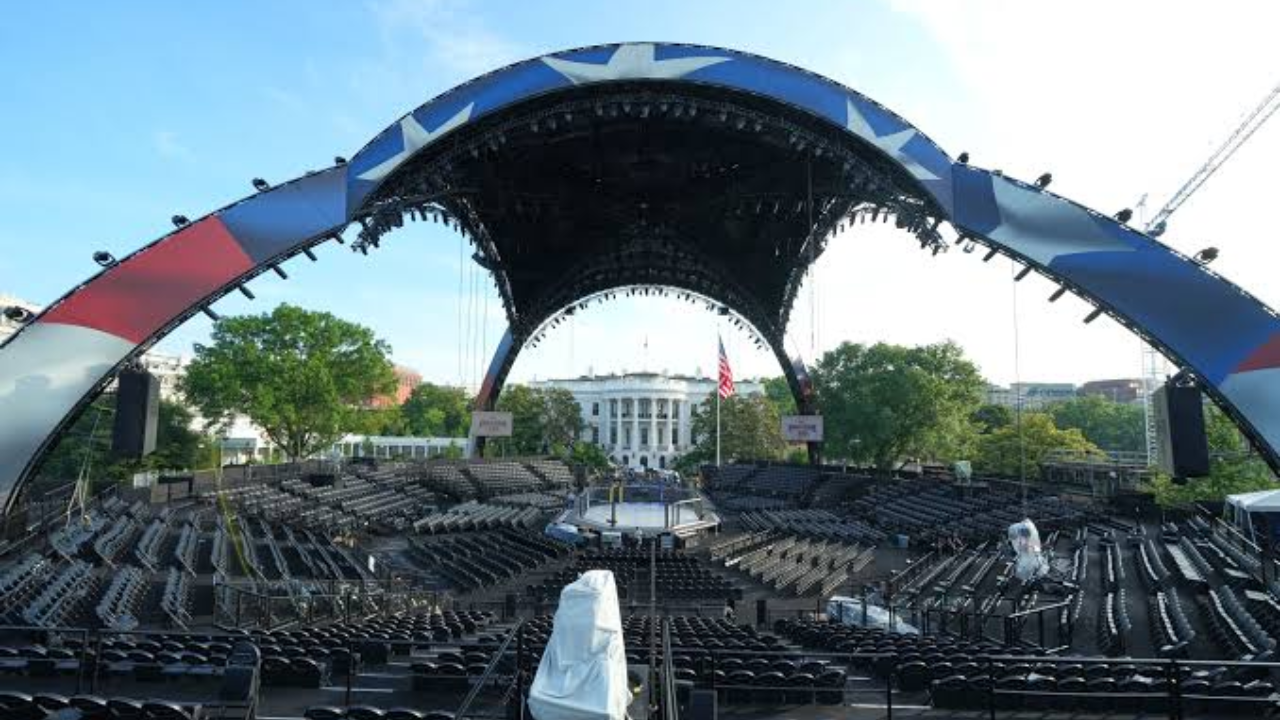
A cage has been built on the White House lawn.
On June 14, 2026, the Ultimate Fighting Championship staged UFC Freedom 250 at the symbolic centre of American executive power. Political donors, lobbyists, corporate partners, government officials, military representatives, celebrities, and invited guests sat near the Octagon. A much larger crowd of ordinary spectators was directed toward a separate viewing area outside the immediate arena. Members of Trump’s Cabinet, hundreds of Trump allies and thousands of members of the military attended as long as they passed a fitness test — all of them steps away from the Oval Office as the fighters worked.
The fighters produced the entertainment. The UFC owned the broadcast, controlled the matchmaking, distributed the compensation, sold the sponsorships, and preserved the footage as corporate property. The White House provided the national symbolism. Donald Trump, a president convicted on 34 felony counts in New York, received another spectacle organized around his presence, his birthday, and his personal relationship with UFC leadership.
Much of the MMA media described the arrangement as “good for the sport.”
That phrase is the ideological shield around the entire event. It collapses the distinction between mixed martial arts and the corporation that dominates it. It treats the UFC’s commercial success as identical to the health of MMA. It turns criticism of fighter exploitation, political propaganda, elite access, or the use of public space for a private vanity spectacle into an attack on the sport itself. Anyone who objects can be accused of wanting the UFC to fail. Anyone who criticizes the UFC can be accused of rooting against the fighters. Anyone unwilling to celebrate the merger of corporate entertainment and presidential power can be dismissed as bitter, partisan, or hostile to mixed martial arts.
The accusation protects the corporation by hiding it behind the sport.
Mixed martial arts is not the UFC. It is a sport practiced by thousands of fighters across countries, gyms, amateur systems, regional promotions, and competitive traditions. The UFC is a private company that controls the most valuable portion of that sport’s commercial market. The interests of the two are not identical. MMA benefits when fighters receive a larger share of the wealth they create, when athletes can negotiate freely, when competitive merit shapes title opportunities, when journalists can investigate promoters without fearing the loss of access, and when no single corporation can determine which careers, championships, and histories matter. The UFC benefits from controlling those things.
UFC Freedom 250 is not simply a fight card in an unusual location. It is a public ceremony joining monopoly sports capital to political authority. The cage on the White House lawn makes these relationships unusually visible. A promotion that resists increasing fighter compensation is prepared to spend tens of millions of dollars transforming federal grounds into a temporary arena. A corporation that insists it is not political is holding an event at the White House for a president its CEO endorsed at three Republican National Conventions. An event advertised as a gift to the American people reserves its most valuable access for people who already possess money, influence, or proximity to power.
The spectacle does not hide these contradictions particularly well. It survives because the UFC has enough power to impose them, and because much of the industry built around the company has learned to rename corporate power as progress for the sport.
The Capital Behind the Cage
The story usually told about the UFC begins with a near-bankrupt promotion saved in 2001 by two enthusiastic Las Vegas brothers and their high school friend. The documented version is more specific.
Lorenzo Fertitta was appointed to the Nevada State Athletic Commission in November 1996, at twenty-seven, by Governor Bob Miller — a longtime associate of his father Frank Fertitta Jr., the founder of Station Casinos and a major Republican donor. The commission is the most consequential regulator in combat sports. While serving on it, Lorenzo attended his first MMA event in 1999 at the personal invitation of Robert Meyrowitz, then-owner of the UFC, who was attempting to get the sport sanctioned in Nevada. According to Meyrowitz, Fertitta cast the deciding vote against sanctioning, then quit the commission the following year to purchase the ailing UFC for $2 million in 2001. The NSAC reversed the decision and sanctioned MMA in Nevada four months after the Fertittas took over.
Read together, those moves describe regulatory capture in the textbook sense: an industry insider on the licensing body uses his position to depress the value of the asset he intends to acquire, then exits the regulator to acquire it. The most charitable reading available is that the timing was coincidental. The less charitable reading — and the one the dates make harder to dismiss — is that Lorenzo Fertitta’s vote against sanctioning was part of the acquisition strategy.
The same names recur on both sides of the regulatory line for thirty years. After leaving the NSAC, Lorenzo served as Chairman of the Nevada Resort Association and as a Director of the American Gaming Association. The UFC’s first hire in regulatory affairs was Marc Ratner — the former Executive Director of the NSAC — who became Zuffa’s Vice President of Regulatory Affairs. A decade later, after the Fertittas sold their majority stake, Governor Brian Sandoval — whose campaigns both Zuffa and Station Casinos had donated to, and whose 2014 election-night party was held at the Station-owned Red Rock Resort — appointed Staci Alonso, then an executive vice president at Station Casinos, to the Nevada Athletic Commission.
The labour model the Fertittas built into the UFC is not separable from the one they built into Station Casinos. The Culinary Workers Union Local 226 has been attempting to organize Station’s casinos for more than three decades. Station Casinos was placed on trial in July 2024 in what the National Labor Relations Board called one of the largest labor law enforcement actions in American history. The Fertitta brothers were required to testify personally. The Culinary Union has documented that workers at Station Casino properties make three to four dollars an hour less than workers under union contracts negotiated at the rest of the strip. A 2021 NLRB complaint alleges Station Casinos used COVID-era layoffs to undermine union activity, culminating in the unlawful withdrawal of union recognition at Palace Station and Boulder Station based on anti-union petitions the company encouraged employees to circulate and sign.
This is the same family, applying the same labour discipline, in the same city, across two industries.
The UFC was sold by the Fertittas to WME-IMG (now Endeavor) over 2016 and 2017 for approximately $2 billion apiece. TKO Group Holdings, formed in September 2023 through the merger of UFC parent Zuffa and World Wrestling Entertainment, is the direct corporate owner of the UFC today. Endeavor Group Holdings owns approximately 59% of TKO as of early 2025, with effective control over its strategic decisions. In April 2024, Endeavor entered an agreement to be taken private by Silver Lake at an equity value of $13 billion and a total consolidated enterprise value of $25 billion — described by Silver Lake as the largest private equity public-to-private transaction in over a decade, and the largest ever in the media and entertainment sector. The transaction closed in March 2025.
In September 2025, Electronic Arts was announced as being taken private for $55 billion by Saudi Arabia’s Public Investment Fund, Silver Lake, and Affinity Partners — a Miami-based investment firm founded in 2021 by Jared Kushner. It was the largest all-cash sponsor take-private investment in history. PIF already owned stakes in LIV Golf and football clubs in Saudi Arabia and the UK, and is set to host the 2034 World Cup. Silver Lake remained the majority shareholder in Endeavor, the controlling owner of UFC, and a minority investor in Manchester City FC.
The lines are these: UFC → TKO (Endeavor majority) → Endeavor (Silver Lake-owned as of March 2025) → Silver Lake, which is now in business with the Saudi Public Investment Fund and Jared Kushner’s investment firm on the largest take-private deal in history. Each of these moves can be defended on ordinary commercial terms. There is no documented contract describing the consortium as a political instrument. The reading the structure invites is this: the corporation hosting a fight card on the South Lawn for the President’s eightieth birthday is, two layers above the cage, a portfolio company of the same private equity firm that has just gone into business with the President’s son-in-law and the largest Gulf sovereign wealth fund in the world.
That is the capital substrate the “good for the sport” framing prefers not to discuss.
The Promise Was the First Product
The disappointment surrounding UFC Freedom 250 began long before the card was announced. Dana White promised something unprecedented. Donald Trump went further, publicly describing a card that could contain eight or nine championship fights. The UFC has never placed anything close to that number of legitimate title fights on one event. The company does not have enough active undisputed champions to make such a promise realistic without freezing several divisions and reorganizing much of its schedule.
The claim did not need to be realistic to become useful. For months, the White House card dominated discussion around the UFC. Every major fighter became a possible participant. Jon Jones discussed returning. Conor McGregor campaigned for a place. Michael Chandler attached himself to the event. Fans constructed imaginary cards involving Islam Makhachev, Ilia Topuria, Alex Pereira, Tom Aspinall, Max Holloway, Ronda Rousey, Gina Carano, Khamzat Chimaev, and nearly every other available star. The fantasy became the product before the company produced an actual lineup.
This is how contemporary sports promotion increasingly operates. The corporation announces history first and determines what history will contain later. Anticipation creates media coverage. Media coverage creates engagement. Engagement creates sponsorship value, platform attention, political excitement, and months of unpaid publicity. The UFC did not need to have eight championship fights under contract for Trump’s claim to generate value. It only needed commentators, reporters, podcasters, and fans to repeat it. The MMA media — which depends on the UFC for credentials, interviews, footage, and audience attention — converted the unfulfilled promise into daily programming for months.
When the actual card appeared, it looked less like the carefully protected centrepiece of the UFC calendar and more like a collection of available parts assembled around a political commitment. The headline matchups — Ilia Topuria against Justin Gaethje, Alex Pereira against Ciryl Gane — are serious fights. They are not eight title bouts. They are not even the version of the card the conversation around it had constructed. The political spectacle came first. The sporting product was built afterward.
The Fighters Produce the Value
The weakest explanation for the underwhelming card is that the UFC lacked the resources to assemble something larger. The company could afford major fights. It chose not to meet the financial demands required to secure several of them. The pattern is documented far beyond the disputes around this particular event.
In December 2014, six former and current UFC fighters — Cung Le, Nate Quarry, Jon Fitch, Brandon Vera, Luis Javier Vazquez, and Kyle Kingsbury — filed a federal class action against Zuffa LLC in the District of Nevada. The fighters alleged that, as a result of its anti-competitive conduct, the UFC received more than 80% of all revenue generated by MMA events in the US while paying fighters a fraction of what they would earn in a competitive marketplace. In 2023, U.S. District Judge Richard F. Boulware certified the class, finding that Zuffa had “willfully engaged in anticompetitive conduct” to maintain or increase its market power. In April 2024, weeks before trial, the company settled. Final approval of a $375 million settlement was granted on February 6, 2025, covering more than 1,100 fighters who competed in UFC-promoted bouts between December 16, 2010 and June 30, 2017.
The class action established, in documents the company elected to settle rather than litigate to a verdict, the basic shape of the UFC labour model. Fighters in the UFC class period earned an average of roughly 16 to 17 percent of total UFC revenue — far below the roughly 50 percent that athletes receive in the NFL or NBA. The mechanism was a system of long-term exclusive contracts, champion’s clauses, and contract extensions that prevented fighters from negotiating with rival promotions or organizing collectively, while the UFC simultaneously acquired its major competitors — Pride in 2007, Strikeforce in 2011, WEC in 2010 — to eliminate alternative employers. Since 2021, the UFC has inserted arbitration clauses and class-action waivers into fighter contracts, potentially blocking newer athletes from joining collective lawsuits. Fighters who participated in UFC bouts since July 1, 2017 continue to litigate a second antitrust class action, Kajan Johnson et al. v. Zuffa, filed in 2021.
The numbers are worth holding against the visual of the cage on the White House lawn. In January 2001, the Fertittas bought the UFC for $2 million. By 2016 they sold it for approximately $4 billion. By September 2023, inside the newly merged TKO Group, the combined enterprise was valued at over $20 billion. By late 2025, UFC alone was valued at $12.1 billion, with TKO Group Holdings as a whole valued at $27 billion and climbing. TKO’s market capitalization reached $39.7 billion ahead of its Q4 2025 earnings. The entity grew six thousand times over twenty-five years. The fighter wage share, across the period the federal court found anticompetitive, sat at 16–17%.
The Reebok deal illustrates the spread in a single transaction. The UFC signed a six-year exclusive outfitting agreement with Reebok worth $70 million in 2014. Fighters could no longer wear other sponsor logos at UFC events. Reebok paid out a total of $39,346,500 to fighters over the six years of the deal. The company retained roughly $30 million for itself. 61% of the UFC’s roster fell into the lowest pay tier, receiving as little as $2,500 per fight. Before the deal, top fighters had routinely earned six figures per bout from individual sponsors.
The Le v. Zuffa class accounting completed the picture in federal court. The class covers 1,100 fighters who fought in the UFC between December 2010 and June 2017. The projected average payout was $230,792, with a median of $85,949. The highest payment will be $10.3 million, to Anderson Silva. Judge Boulware rejected the original $335 million settlement as insufficient before approving the revised $375 million, on the ground that he wanted to return “life-changing” money to the plaintiffs. Across the same window the company’s valuation multiplied by 6,000x, the fighters were collectively short by enough money that the federal judiciary characterized what they should have been paid as life-changing.
And the proliferation of events did not produce proportionally more title fights. In 2001, the UFC held 5 events and 10 title fights — two per event. By 2014, 46 events with 16 title fights — roughly one every three events. Fans who watched everything the UFC produced in 2024 watched roughly nine times as many cards as fans who watched everything in 2001 to see roughly twice as many championship bouts. The denominator grew faster than the numerator. More cards, fewer of them with title stakes per card. The expansion was in television product, not in competitive elevation.
The company is not merely trying to save money on one card. It is defending a system of labour discipline that has now been independently described in federal court findings, settled for $375 million covering only the 2010–2017 window, and replicated in adjacent labour markets controlled by the same ownership network. The fighters create the product through their bodies. Without them, there is no live event, no broadcast, no highlight footage, no championship lineage, no promotional archive, and no reason for spectators to gather. Yet fighters do not own the events they create. They are generally classified as independent contractors while operating inside a system where one corporation controls the most commercially valuable route to recognition in the sport.
Monopoly Makes Contempt Profitable
Dana White’s treatment of fighters and fans is often explained as a personality problem. The structural explanation is more useful. A company operating in a genuinely competitive market cannot indefinitely degrade its product, suppress the compensation of its essential workers, insult customers, and assume they will remain. The UFC operates under different conditions.
No other MMA promotion offers an equivalent combination of elite talent, historical prestige, championship recognition, media visibility, and global distribution. Other organizations exist, and some provide better terms in individual cases. None has consistently displaced the UFC as the institution that defines the commercial summit of the sport. This gives the company power over both fighters and audiences. Fighters who leave may receive more money, but they often lose access to the visibility, rankings, and symbolic legitimacy attached to the UFC. Fans who become dissatisfied can watch another promotion, but they cannot move the UFC’s roster, championships, history, and rivalries somewhere else. The company controls the scarce object both groups want.
That power allows the UFC to lower the quality of individual cards without necessarily losing its dominant position. It can increase the number of events, distribute recognizable fighters across more broadcasts, rely on the brand rather than the strength of each lineup, and still present every weekend as mandatory viewing. Guaranteed media revenue reduces the importance of satisfying every consumer. When a platform pays for a large package of live programming, the UFC receives value by consistently supplying content. A mediocre card still fills hours, carries advertisements, drives subscriptions, and keeps the promotional cycle moving. The audience’s dissatisfaction becomes manageable rather than threatening.
This is why criticism of UFC Freedom 250 does not force the company to reconstruct the event. The location guarantees coverage. Political figures guarantee coverage. The scale of the production guarantees coverage. Sponsors receive exposure. The UFC gets paid. Images of the Octagon at the White House enter the company archive permanently. The spectacle succeeds institutionally even if the fights fail to meet the expectations created around them.
“Shut up and watch the fights” is not an accidental lapse in public relations. It is the voice of a corporation that believes access to its product matters more than the audience’s opinion of how that product is made. The UFC can speak to fans this way because it does not view them as members of a sporting community with legitimate claims over the future of MMA. It views them as a captive market.
The Media Defends the Monopoly
The UFC’s power does not rest on contracts and market share alone. It also depends on an ideological system that teaches audiences to confuse the interests of the corporation with the interests of mixed martial arts. Parts of access-dependent MMA media perform this function every day.
When critics object to fighter exploitation, corporate secrecy, declining card quality, political propaganda, artificial intelligence slop, elite access, or the conversion of the White House into a stage for Trump’s vanity, defenders rarely engage those objections directly. They accuse the critics of wanting the UFC to fail. One MMA commentator summarized the position before the White House event: “There are tons of people out there who want to see the UFC fail tonight. Including some people in the MMA media. I don’t get it. Best sport in the world and this event has the potential to be amazing.”
The formulation depends on a substitution. The criticism is directed at the UFC, a private corporation. The defence invokes MMA, a sport. The corporation disappears behind the athletes it employs. A person can want fighters to perform well while opposing the conditions under which the event was organized. A person can love mixed martial arts while opposing the UFC’s labour model. A person can enjoy competition while rejecting the use of that competition to glorify a criminally convicted president. None of these positions requires wanting the fighters to fail. The accusation exists to make structural criticism appear emotionally illegitimate. Instead of asking whether the criticism is true, defenders ask whether the critic loves MMA enough. This is how corporate loyalty disguises itself as sporting loyalty.
The phrase “good for the sport” performs similar work. It treats any increase in attention, corporate revenue, broadcast reach, or political prestige as automatically beneficial to everyone involved in MMA. But increased attention does not necessarily increase fighter power. A more valuable UFC does not automatically produce a larger fighter revenue share. Greater visibility does not create collective bargaining rights. A prestigious venue does not create independent rankings, employment benefits, pensions, health protections, or freedom of movement between promotions. The corporation can grow while the workers remain structurally weak. The UFC has already demonstrated this: its valuation has gone from $2 million in 2001 to $12.1 billion in 2025, and the fighter wage share, across the same window, has remained between 13% and 18%.
The position is especially convenient for journalists and commentators whose employment, credentials, interviews, audience growth, and visibility depend on remaining within the UFC ecosystem. Journalists learn which questions produce interviews and which questions end them. They learn which criticisms can threaten credentials. They learn that repeating promotional announcements produces traffic while sustained investigations into labour conditions require time, resources, legal caution, and a willingness to alienate the most important company on the beat. The structure rewards stenography. A fighter saying he wants to compete generates a quick story. Examining why the UFC will not meet his financial demands requires confronting the promotion. Repeating that the White House card is historic is easy. Examining who benefits from that history is politically and professionally riskier. The result is a media culture in which the corporation’s success is treated as a universal good, while criticism is portrayed as bitterness, negativity, or betrayal.
The White House Becomes a Corporate Venue
The White House is formally presented as the symbolic property of the American public. It is the residence of the president, the administrative centre of the executive branch, and one of the most recognizable state buildings in the world. Its imagery represents national government, public authority, and the continuity of the state. UFC Freedom 250 converts that symbolic public space into a branded corporate arena.
The UFC receives something no ordinary entertainment company can purchase through standard venue rental. It receives the legitimizing force of the presidency. A cage placed on the White House lawn tells viewers that the UFC is not merely tolerated by the state. It has been invited into the state’s most exclusive symbolic space. The administration receives something in return. Trump gains direct access to the UFC’s cultural audience, particularly young men attracted to combat sports, anti-establishment branding, entrepreneurial mythology, military imagery, online grievance culture, and performances of toughness. The exchange does not require a written contract describing it as a political transaction. Corporate and state institutions routinely trade legitimacy, audiences, access, and prestige without transferring them through an ordinary purchase.
The seating structure makes the class content of the exchange visible. A relatively small group occupies the actual arena, distributed among the UFC, TKO, the administration, corporate partners, military allocations, political connections, and invited guests. The most valuable experience is not being distributed as a universal patriotic entitlement. It is rationed through wealth, institutional status, and proximity to power. A much larger public gathering outside the arena allows the event to retain a mass character. Ordinary people generate crowd imagery, atmosphere, and political legitimacy. They participate emotionally while remaining physically separated from the most exclusive space. This is a familiar structure under capitalism: public participation supplies legitimacy, while private access captures the value.
The state is not standing outside the market and regulating a private corporation. State space, national symbolism, public security, political authority, and government prestige are being integrated into the corporation’s production. The UFC is not merely advertising at the White House. The White House has become part of the advertisement.
Media defenders erase this transformation by treating the venue as proof that MMA has finally arrived. The sport, we are told, has travelled from being dismissed as human cockfighting to being welcomed at the centre of government. The story sounds triumphant because it presents institutional acceptance as liberation. But recognition by state and corporate power does not liberate fighters from the UFC. It strengthens the institution that controls them. The Octagon’s arrival at the White House represents the UFC’s legitimacy, not the emancipation of mixed martial artists.
Nationalism Hides the Class Structure
The word “freedom” performs heavy ideological labour in UFC Freedom 250. The event is tied to American independence, Flag Day, military symbolism, the presidency, and Trump’s birthday. The UFC insists that the event is patriotic rather than political, as though placing a corporate fight card at the White House could exist outside politics. The attempted distinction is necessary because patriotism presents power as unity. Politics raises questions about who controls institutions, who receives resources, whose interests are represented, and who bears the costs. Patriotism replaces those conflicts with a shared national identity. The executive, the corporation, the fighter, the soldier, the billionaire, and the fan are presented as equal members of one symbolic community. Class divisions do not disappear. They are covered by the flag.
The UFC’s nationalism combines several useful images. The fighter appears as a self-made entrepreneur. The military represents sacrifice and discipline. The cage represents controlled violence. Trump represents state authority. The corporation presents itself as the institution capable of bringing all of them together. A private entertainment product becomes a national ritual. The fighter’s body is central to that ritual but remains economically subordinate within it. Fighters are expected to embody courage, individual responsibility, toughness, and national pride. Their injuries become evidence of character. Their willingness to accept difficult conditions becomes part of the mythology. Collective bargaining, revenue sharing, employment protections, independent rankings, and labour organization do not fit as easily within that mythology.
The ideal UFC fighter is represented as a sovereign individual who enters the cage alone and earns everything through personal courage. The structure surrounding that individual disappears. The contracts, promoters, media platforms, investors, regulators, managers, sponsors, and political relationships are pushed behind the image of two people fighting. This is one reason individualism serves the promotion so well. If every fighter is solely responsible for success or failure, low pay can be explained by insufficient popularity. A missed opportunity can be explained by a poor performance. A contract dispute can be explained by greed. The company’s control over the conditions of success becomes less visible.
Nationalism strengthens this individualism by translating cooperation with the promotion into loyalty to the country. Complaints about compensation can be made to look selfish during an event framed as a gift to America. Criticism of the venue can be portrayed as hostility toward the nation. Objections to Trump’s central role can be dismissed as partisan attempts to ruin a historic moment for the sport. The patriotic language allows the UFC to present TKO’s private interests as the interests of the public. A profitable media event becomes a national celebration. Corporate access becomes public recognition. Political networking becomes patriotism. Military participation sanctifies the entire arrangement. The spectacle does not conceal hierarchy by denying that hierarchy exists. It makes hierarchy appear deserved and nationally meaningful.
The UFC Became Political Infrastructure
The UFC’s relationship with Trump cannot be reduced to Dana White having a famous friend. It began as a commercial transaction during the worst period of both men’s careers. In January 2001, the Fertittas bought the UFC out of bankruptcy for $2 million. Within weeks, the new ownership needed a venue willing to host a sport thirty-six states had banned. Though most states had banned the UFC, the New Jersey State Athletic Control Board allowed a sanctioned event at the Taj Mahal in Atlantic City — a hotel and casino owned by Donald Trump — on November 17, 2000. The next two events, UFC 30 and UFC 31, in February and May of 2001, were the first under Zuffa ownership, and both were staged at the Trump Taj Mahal. “This brand was so bad, venues didn’t even want us,” White has said. “Trump literally called us. He said ‘Come to my place, do the event here.’”
The Taj Mahal of 2001 was not the Trump property of myth. According to PBS’s Frontline, Trump’s Atlantic City operation reported a net loss of $133.8 million for the 1999 fiscal year. The umbrella company holding the casinos filed for bankruptcy twice within the following decade. Hosting an unsanctioned cage-fighting promotion was a commercial decision made by an operator with declining revenue who needed events that would fill an arena no one else wanted to fill. The UFC needed a venue. The Trump Organization needed traffic. The relationship that produced the White House card a quarter-century later began as two struggling businesses doing each other a favour.
It scaled with both of them. White introduced Trump at Republican National Conventions, including 2024, and joined Trump on stage at his election-night victory party in West Palm Beach in November 2024. At UFC events during Trump’s first term and after, the camera repeatedly cut to Trump in the crowd. His walk to his seat became part of the show. Fighters greeted him. Broadcasters acknowledged him. The crowd reaction became content distributed through social media and political media. These appearances converted political support into entertainment. After January 6, criminal prosecutions, a felony conviction, civil judgments, and widespread public controversy, UFC broadcasts provided Trump with repeated images of acceptance. He was not shown isolated behind a podium or surrounded only by party officials. He was presented inside a live crowd as a familiar, admired, culturally dominant figure.
Political rehabilitation does not occur only through campaign advertisements or official speeches. It also occurs through cultural repetition. A figure becomes normalized when audiences repeatedly encounter that person in spaces associated with pleasure, community, masculinity, and identity. The UFC supplied such a space. Its audience was particularly useful. The promotion reaches young male viewers who may distrust traditional institutions but respond to narratives about strength, national decline, personal wealth, censorship, cultural grievance, and opposition to liberal authority.
The political value of that incorporation began to be paid in board seats. Two weeks before Trump took office, Meta appointed Dana White — president and CEO of the Ultimate Fighting Championship — to its board of directors alongside two other new appointees, in a move that aligned Zuckerberg more visibly with the incoming administration. White, who runs a corporation whose controlling shareholder is in business with Jared Kushner’s investment firm and the Saudi Public Investment Fund, now sits on the board of the largest social media company in the United States — the same company that banned Trump after January 6 and unbanned him before he returned to office.
UFC Freedom 250 functions as a political return on years of cultural service. The company helped provide Trump with legitimacy, attention, and access to a desirable constituency. The administration now grants the UFC an unprecedented institutional honour. This does not require proving that the event was negotiated as an explicit reward. Its function is visible. The UFC receives state prestige. Trump receives another mass spectacle built around his presence — on his eightieth birthday. Executives and political insiders receive access to one another. The administration wraps itself in the aesthetics of combat, physical strength, military honour, and popular entertainment. Each side receives a form of capital the other possesses.
The event demonstrates how contemporary political communication operates through privately controlled cultural institutions. The UFC is not formally a party organization, but it performs functions associated with political media: it normalizes figures, defines enemies, circulates ideological language, organizes audiences, and transforms political loyalty into a consumer identity. The UFC’s conflict machine helped build this infrastructure by treating Trump’s appearances as celebrity moments rather than political interventions. His entrances were covered as crowd reactions. His relationships with fighters were covered as personality stories. His alliance with White was described as friendship. The political function of repeated normalization was hidden inside entertainment coverage.
Now that the relationship has produced a fight card on the White House lawn, the same media culture asks why anyone would want the event to fail. A corporation helped rehabilitate a political figure. The political figure opened the state’s most symbolic venue to the corporation. Commentators then described the exchange as a victory for mixed martial arts. The laundering has reached its conclusion.
The Politics Serve Accumulation
Some conservative UFC fans interpret the company’s relationship with Trump as proof that the promotion represents their values. That belief confuses a profitable alignment with ideological loyalty. The UFC has benefited from presenting itself as a refuge from liberal cultural institutions. Its leadership emphasizes opposition to political correctness, contempt for media criticism, hostility toward labour complaints, admiration for individual wealth, and reverence for military power. These themes serve the company’s economic interests. Anti-union politics protects management control. Radical individualism discourages fighters from understanding themselves as a workforce. Hostility toward regulation weakens demands for public oversight. Contempt for “complainers” delegitimizes worker and consumer criticism. Militarized masculinity turns bodily sacrifice into a personal virtue rather than a workplace condition. The rightward cultural style reinforces the UFC’s labour model.
That does not mean the company will remain permanently loyal to one politician or party. Capital seeks favourable regulation, media opportunities, political access, market expansion, public subsidies, and institutional legitimacy. It will work with political formations capable of providing them. The UFC can celebrate Trump at the White House and cooperate with Democratic officials elsewhere. It can use conservative cultural language while negotiating with state governments controlled by either party. It can present itself as anti-establishment while maintaining relationships with broadcasters, investment firms, regulators, sponsors, and political elites. The Fertitta family has continued, through Station Casinos and personal donations, to support major Republican campaigns — including $292,000 to Team McConnell in September 2022, $46,400 to Adam Laxalt for Senate in 2021, and $303,600 to the Take Back the House 2022 PAC — while the corporation they founded operates through capital structures that include a Hollywood agency, a Silicon Valley private equity firm, and consortia containing Gulf sovereign wealth funds.
There is no contradiction from the company’s perspective. The politics are instrumental. They are useful as long as they increase corporate power. Conservative fans may eventually confront this reality. The UFC does not belong to them because it mocks people they dislike. Their position remains that of consumers. They can buy subscriptions, defend the company online, wear branded clothing, and celebrate the political identity attached to the promotion. They do not control ticket distribution, fighter compensation, matchmaking, media agreements, or corporate strategy. The same applies to commentators who imagine proximity to the UFC makes them stakeholders in its success. Access is not ownership. The company can withdraw credentials, deny interviews, change broadcast partners, replace media outlets, and cultivate new personalities whenever its interests change.
Liberal fans who once imagined the UFC could remain politically neutral face a related illusion. The promotion was never separated from power. It has always depended on athletic commissions, state licensing, venue relationships, casino capital, media agreements, labour classification, and corporate finance. The Trump alliance did not introduce politics into the UFC. It made the relationship between sport, capital, and government more theatrical.
Freedom for Capital
UFC Freedom 250 presents itself as a celebration of national freedom. The freedom on display is more specific. It is the freedom of a corporation to occupy public space and convert state symbolism into private brand value. It is the freedom of executives to spend on prestige while restricting labour costs. It is the freedom of political power to transform government property into a stage for personal mythology. It is the freedom of wealthy insiders to purchase proximity while the public watches from outside.
The fighters are free to accept the opportunities offered to them or risk losing their place in the most powerful promotion in the sport. Fans are free to watch the UFC or accept that the most recognizable athletes, championships, and rivalries remain under its control. Journalists are free to criticize the company while calculating what that criticism may cost them in credentials, interviews, access, and relevance. This is freedom organized through unequal power.
The cage on the White House lawn does not represent an accidental corruption of sport. It reveals the forces already organizing the UFC. The company controls the contracts. Media capital supplies distribution. The state supplies legitimacy. Nationalism supplies emotional language. Fighters supply labour. Fans supply attention and identification. Access media supplies ideological protection. The rewards move upward.
The event was never primarily built for the people watching from the Ellipse or at home. It was built through them and presented to them. Their enthusiasm makes the arrangement appear popular. Their loyalty gives the company leverage. Their national identity converts private accumulation into a shared celebration. The media figures accusing critics of wanting the UFC to fail complete the process. They tell the audience that there is no distinction between the company extracting value and the sport from which that value is extracted. They turn corporate success into a moral obligation. They treat criticism as betrayal.
But the UFC is not mixed martial arts. A corporation can succeed while fighters remain underpaid. It can grow while cards become weaker. It can gain political power while fans lose influence. It can stage the biggest spectacle in its history while refusing to pay for the biggest available fights. It can multiply its value six thousand times while keeping its workforce on roughly the same wage share that prompted federal antitrust litigation a decade ago.
The cage on the White House lawn is therefore an unusually honest monument. It shows a public institution opened to private capital, a workforce displayed but not empowered, a political leader transformed into the central celebrity, and a mass audience invited to celebrate its own exclusion. It shows a relationship that began at the Trump Taj Mahal in 2001 with two struggling businesses helping each other survive — scaled through a quarter-century of state licensing, federal antitrust findings, monopoly consolidation, Silicon Valley capital, Hollywood representation, sovereign wealth, and political infrastructure — and arrived at the South Lawn on the president’s eightieth birthday as the ceremony that made the arrangement visible.
Calling that arrangement “good for the sport” does not make it so. It only reveals how completely the corporation has taught its defenders to speak on its behalf. The UFC is not bringing freedom to the White House. It is showing whose freedom the White House already protects.