
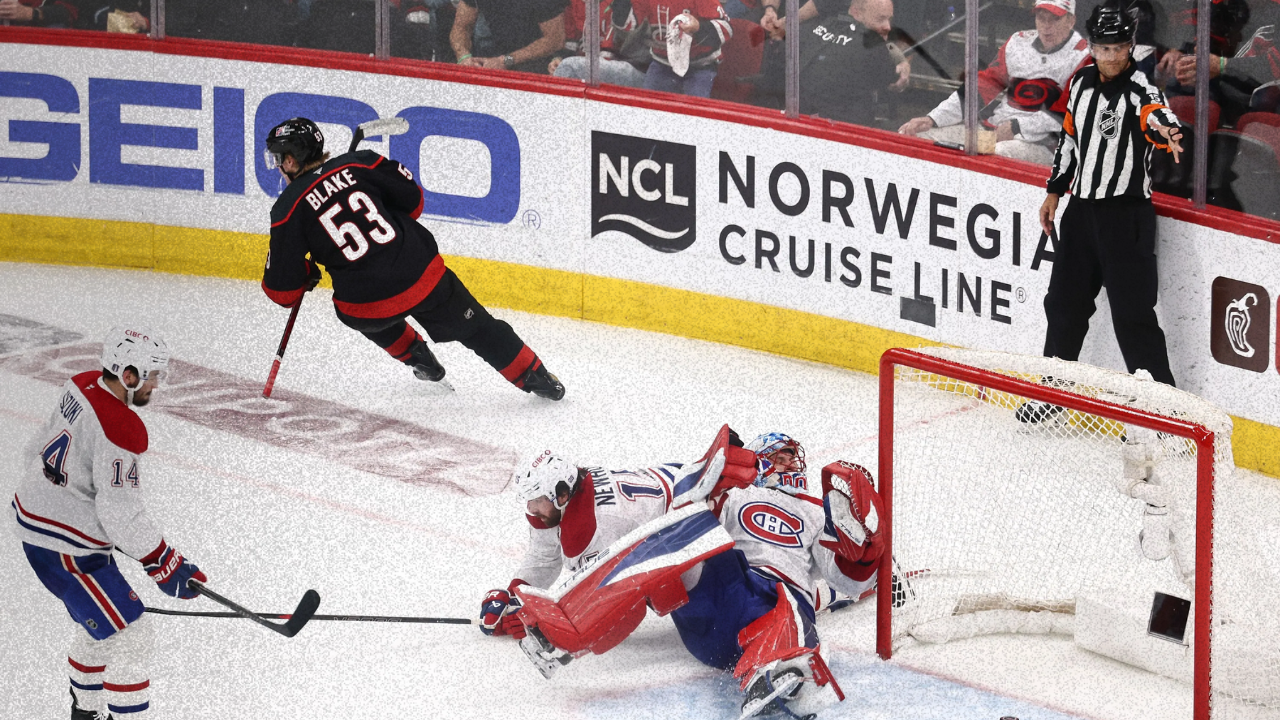
Canadiens Game 5 loss ended the run 6-1 after Carolina scored three in the first, won the series 4-1, and reached its first Final since 2006.
Taylor Hall, Logan Stankoven, and Eric Robinson scored in the first period on Friday night at Lenovo Center, Jackson Blake and Shayne Gostisbehere added second-period goals, and the Carolina Hurricanes beat the Montreal Canadiens 6-1 in Game 5 of the Eastern Conference Final. Hall and Stankoven each finished with a goal and two assists. Blake and Seth Jarvis each had a goal and an assist. Frederik Andersen made twenty-three saves. Jakub Dobes made twenty-four. Cole Caufield scored Montreal’s only goal. Carolina won the series 4-1 and reached the Stanley Cup Final for the first time since 2006.
There are playoff exits where the losing team spends the summer replaying one bounce, one missed call, one puck off a post, one line change made by a coach who will be cursed by name at every barbecue until training camp. This was not that. The Canadiens were not robbed by a cosmic clerk with bad handwriting. They were escorted out by a better team that had spent four straight games removing their oxygen one shift at a time.
Montreal’s run was too good to sneer at and too revealing to romanticize. The Canadiens went through Tampa and Buffalo, dragged a young roster deeper than anyone had a right to expect, and then ran into a Carolina team that treated the Eastern Conference Final like a long-overdue appointment with itself.
The first period ended the season
The game did not explode immediately. That almost made it worse. For nine minutes, Montreal got to inhabit the fiction that Game 5 might become something tense and survivable, some weird road elimination game where the Habs hang around on Dobes saves, annoy Carolina into gripping the stick, and make everyone in Raleigh start remembering the previous decade of conference-final trauma.
Then Hall jammed in a rebound at 9:17 after Dobes stopped Stankoven cutting in from the left circle. Montreal challenged for goaltender interference. The goal stood. Six minutes later, Hall held off Mike Matheson behind the net and fed Stankoven in the right circle. Stankoven snapped it over Dobes’ left shoulder at 15:12. At 16:52, Robinson took a William Carrier flip pass, broke in alone, settled the puck on his backhand, and slid it through the five-hole.
Three goals in 7:35. One period. Season functionally over.
It was not a fluke period in the sense people usually mean. Carolina did not throw three muffins from the state fair parking lot and watch them turn into history. The goals were exactly the kind of goals Montreal had stopped preventing: rebound pressure, work below the goal line, a clean shooter walking into space, a neutral-zone flip turning into a breakaway because the Canadiens were no longer managing the ice between desperation and panic.
Carolina’s second line ran the whole thing
The series-clinching game belonged to the Hall-Stankoven-Blake line, which sounds like the answer to a front office riddle and played like a solved math problem. Hall started the scoring, set up Stankoven, helped drive the Blake goal in the second, and finished the night with sixteen points in thirteen playoff games. Stankoven scored his team-leading ninth of the postseason, added two assists, and somehow looked both twelve years old and like the most annoying adult in the room.
That line was Carolina’s argument in miniature. The Hurricanes have structure, yes. Everyone knows about the structure. People talk about Carolina’s structure like it has its own dental plan. But Game 5 was not won by structure alone. It was won by depth players and second-line players repeatedly turning Montreal’s small mistakes into actual consequences.
Blake made it 4-0 at 7:19 of the second after Hall forced a turnover, carried through the neutral zone, drove the net, and left a rebound sitting where Blake could sweep it in. Gostisbehere made it 5-0 on a power play at 18:02, finishing at the back door off a Jarvis feed across the low slot. By then the game had stopped being a game and become a travel itinerary for the Stanley Cup Final.
The shot warning became the autopsy
Montreal’s series had been warning everyone for a week. In Game 2, the Canadiens managed twelve shots and still made it to overtime. In Game 3, they managed thirteen shots and still got two chances inside the first minute of overtime that could have changed the series. In Game 4, they got shut out and spent the third period being yelled at by their own building to shoot the puck.
Game 5 made the warning useless because the thing being warned against had already happened. Carolina outshot Montreal 167-89 in the series and scored first in all five games. That is not a trend. That is a team taking the steering wheel, the map, the aux cord, and eventually the keys.
The Canadiens’ offense did not vanish because the players forgot where the net was. It vanished because Carolina kept preventing the first useful thing from happening. Breakouts got squeezed. Neutral-zone speed got interrupted. The far-side winger waited for passes that never arrived. Lane Hutson and Mike Matheson were asked to solve pressure that arrived faster than the help did. Suzuki and Caufield had to create inside traffic that already knew their address.
At some point, shot totals stop being a stat and start being a custody arrangement.
Andersen turned the door into a wall
Frederik Andersen did not need a shutout this time because Caufield broke it on a third-period power play at 10:50. He did not need to be spectacular for sixty minutes, either. That is the luxury Carolina gave him. He needed to be steady, clean, and rude enough to deny Montreal the tiny flickers that keep a team emotionally employed in a blowout.
He did that. Twenty-three saves. One goal against. A 12-1 postseason record. The third goaltender in NHL history to win twelve of his first thirteen games in a playoff year, joining Ken Dryden in 1976 and Gerry Cheevers in 1970. If the hockey gods have a sense of comedy, they enjoy making Montreal read Dryden’s name in someone else’s goalie note.
Andersen was not the whole reason Carolina won the series, because Carolina did not need him to be the whole reason. That was the problem for Montreal. The Hurricanes got goaltending, depth scoring, special-teams damage, forecheck pressure, and enough transition punishment to make every Canadiens mistake feel pre-approved by a committee.
The Habs ran out of spring
There is a version of this article that spends 900 words telling everyone how bright the future is, and the future is bright. The Canadiens were the youngest team left. They won two Game 7s. Dobes was a playoff story before Carolina turned him into a nightly weather event. Hutson learned hard lessons in public. Caufield scored fifty-one in the regular season, then scored the last goal of Montreal’s postseason. Suzuki became a Selke-level captain who still had to spend this series trying to manufacture offense from behind a locked door.
All of that matters. None of it makes 6-1 feel poetic.
The Canadiens had already spent too much. They needed seven against Tampa, seven against Buffalo, and then five against a Carolina team that had swept Ottawa, swept Philadelphia, and arrived with more rest, more structure, and more ways to win. By the end, Montreal looked like a team that had gotten very far by being brave, fast, and young, then discovered that Carolina had a machine specifically designed to make bravery look like cardio.
Carolina finally broke through
The Hurricanes needed this series for reasons bigger than Montreal. They had been in the conference final under Rod Brind’Amour before. They had been close enough to hear the Final and far enough away to become a joke about systems hockey dying at the last hill. Then Montreal beat them 6-2 in Game 1, and all the old ghosts came back for one night, wearing little red sweaters and pretending they paid rent.
Carolina answered by winning four straight. Two in overtime, one by shutout, one by demolition. That is how a team breaks a curse without making a speech about it. It stops acting haunted and starts making the other team chase.
The Hurricanes are 12-1 in the playoffs. They have lost once since April 18. They are back in the Stanley Cup Final for the first time since Brind’Amour wore the “C” instead of the suit. That is not a narrative flourish anymore. That is the bracket.
What the ending actually means
For Montreal, the ending should hurt without becoming a referendum on the whole thing. This was not a fake run. Fake runs do not win two seven-game series. Fake runs do not get to the Eastern Conference Final. Fake runs do not leave a fan base angry at losing to Carolina instead of stunned that Carolina was even on the schedule.
The hard part is that the series also told the truth. Montreal needs more than survival offense. It needs a way to generate shots when the opponent takes away transition. It needs another layer of finishing. It needs the top of the roster to have more answers when structure beats speed. It needs to make the next run less dependent on Dobes turning into municipal infrastructure.
That is not a condemnation. It is the cost of becoming serious. The Canadiens got far enough for their flaws to be scouted, pressed, and televised every other night. Carolina did not expose them as frauds. Carolina showed them the difference between arrival and contention.
The handshake line came after a 6-1 loss, which is a lousy way to end a season and a pretty honest way to start an offseason. Montreal’s run was real. Carolina’s answer was better. The Habs spent two rounds winning the game after the game looked gone. In the Eastern Conference Final, the game finally got away and did not look back.
Sources
- NHL.com — Hurricanes cruise past Canadiens in Game 5 to reach Stanley Cup Final; Hall and Stankoven three-point nights, Andersen 23 saves, first Carolina Cup Final since 2006, May 30, 2026
- Montreal Canadiens — MTL@CAR: Game recap, Game 5; Caufield as Montreal’s lone scorer and full goal log for Carolina’s 6-1 win, May 30, 2026
- NHL.com — Hurricanes game-by-game recap on way to Stanley Cup Final; Game 5 scoring sequence and Carolina’s road through Ottawa, Philadelphia, and Montreal, May 30, 2026
- Sportsnet / Associated Press — Hurricanes defeat Canadiens in Game 5 to advance to Stanley Cup Final; first-period Hall, Stankoven, and Robinson goals, May 30, 2026
- ESPN — Canadiens vs. Hurricanes Game 5 summary and scoring log; full period-by-period scoring details, May 29, 2026