
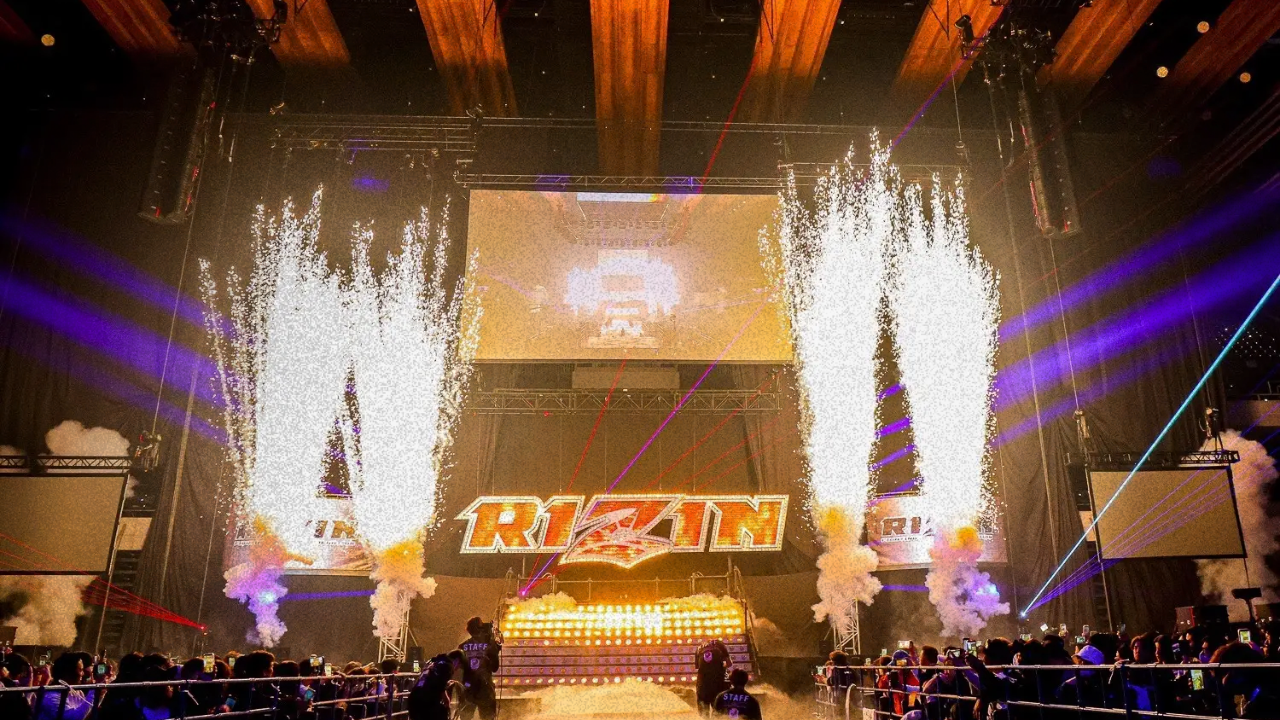
RIZIN Fighting Federation is ten years in, 79 events deep, and still built around the thing corporate MMA keeps trying to optimize out of the room.
RIZIN Fighting Federation enters the summer of 2026 as a strange living object: part fight promotion, part archive, part ritual machine, part reminder that mixed martial arts did not have to become one company, one cage, one ruleset, one broadcast grammar, and one sanctioned memory of itself.
The schedule is real. RIZIN.54 is listed for August 11 at Toyota Arena Tokyo. Super RIZIN.5 is listed for September 10 at Kyocera Dome Osaka. Sherdog currently lists the promotion at 79 events and roughly 815 matches. The Japan Heavyweight Grand Prix is scheduled to begin at RIZIN.54, with Tsuyoshi Sudario, Mikio Ueda, and King Edokpolo among the announced names. Heavyweight tournaments are never clean things. That is one of the reasons they remain spiritually useful.
That is the factual version. The more honest one is that RIZIN should not really exist like this. Japanese MMA was supposed to have been swallowed, bought, archived, and turned into a nostalgia category for people who miss soccer kicks, elaborate walkouts, and production values that treated a fight card like a weather system. PRIDE died. DREAM faded. The UFC won the market. The cage became the sport’s default architecture.
Then Nobuyuki Sakakibara came back, named a promotion after thunder and rising, put a ring back in the middle of the room, and kept insisting that MMA could still feel like something stranger than a quarterly earnings call in gloves.
MMA was not born in one place
Everyone wants an origin story because origin stories are cleaner than fight history, and fight history is not clean. It is a pileup of martial artists, pro wrestlers, jiu-jitsu families, promoters, cable executives, athletic commissions, legislators, gamblers, gangsters, and men in bad suits trying to decide whether knees to a grounded opponent counted as civilization.
Was MMA born in Brazil, where vale tudo and jiu-jitsu made style-versus-style fighting feel like family business? Was it born in Japan, where pro wrestling, judo, karate, shoot-style experimentation, and combat philosophy had been cross-contaminating for decades? Was it born in the United States, where the UFC took the whole thing, added pay-per-view, scandal, state panic, and a brand identity?
Yes. Also no. MMA was never one invention. It was a traffic accident between cultures that all thought they owned violence.
The UFC arrived in 1993 with few rules, no real apology, and the exact energy of a country that had just been told history was over and responded by putting a karate fighter, a sumo wrestler, and a Brazilian jiu-jitsu evangelist in the same bracket. John McCain later helped turn early MMA into a political target by calling it “human cockfighting.” States banned events. Cable companies backed away. The sport was legally unstable, commercially embarrassing, and alive in the way regulated products rarely are.
The chaos mattered because it proved something before the sport had language for itself. Fighting was not only brutality. It was an argument about bodies, systems, training, fear, rules, belief, and hierarchy. The problem was that North American institutions wanted the argument cleaned up before they would let it be sold.
Kahnawake kept the door open
On April 26, 1996, Battlecade Extreme Fighting 2 took place at Kahnawake Sports Complex, on Mohawk territory outside Montreal. Tapology lists six MMA bouts on the card. The event was not a footnote as much as a trapdoor. North American MMA needed places where the official sporting order could not quite close its hand around the sport, and Kahnawake became one of those places.
Battlecade’s Kahnawake card also gave Carlos Newton his professional debut. He was 19 years old. He faced Jean Rivière, who outweighed him by a ridiculous amount. CombatReg lists Rivière beating Newton by submission due to exhaustion at 7:47 of the first round. There are cleaner ways to start a career. There are very few more honest ones.
Newton lost because early MMA still had the cruel laboratory logic of a sport not yet sure what weight classes were supposed to protect. A teenager with elite grappling could be fascinating, talented, and still get buried under physics. The promise was visible anyway. The sport had not yet built the right box for him, so he did what a lot of the right fighters did. He went to Japan.
The Kahnawake night matters because it shows what MMA was before the sales department got custody. It was legally precarious, improvisational, and dependent on spaces the official sporting order did not control. A sport treated as too rough for polite jurisdictions found room on Indigenous land because state authority had limits there. MMA has never fully outrun that image, and it probably should not try.
Japan did not just host MMA
Japan was not merely a destination for fighters who needed bookings. It was the place where MMA could become theatrical without becoming embarrassed by itself. PRIDE Fighting Championships took the athletic question and wrapped it in entrances, lights, mythology, drums, long walks, terrifying rule sets, and crowds that somehow understood both the violence and the craft.
Newton fit there because he was exactly the kind of fighter Japan rewarded: technical, strange, brave enough to accept bad ideas, and good enough to make those bad ideas feel like research. In June 1998, he faced Kazushi Sakuraba at PRIDE 3 at Nippon Budokan in Tokyo. Tapology lists Sakuraba winning by kneebar at 5:19 of the second round. The loss still became part of Newton’s legend because the fight looked like two grappling artists arguing in a language the UFC had not yet learned to subtitle.
Sakuraba beating Newton was not just a result. It was an early marker of the Japanese MMA imagination. A pro-wrestling icon could become a legitimate Gracie hunter. A Canadian prospect could become part of the same lineage. A fight could be both sport and artifact, both competition and evidence that MMA had an aesthetic life beyond the win column.
Newton eventually became UFC welterweight champion by submitting Pat Miletich at UFC 31. His first title defense ended in the famous Matt Hughes slam at UFC 34, where Newton had Hughes caught in a triangle before the whole thing became a physics demonstration with a referee. The mythology around that finish has never fully gone away because it contains early MMA in one frame: a champion with the choke, a challenger lifting through blackout danger, a slam, confusion, a belt changing hands, and the sport pretending the rulebook had been ready for the moment. It had not. It rarely was.
PRIDE died and something went with it
PRIDE did not simply lose a promotional war. It collapsed under the kind of business mess that makes fight sports feel less like sport than a series of locked rooms where nobody agrees who owns the door. Reporting on PRIDE’s final years has traced the collapse through allegations of yakuza connections, the loss of the Fuji Television deal, the failed push into the American market, and Zuffa’s eventual 2007 purchase of PRIDE’s assets.
The fighters moved. The tape library survived. The name became nostalgia. DREAM tried to carry some of the atmosphere forward, then faded too. The country that had given MMA its greatest theatrical stage went quiet at the highest level for years.
Secret Base’s Fighting in the Age of Loneliness, written and narrated by Felix Biederman and produced and directed by Jon Bois, understood what had been lost better than most straight fight histories. It treated MMA as refuge, bloodsport, business scam, loneliness machine, and cultural weather system all at once. PRIDE was not innocent in that story. It was never innocent. That was part of why it mattered.
The UFC consolidation gave MMA legitimacy, stability, rankings graphics, cleaner rules, corporate partners, and a much better chance of being watched by your dad without him asking whether this was legal. It also sanded down the sport until too many events risked feeling like content management with elbows.
The cage won. The ring became a memory. The walkouts got shorter. The tournaments became rare. The weirdness had to find somewhere else to live.
Sakakibara brought back thunder
Sakakibara had run PRIDE. After the Zuffa sale, he sat out under a non-compete and did not immediately return to the sport. Then RIZIN appeared in 2015, not as a clean reboot, because clean reboots are for streaming services and cowards, but as a deliberate act of continuity.
The name did a lot of work. Raijin points to the Japanese thunder god. Rising gives the promotion its motion. The whole thing sounds like a mythological weather emergency, which is much more honest than calling a fight company something bland like Elite Combat Series 12.
RIZIN’s first major run came across the end of 2015 at Saitama Super Arena, with Fedor Emelianenko headlining on New Year’s Eve. Sakuraba fought Shinya Aoki on December 29 and lost. He was not there because the matchup made competitive sense in the sterile spreadsheet way. He was there because the promotion was making a public claim about lineage.
Sakuraba’s presence said the dead had been acknowledged. It did not say the past was coming back unchanged. PRIDE was gone. Nobody could unsell it. Nobody could make 2003 reappear with a fog machine and a contract dispute. RIZIN was doing something more interesting. It carried the remains forward without pretending the body was still breathing.
The federation idea matters
Sakakibara has been clear that RIZIN was not built to become another UFC rival. In 2023, he told MMA Mania that doing the same thing as the UFC made no sense because the UFC was already established. The original idea was a federation: a platform where promotions could collaborate instead of simply trying to eat one another.
That philosophy matters because it is the anti-UFC move without pretending to be fake-rebel about it. The UFC’s genius is centralization. It wants the roster, the history, the archive, the rules, the broadcast window, the belt, and the official memory. RIZIN’s premise is more porous. Fighters cross over. Rules differ. Events breathe differently. The ring changes the geometry. The audience is allowed to feel like the show belongs to something older than the sponsor deck.
Bellator vs. RIZIN on New Year’s Eve 2022 made that idea visible. The event put fighters from both promotions against each other at Saitama Super Arena under RIZIN’s ruleset. It was not perfect. Cross-promotion never is. But it remembered something the UFC business model prefers everyone forget: other fight worlds can meet without one of them having to become a corpse.
RIZIN’s stubborn continuity also exposes the point made by the UFC’s Japanese inheritance. The UFC tried to absorb PRIDE as property, but it could not absorb all of its meaning. Fighters, aesthetics, entrances, tournament ideas, and the basic thrill of Japanese MMA kept leaking back into the sport.
The present is not nostalgia
RIZIN is not only selling old men their PRIDE DVDs back with better streaming compression. It is active, current, and busy enough that calling it nostalgia misses the sport happening in front of everybody. RIZIN.TV is the international streaming home. Sherdog lists 79 events and about 815 matches. RIZIN’s official schedule lists RIZIN.54 for August 11 at Toyota Arena Tokyo and Super RIZIN.5 for September 10 at Kyocera Dome Osaka.
RIZIN’s official page lists Super RIZIN.5, Naniwa No Chou Fukkatsu Matsuri, for September 10 at Kyocera Dome Osaka. That booking is not small. A dome show is a declaration that this thing still wants scale, spectacle, and the kind of event that makes combat sports feel closer to weather than programming.
RIZIN.54 is carrying the Japan Heavyweight Grand Prix. Cageside Press reported that the tournament begins August 11 at Toyota Arena, with Tsuyoshi Sudario, Mikio Ueda, and King Edokpolo announced among the field, and a November final planned. Heavyweight tournaments are almost always at least 28 percent nonsense. That is not a flaw. It is one of their load-bearing features.
Patchy Mix getting stopped by Kyoma Akimoto at RIZIN.52 in March 2026 also matters because it broke the usual American sorting machine. A former Bellator champion arrived, and the Japanese ring did not politely validate his resume. It ate him in the second round with punches and soccer kicks. That is what a real fight ecosystem does. It ruins imported assumptions on contact.
The ring changes the sport
The ring is not a cosmetic choice. It changes the sport’s grammar. Cages reward certain pressures, certain fence-wrestling habits, certain kinds of containment. The ring creates different problems. Corners matter differently. Ropes change clinches. Resets interrupt some forms of control and reward other forms of danger. The fight looks less like an optimized control surface and more like a stage that occasionally tries to betray everyone involved.
RIZIN’s official rules describe a roped ring as part of the promotion’s format and allow soccer kicks, stomps, and knees to the head of grounded opponents within its MMA rules. That is not just a different rulebook. It is a different risk environment. The geometry, permissions, and pacing produce situations the UFC’s standardized model usually avoids.
Sometimes that creates brilliance. Sometimes it creates chaos. Sometimes it creates the kind of card where everyone online asks whether the matchmaker should be given a medal or a wellness check.
Combat sports have always needed that edge. The cleanest version of a fight is not always the truest version. Ritual combat has never been only about determining who is better at hurting another person under rules. It is about pageantry, fear, identity, hierarchy, release, and the crowd agreeing for one night that danger can mean something.
RIZIN understands that. The UFC often understands it too, then hides that understanding under corporate seriousness because the machine needs to look adult while selling blood to advertisers. RIZIN has the good manners to be ridiculous in public.
What RIZIN does not fix
None of this makes RIZIN pure. Fight nostalgia has a bad habit of turning every non-UFC promotion into a moral alternative, as if the absence of Dana White automatically grants labor justice, spiritual clarity, and affordable concessions. It does not. RIZIN is still a fight promotion. Fighters still absorb the risk. Promoters still sell the danger. The market still shapes what gets made.
The UFC’s domination remains the big economic fact of MMA. It controls the highest-profile belts, most of the global attention, and the sport’s mainstream institutional memory. RIZIN cannot fix fighter classification, pay distribution, health risk, or the fact that MMA became another industry where athletes bleed first and negotiate later.
What RIZIN can do is keep a different value system alive inside the same bad world. That is not nothing. The sport does not only need better contracts, although it absolutely needs those. It also needs places where the imagination has not been fully colonized by efficiency.
RIZIN keeps saying a fight card can still be a festival, a bracket can still be a story, a ring can still matter, and a promotion can collaborate without treating every other company as prey. That is not revolution. It is maintenance of a fire that very rich people tried to put in a branded lantern.
Pride never die was not nostalgia
“Pride never die” became a joke, a chant, a meme, and eventually a kind of prayer. The grammar was broken because the feeling was not. People were not saying the company still existed. They were saying something in PRIDE had survived the company’s death and the UFC’s archive purchase.
RIZIN is the best proof that they were right. Not because it recreated PRIDE. It did not. Recreating PRIDE would be impossible and probably illegal in at least six emotional jurisdictions. RIZIN matters because it understood that the inheritance was not the exact card structure, exact rule set, or exact cast of beautiful maniacs. The inheritance was the belief that MMA could still feel huge, strange, collaborative, theatrical, and human.
Carlos Newton’s career makes sense inside that lineage. Kahnawake, Japan, Sakuraba, UFC gold, the Hughes slam, PRIDE recognition, and the long strange road after. He belongs to the era before the sport knew how to flatten its own weirdness. RIZIN belongs to the era after the flattening, trying to keep one part of the map folded wrong on purpose.
The sport got monetized into meaninglessness in plenty of places. RIZIN did not stop that. It just refused to admit that meaning had nowhere left to live.
Ten years in, with a heavyweight tournament on the way and a dome in Osaka waiting, RIZIN is still standing there with thunder in its name and a ring in the middle of the room. It is not the biggest thing in MMA. It might still be the thing that remembers why any of this felt alive in the first place.
Sources
- Sherdog — RIZIN Fighting Federation promoter page; current event count, match total, and upcoming-event listing
- RIZIN Fighting Federation — RIZIN.54 official event page; August 11, 2026 date and Toyota Arena Tokyo venue, April 12, 2026
- RIZIN Fighting Federation — Super RIZIN.5 official event page; September 10, 2026 date and Kyocera Dome Osaka venue, April 18, 2026
- Cageside Press — Four Man Heavyweight Grand Prix Announced, Launches at RIZIN 54; August 11, 2026 tournament start at Toyota Arena, April 23, 2026
- Tapology — Battlecade: Extreme Fighting 2 event page; April 26, 1996 Kahnawake card and event details
- CombatReg — Extreme Fighting 2 results; Jean Rivière defeated Carlos Newton by submission due to exhaustion at 7:47 of Round 1
- Kahnawà:ke official website — Kahnawà:ke as one of several communities that comprise the Mohawk Nation
- Tapology — Kazushi Sakuraba vs. Carlos Newton at PRIDE 3; Sakuraba kneebar result, June 24, 1998, Nippon Budokan, Tokyo
- UFC.com — Defining Matt Hughes; UFC 34 Hughes vs. Newton finish and triangle/slam context
- Sherdog — MMA Roots: The Last Days of Pride Fighting Championships; Fuji TV loss, yakuza allegations, Las Vegas shows, and Zuffa purchase context, January 19, 2026
- ESPN / Associated Press — Source: UFC buys Pride for less than $70M; March 27, 2007
- SB Nation / Secret Base — Fighting in the Age of Loneliness; Felix Biederman and Jon Bois documentary series on MMA history, PRIDE, UFC consolidation, and the sport’s cultural meaning
- MMA Mania — Sakakibara interview on RIZIN as a federation model and why he did not want to build a UFC rival, October 12, 2023
- RIZIN Fighting Federation — Official rules page; ring format, MMA rounds, judging criteria, soccer kicks, stomps, knees to grounded opponents, and elbow rules
- Cageside Press — RIZIN 52: Akimoto vs. Mix Full Results; Kyoma Akimoto defeated Patchy Mix by TKO via punch and soccer kicks, March 2026
- Tapology — RIZIN 54 event page; August 11, 2026 date, Toyota Arena Tokyo venue, and ring enclosure
- Tapology — Super RIZIN 5 event page; September 10, 2026 date, Osaka location, and ring enclosure