
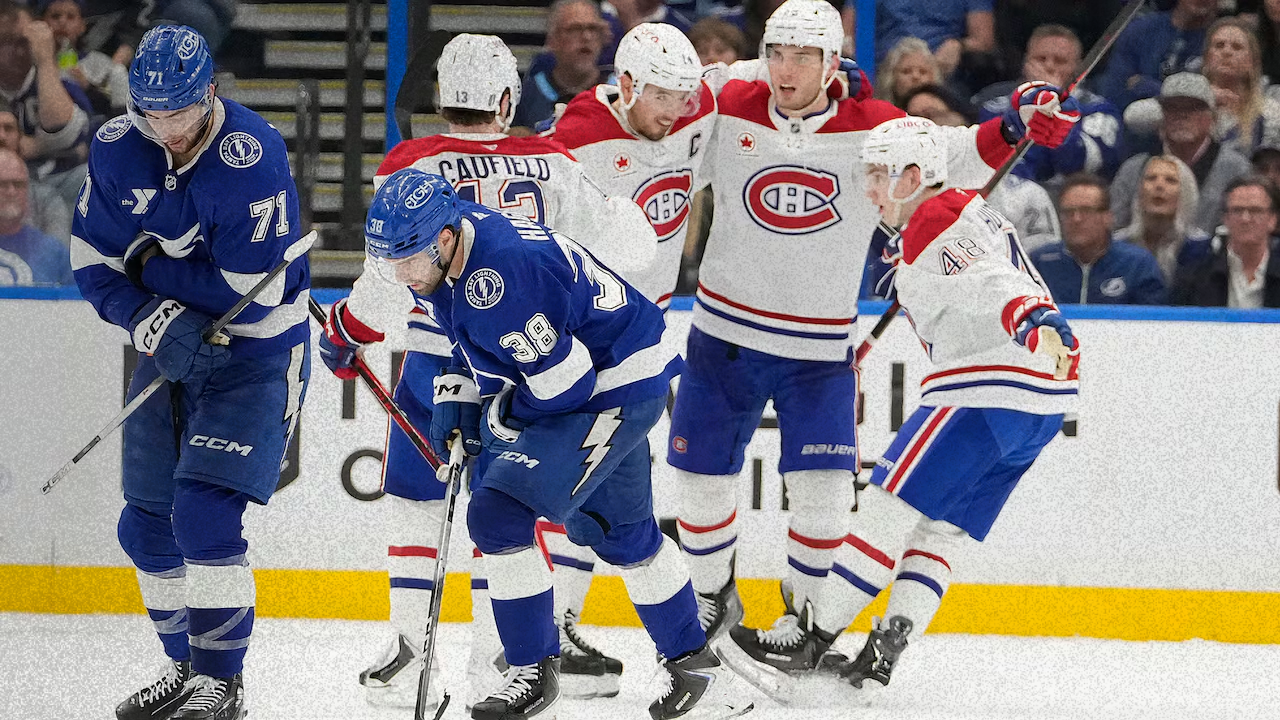
Habs power play in Tampa scored three times from a structural overload that read Tampa’s penalty kill adjustment and punished it at the back post.
Three power play goals don’t happen by accident
The story of Game 1 was written by the Habs’ man-advantage unit, and the broadcast knew it. Three of Montreal’s four goals came on the power play, all from Juraj Slafkovsky, and the structure that produced them was visible across every sequence.
Tampa Bay made a tactical adjustment after Slafkovsky’s first goal — collapsing harder to cut off the primary shot lane — and Montreal read it. The back-door slide that produced the second power play goal was not improvisation. It was a player knowing exactly where he would be before the pass arrived, because the structure of the play told him.
That is what separates a functioning system from a roster of talent hoping something breaks right. The formation itself is worth breaking down. What the broadcast described as a four-man triangle with a floater was not accidental geometry. It is a deliberate overload structure that forces the penalty-killing unit to choose: collapse the strong side and surrender the weak-side back door, or hold width and give up the one-timer. Montreal’s execution forced that choice and punished the answer.
Slafkovsky’s three-goal night was the product of that structure, not despite it. He shot seven times and converted on three of them, all from the man advantage. Nick Suzuki ran the operation from the dot, picking up two assists — including the overtime helper — while winning 71% of his faceoffs. Cole Caufield contributed two power play assists, distributing from the perimeter to the spots Tampa’s adjustment opened up. The unit went 3-for-5 with the man advantage and produced ten shots from those five opportunities.
Talent is the raw material, system is productive
This is the materialist read on what Montreal is building. The broadcast commentary landed on it almost by accident: they have so much talent, but the difference is the details of how they play. That is the whole analysis, stated and then immediately abandoned in favour of highlight enthusiasm. The details are not decoration on top of talent. The details are the productive force.
Caufield is not dangerous because he can shoot. He is dangerous because the system creates the conditions where his shot is the logical endpoint of every sequence the team builds. Slafkovsky scoring three power play goals against Andrei Vasilevskiy is not a fluke of individual brilliance. It is what happens when the structural overload puts the goalie in an unwinnable read, every shift, for five power play opportunities. The puck arrives at the spot the structure created. The player at that spot shoots.
Lane Hutson’s defensive work in the final minutes — tracking back to cut the slot, denying the high-danger chance in tight — is the same principle applied in the other direction. Defensive structure is not reactive scrambling. It is preemptive positioning based on reading what the system tells you the opponent will try. The hustle was the execution of a read, not a panic response.
Cooper Tampa tenure is continuity, not mythology
The broadcast made much of John Cooper’s tenure as Tampa’s coach, which by now is 13 years — Cooper took the job in March 2013. The instinct to frame this as personal longevity is the wrong lens. Cooper matters because Tampa Bay built an institutional structure around a coaching philosophy and then held it through the league’s normal churn toward short-termism.
The franchise’s willingness to keep a system intact across a decade-plus is what produced the Cup runs, not Cooper’s individual genius. The system is the story. The coach is the point of continuity who makes the system legible from year to year. The 2020 and 2021 Cups belong to that institutional commitment. They do not belong to the cult of personal greatness the broadcasts always reach for.
One factual correction the broadcast did not catch. Cooper was never an NHL player and had no connection to Tampa’s 2004 Stanley Cup as a player. He came to the NHL from minor-league coaching after a career as a lawyer. The 2004 Cup belongs to that roster — Dave Andreychuk, Vincent Lecavalier, Brad Richards, Martin St. Louis, Nikolai Khabibulin — not to a coach who arrived nearly a decade later. Conflating the two collapses distinct institutional eras into a personal narrative, which is exactly the kind of history the mythology machine prefers.
Dick Irvin Sr. understood what the system required
The historical detour into Dick Irvin Sr. during the second-period intermission was the most interesting segment of the broadcast, and it deserved more than passing anecdote. Irvin coached Montreal from 1940 to 1955 — fifteen years — won three Stanley Cups in 1944, 1946, and 1953, and is correctly credited with grooming Maurice “Rocket” Richard through Richard’s formative years in the league.
That mentorship was not sentiment. Irvin recognized in Richard a player whose intensity and positioning instincts could be channelled by a system that gave him the right entry points. Richard did not become the Rocket in spite of Irvin’s coaching structure. He became the Rocket inside it. The greatest Quebecois athlete of the twentieth century was the product of the same kind of institutional commitment Montreal is now trying to rebuild around Slafkovsky and Suzuki.
The 1915 framing the broadcast offered — a debate over whether Hobey Baker or Irvin was the greatest player in the world — is plausible in spirit. Both were dominant figures in the pre-NHL era, and Baker’s legacy is institutionalized in the NCAA’s annual award for the top men’s collegiate player, bearing his name since 1981.
The specific claim about Irvin scoring in a 9–2 game against Winnipeg for a city team is oral history more than documented record. What is documented is that Irvin’s playing reputation was substantial enough to anchor his Hall of Fame case before his coaching record made it unassailable.
Where this leaves the Habs heading home
The Canadiens’ rebuild has been framed in the hockey press almost entirely through the individual development arc. Caufield’s shot. Suzuki’s reads. The defensive maturation of the back end. That framing is insufficient. What Game 1 demonstrated is that Montreal is developing system coherence, not just individual talent. The power play geometry, the back-door reads, Hutson’s positional discipline in the final minutes — these are markers of a team learning to trust collective structure over individual improvisation.
That is the harder thing to build. It is also the thing that turns a talented young roster into a team that can win when the opponent adjusts. Tampa adjusted. Montreal read the adjustment and punished it. The structural overload kept producing three-on-twos and back-door looks every time Tampa committed to one side. The result was a 4-3 overtime win in a building where Montreal was supposed to be a sacrifice.
That is not luck. That is what a system looks like when it is working.