
Bad Bunny’s Super Bowl halftime show wasn’t revolutionary or un-American. It showed how U.S. power absorbs difference without conceding autonomy.
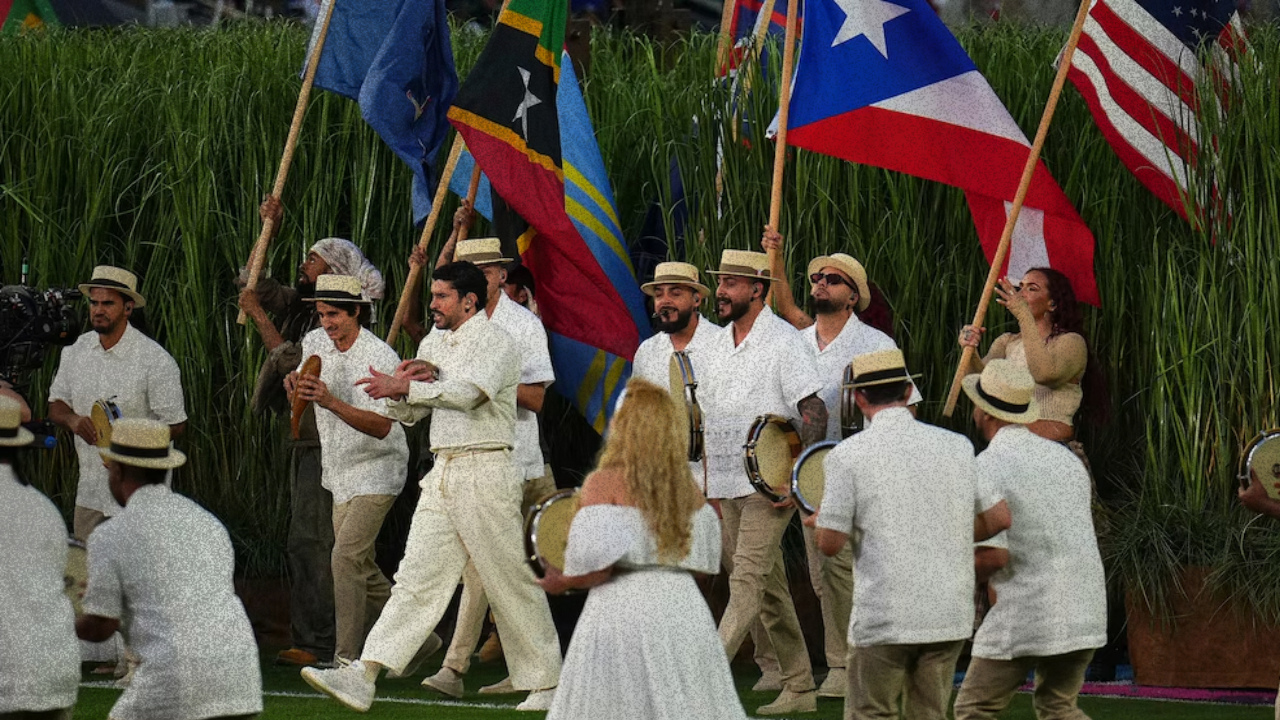
On February 8, at Levi’s Stadium in Santa Clara, Benito Martínez Ocasio — Bad Bunny — performed the first Super Bowl halftime show conducted almost entirely in Spanish. For thirteen minutes, he walked through sugar cane fields, climbed a power line, hosted a wedding, brought out Lady Gaga and Ricky Martin, and closed by naming every country in the Americas before holding up a football that read “Together We Are America.” The crowd was 128.2 million people. The NFL’s most-watched ritual had just hosted something it had never hosted before.
Donald Trump posted on Truth Social within minutes. “Absolutely terrible, one of the worst, EVER,” he wrote. “An affront to the Greatness of America.” He said the dancing was “disgusting, especially for young children,” that “nobody understands a word this guy is saying,” and called the whole thing a “slap in the face to our Country.” Turning Point USA had already held a counter-programming event on the same night, featuring Kid Rock. California Governor Gavin Newsom had declared it Bad Bunny Day, called the show “beautiful,” and posted “America, the beautiful. THANK YOU, BAD BUNNY” on social media.
The political fracture formed before the first beat dropped. That fracture is the actual subject of this piece.
What the Super Bowl Is
The Super Bowl halftime show is not a concert. It is the most tightly managed cultural ritual in the United States — a corporate mass ceremony built to absorb difference, smooth contradiction, and translate identity into brand value. It exists to launder power through celebration. The halftime show does not challenge the system that hosts it. The only meaningful question is how the system metabolized what it chose to host.
The show is, in the terms of cultural theory, a pressure valve. Empire does not require cultural consensus to maintain control. It requires recognition without autonomy — expression without consequence, joy without structural change. Multicultural spectacle is not the opposite of imperial power in the American context. It is one of its most effective operating systems.
The structural history of how sports became that operating system — how leagues, broadcast deals, and nationalist ritual were assembled into infrastructure that converts cultural expression into state legitimacy — is examined in the analysis of sports as infrastructure powering capital and state.
The Liberal Misread
When liberals saw the Spanish-language set, the flags from across the Americas, the song about colonial dispossession in Puerto Rico — when they saw Ricky Martin performing “Lo Que Le Pasó a Hawaii”, a track that draws a direct parallel between gentrification in Puerto Rico and displacement in Hawaii — many experienced that as a breach in the social order. Not because it actually disrupted power, but because it violated their expectation of how inclusion is supposed to look.
In the dominant liberal narrative, difference is acceptable when framed as aspiration, as gratitude, or as arrival. When it appears as continuity — as the unbroken persistence of a people who never asked permission — it feels transgressive. That is why the performance got misread as revolutionary. It violated the progress narrative liberals use to tell a story about themselves.
Jacobin, writing from the left, called the performance “political art at its best” and “a gesture of defiance toward the xenophobia of Donald Trump’s base.” That framing is understandable as political solidarity, but it does analytical work it cannot support. Defiance that reaches 128 million people through an NFL broadcast, sponsored by Apple Music, with league approval and a Jay-Z-affiliated booking agency, is not defiance in any structural sense. It is a performance the system selected, scheduled, and distributed.
Calling it resistance does not describe it accurately. It describes the liberal desire to find resistance in it.
The mechanics of that desire — symbolic participation substituting for material intervention, emotional release displacing structural challenge — are examined in the analysis of Stand Up to Cancer as sponsored spectacle, which documents how sports charity rituals channel dissatisfaction into market-driven compassion rather than leverage.
The Right Misread
The conservative reading is also wrong, and in a different way. Trump’s claim that the performance was un-American collapses the moment you note that Puerto Rico is a US colony and has been since 1898 — that its people are US citizens, that the island’s electrical grid failed catastrophically after Hurricane Maria while the federal government delayed its response, and that approximately 41 million people in the United States speak Spanish at home. The performance did not sneak a foreign language into an American institution. It broadcast the language of tens of millions of Americans at American Americans, and a significant portion of them did not want to hear it.
That is not a cultural invasion. It is a demographic reality the right is trying to suppress through policy and through the symbolic politics of complaining about a halftime show.
The TPUSA alternative event — Kid Rock on a streaming platform, watched by roughly four million people against the broadcast’s 128 million — was not a counter-culture. It was a monument to the gap between the country’s demography and one faction’s nostalgia for a country it invented.
The right treats the halftime show as pure ideology — as if anything appearing inside American mass culture must automatically affirm American dominance or represent an attack on it. That assumption underestimates how unstable the platform has become. The NFL’s halftime show is not an ideological transmission. It is a market calculation, and the market’s calculation is that 70 million Latinos are a consumer base worth addressing.
What the Performance Actually Did
The most analytically interesting thing about Bad Bunny’s set was not that it opposed empire. It did not. It was that it refused some of the rituals of translation.
The show did not explain itself to a dominant audience. It did not apologize for performing in Spanish or contextualize its political references for viewers unfamiliar with them. The power line sequence — dancers pretending to fix Puerto Rico’s collapsed grid while Bad Bunny climbed to the top — was not accompanied by a subtitle or a tearful speech about resilience. “Lo Que Le Pasó a Hawaii” was performed by Ricky Martin without annotation. If you knew the song, you knew what it meant. If you did not, you watched something you could not fully read.
Empire prefers difference that can explain itself — a difference that can apologize for itself, resolve itself into loyalty, and confirm the host’s generosity by arriving properly grateful. When something appears inside one of its most sacred rituals and refuses to do that, the system can still absorb it. But only at the cost of revealing its own limits of comprehension.
The colonial dispossession framing that structured the Puerto Rico and Hawaii references — and why sport has historically been a site where that history surfaces and gets managed — is examined in the analysis of decolonizing hockey and Canada’s national story.
The NFL hosted a Spanish-language set, Caribbean joy, and references to colonial dispossession. What it cannot easily host is unresolved tension — which is why the liberal commentary immediately moved to resolve it. By calling the show revolutionary, commentators neutralized its ambiguity. They folded the performance back into a story where empire is learning, progressing, becoming more inclusive, and therefore more legitimate. In that story, no further demands are necessary. The spectacle becomes the victory.
The Wider Frame
For audiences watching the same broadcast from inside the consequences of the empire those flags represented, the spectacle carries a different weight. Multicultural celebration does not stop the bombing. It does not dismantle an occupation or protect people from state violence. The disconnect between the celebration and the material is not incidental to the ceremony — it is the ceremony’s function. The halftime show is not simply a distraction from material struggle. It is a demonstration of how cultural management now operates inside the imperial core.
The system no longer insists on uniformity. It insists on containment. It no longer needs to suppress difference outright. It needs to ensure that difference does not become autonomy — that visibility does not turn into social leverage.
Bad Bunny’s halftime set sits in an uncomfortable position. It was not resistance. It was not liberation. It was a demonstration of how empire now consolidates through inclusion rather than exclusion — while still leaving cracks where the belief does not fully take hold.
The argument is not that the halftime show should be celebrated or condemned. The argument is that it should be understood. The liberals are wrong because they confuse representation with power. The conservatives are wrong because they believe the empire they imagine they’re defending is coherent and legible. It is neither. Power is strong enough to host what it does not believe in. It is not strong enough to make everyone believe in it.
That unresolved tension — between the joy on the field and the conditions that produce it — is the actual content of what happened at the Super Bowl.