
The silence after Renée Nicole Good’s killing shows how quickly social conscience in sports collapses when domestic state power, risk, and enforcement collide.
On January 7, federal agents from Immigration and Customs Enforcement shot and killed Renée Nicole Good, a U.S. citizen and mother of three, during an ICE operation in Minneapolis.
The killing was recorded on video. Footage of the shooting circulated widely the same day.
By the following morning, national outlets had published biographical profiles of Good and detailed reporting on the incident. The event was neither obscure nor ambiguous. It entered public consciousness immediately and forcefully.
What followed was not outrage but quiet. Across professional sports, where public responses to injustice have become routine, there was no immediate wave of statements, no coordinated league acknowledgments, and no visible mobilization by high-profile athletes.
This absence was notable precisely because it deviated from established behavior.
In recent years, athletes have responded quickly and publicly to incidents with far less documentation and far less institutional visibility. In this case, the silence itself became the defining feature.
The relevant question is not whether athletes noticed what happened. It is why, having noticed, most chose not to speak.
Visibility Without Permission
By any conventional measure, the killing of Renée Nicole Good was maximally visible. Video evidence circulated within hours.
National news coverage followed almost immediately, including reporting on Good’s life, family, and work. There was no delay that would normally justify hesitation or uncertainty.
Athletes did not lack information. This was precisely the type of event that typically generates rapid response: a named victim, visual documentation, and a clear narrative frame.
In previous cases, athletes have posted statements within hours of similar incidents, often before full details were known.
The absence of response here cannot be explained by ignorance or confusion. It can only be explained by constraint. Visibility was present. Permission was not.
Why ICE Is Untouchable
Criticism of ICE occupies a different category than most forms of public dissent. ICE is not an abstract symbol of injustice or a distant authority.
It is a federal enforcement agency embedded at the core of domestic “law and order” politics, actively defended by elected officials, federal institutions, and a well-aligned media ecosystem.
This reality was visible almost immediately after the shooting. Within hours, federal officials and allied commentators began framing Renée Nicole Good as threatening.
The term “domestic terrorist” entered public discourse before any independent investigation had concluded. The narrative moved rapidly away from the fact of the killing and toward its justification.
This was not an accidental framing error. It was a defensive maneuver designed to establish institutional legitimacy early and raise the cost of dissent.
Once the state defines the terms of debate, anyone who challenges those terms risks being framed as irresponsible or dangerous.
For an athlete, intervening under those conditions is not symbolic speech. It is direct confrontation with domestic enforcement power. That distinction matters because confrontation carries consequences that symbolic gestures do not.
Smear as Deterrence
The post-shooting treatment of Renée Nicole Good functioned as a deterrent in real time. Rather than centering the act of lethal force, official narratives emphasized alleged threat, instability, and extremism.
The victim was made morally suspect, and the killing was framed as necessary. This reframing occurred quickly enough to shape the entire discourse around the event.
This pattern is familiar. By undermining the legitimacy of the victim, the state raises the cost of solidarity. Anyone who speaks in defense risks being associated with the same framing. The issue shifts from accountability to reputational risk.
Athletes do not need to speculate about how this works. They have watched similar dynamics unfold repeatedly. Once a person or cause is labeled dangerous, association becomes a liability.
Sponsors withdraw. Media narratives harden. The language of justice is replaced by the language of “brand safety.”
The speed of this process matters. It left little room for neutral or compassionate speech. Silence, under these conditions, is not confusion. It is risk management.
What Was Said, and What Was Avoided
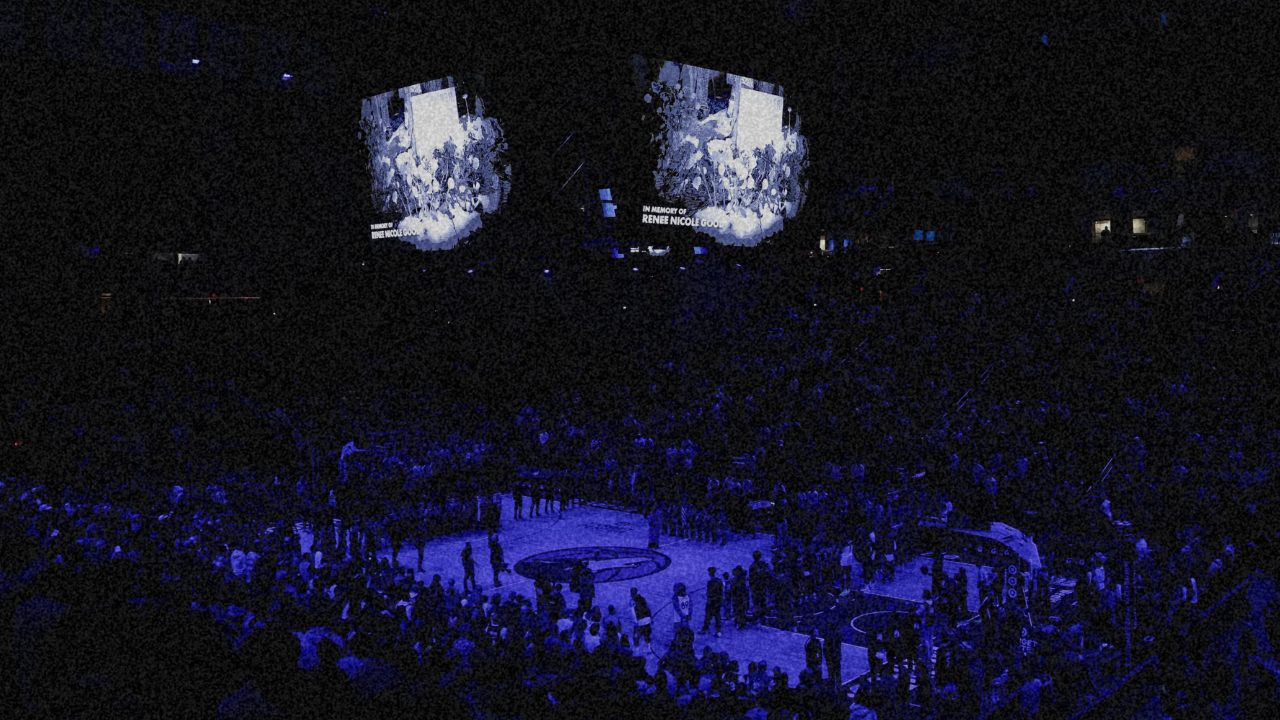
When responses from the sports world did occur, they followed a consistent pattern. On January 11, the Minnesota Timberwolves held a moment of silence before a game.
The gesture acknowledged the death without assigning responsibility. It named no institution and made no claim about injustice.
Later in the month, the Timberwolves issued a statement calling for unity and compassion, again avoiding any reference to ICE as an institution or to the shooting as unjust. The language was carefully non-confrontational.
The National Basketball Players Association eventually released a statement saying that players could no longer remain silent and referencing the fatal shooting by ICE.
This was one of the most explicit institutional responses, and it arrived weeks after the killing, once the initial narrative battle had largely stabilized.
A small number of individual athletes and coaches spoke publicly. Their statements were treated as noteworthy precisely because they were exceptions. They were compiled into roundups rather than forming a collective response.
What did not happen is as important as what did. There were no league-wide statements naming ICE. There was no coordinated athlete action. Renée Nicole Good’s name rarely appeared in direct condemnation of federal enforcement policy. Even symbolic gestures were carefully stripped of attribution.
The boundary was clear.
The Narrow Lane of Acceptable Activism
Athlete activism is often framed as a question of courage or moral clarity. In practice, it operates within a tightly constrained set of expectations that are widely understood, even if they are never formally articulated.
Athletes are permitted to express sympathy. They are permitted to speak in general terms about justice, healing, and unity. They are permitted to participate in rituals that acknowledge harm without assigning blame.
They are not permitted, without significant professional risk, to name domestic enforcement institutions as unjust while those institutions are actively defending themselves. Calling the shooting unjust in real time would have crossed that line. Naming ICE as culpable would have crossed it decisively.
The responses that occurred stayed safely within the permitted lane. The responses that did not occur mark where that lane ends.
Progressive Branding Under Stress
Professional sports leagues have spent years cultivating an image of social consciousness. Justice-oriented language is now standard. Moral positioning has become a routine component of brand identity.
Branding, however, is conditional. It functions until it collides with power.
In this case, the collision was immediate. The injustice involved a U.S. federal enforcement agency operating domestically and backed by the full weight of the state.
Under that pressure, progressive branding narrowed. Coordination disappeared. Moral language softened. The posture shifted toward restraint.
This was not hypocrisy. It was a stress test, and the result was predictable.
Silence as Institutional Behavior
Athletes were not uniquely quiet. City officials hedged their language. Federal agencies closed ranks. Corporate media adopted careful phrasing that emphasized uncertainty and official claims. Across institutions, the response followed the same pattern: avoid attribution, minimize conflict, and wait out the news cycle.
Athletes behaved as other institutions did because they are embedded in the same incentive structures. They operate within corporate environments that prioritize stability and risk management over confrontation.
Seen this way, the silence is not mysterious. It is systemic.
Where the Line Is Drawn
The absence of widespread athlete response following the killing of Renée Nicole Good is not a gap in the record. It is evidence.
It demonstrates that athlete activism exists within a permission structure. It shows that domestic enforcement agencies like ICE sit near the outer boundary of permissible critique. And it shows that when that boundary is reached, speech stops, not because concern disappears, but because the cost of public concern becomes explicit.
The silence does not reveal indifference. It reveals power.
And that is the story.