
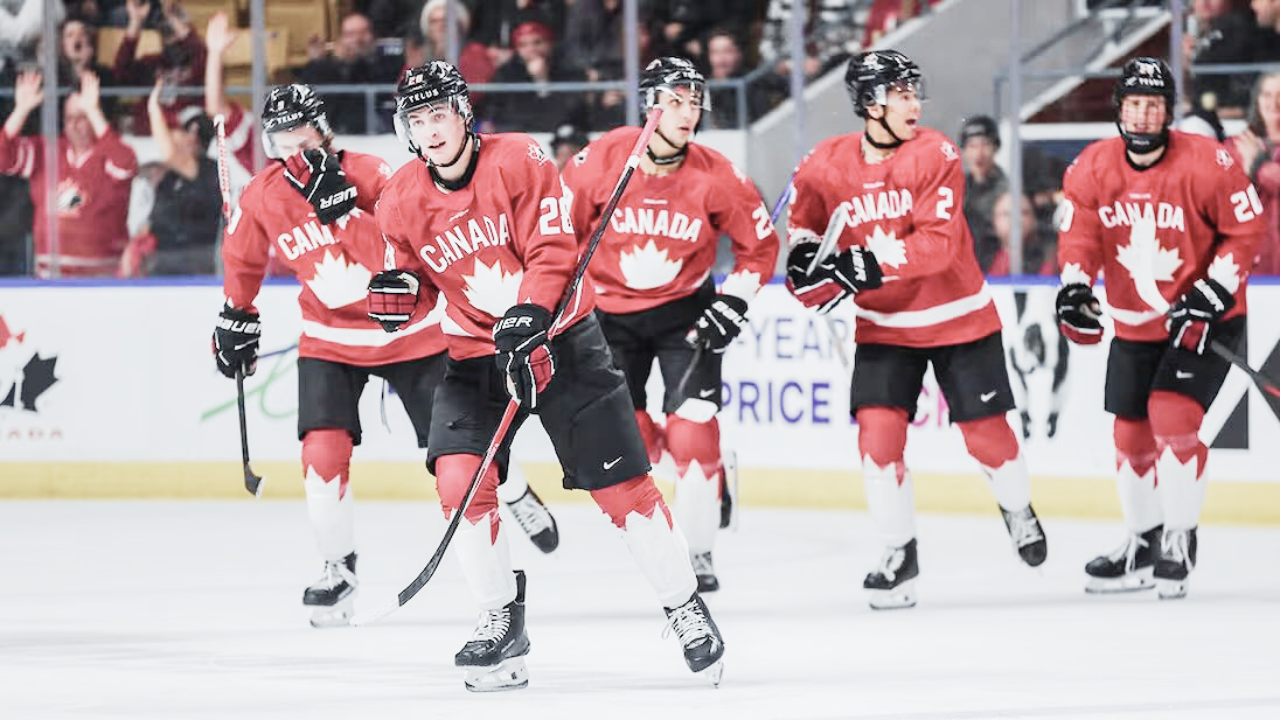
Why Canada vs Denmark at the IIHF World Junior Championship shapes Group B, sets up the Finland showdown, and leaves Canada with no margin for error.
On paper, Canada vs Denmark looks like one of those World Junior games you circle as a formality. A powerhouse versus a minnow. A night where the question is less who wins and more by how much. But this year, that framing misses what’s actually at stake.
Canada’s preliminary-round meeting with Denmark at the IIHF World Junior Championship is not a tune-up, not a showcase, and not an emotional cooldown game before bigger things.
It is a leverage point. A hinge. One of those games that quietly decides whether the rest of the tournament feels manageable or unforgiving.
Group B is already shaping Canada’s path, and Denmark sits right in the middle of that story.
The Group B Reality
After two games, the math is clear and slightly uncomfortable for Team Canada. They sit second in Group B with five points, one regulation win and one overtime win. That’s not a bad position, but it’s not a commanding one either.
At the top of the group is Finland, perfect through two games with six points and a dominant goal differential. Finland hasn’t just won, it has erased opponents. That matters, because goal differential is often the silent decider when teams finish level on points.
Canada’s margin for error is already thinner than it would like. The overtime point they “burned” earlier in the group doesn’t feel catastrophic now, but it looms over everything that follows.
Canada still controls some of its fate, but not all of it. From here on, every game has consequences beyond the scoreboard.
Which brings us to Denmark.
Denmark Is Playing for Survival
For Denmark, this tournament has been brutal out of the gate. Two games, zero points, last place in Group B. At the World Juniors, that position isn’t just cosmetic. Fifth place in the group means relegation danger, where one bad night can undo an entire program’s progress.
That context changes everything about how Denmark approaches Canada.
This isn’t about keeping it close for the cameras or skating hard for pride. Denmark needs points. That reality tends to strip games down to their most pragmatic form. Expect conservative structure, layered defence, shot suppression, and a heavy reliance on goaltending. Expect them to treat the first ten minutes like a survival drill, not an audition.
And most importantly, expect Denmark to be comfortable if the game stays ugly. The longer it remains low-event, the more pressure shifts onto Canada.
Why the Revenge Narrative Isn’t Made Up
This game also carries emotional weight that goes beyond the junior level. Last spring, Denmark stunned Canada at the 2025 Men’s World Championship, eliminating them in the quarterfinals with a late comeback and a last-minute winner.
It wasn’t a fluky group-stage stumble. It was win-or-go-home, and Denmark sent Canada home.
Yes, this is World Junior hockey. Yes, the rosters are different. But hockey culture doesn’t reset emotionally with each new lineup. Programs remember losses. Fan bases remember embarrassment. And Denmark crossing that psychological threshold once matters.
That upset changed how Denmark is perceived when it plays Canada. It is no longer treated as a novelty underdog. It is treated as a team that, if allowed to linger, can turn anxiety into mistakes.
That’s why Canadian hockey fans will talk about this game in terms of revenge. Not because the players owe anything personally, but because the crest does.
Two Very Different Ideas of How to Win
Stylistically, the game sets up as a clash of intent.
Canada wants pace. Early goals. Power-play opportunities. A game that opens up before doubt has time to creep in. They already showed the blueprint in a pre-tournament meeting, where Canada overwhelmed Denmark with speed, transition pressure, and depth scoring.
When Canada plays downhill, Denmark struggles to exit its zone cleanly. Extended shifts turn into penalties. Penalties turn into separation. Separation turns into a rout.
Denmark wants the opposite. It wants patience to turn into frustration. It wants Canada to grip the stick a little tighter with each missed chance. If Denmark can survive the early push and keep the game within one goal into the third period, the entire emotional balance flips. Suddenly it’s Canada feeling the weight of expectation, not Denmark.
That is the danger Canada must avoid at all costs.
Why Denmark Matters More Than It Looks
The importance of this game isn’t limited to beating Denmark. It’s about how Canada beats Denmark.
Canada needs a regulation win. That part is non-negotiable. An overtime win leaves Canada behind Finland regardless of what happens elsewhere. But even a regulation win may not be enough on its own.
Goal differential is looming. Finland’s advantage is massive, and if Canada wants flexibility heading into its New Year’s Eve showdown, it needs to close that gap wherever possible. A tidy 4–2 win over Denmark checks the box. A decisive 7–1 or 8–2 win changes the math.
This is why coasting is dangerous. If Canada plays conservatively once it has a lead, it risks entering the Finland game needing not just a win, but a big one. That’s not a position you want against a team that has looked ruthless so far.
All Roads Lead to New Year’s Eve
No matter what happens against Denmark, the group funnels toward one moment: Canada vs Finland on New Year’s Eve.
That game is effectively a group final. A regulation win is Canada’s only clean path to first place. If Finland drops points before then, Canada can jump them outright. If Finland arrives with nine points, Canada must beat them in regulation just to force tiebreakers, where goal differential could still decide everything.
An overtime win likely isn’t enough. A loss ends the race entirely.
There is no gray area here. The margin is binary.
Pressure, Not Power
Canada enters this stretch with more talent than Denmark, more depth than Finland, and more expectation than anyone else in Group B. But expectation cuts both ways.
Denmark has nothing to lose. Finland has control. Canada has pressure.
The task in front of Canada is simple to describe and brutally difficult to execute: win cleanly now, win decisively later, and hope the group opens just enough to reward perfection.
This is why Canada vs Denmark matters. Not because it’s dramatic on its own, but because it determines whether the rest of the tournament feels like a climb or a cliff.