
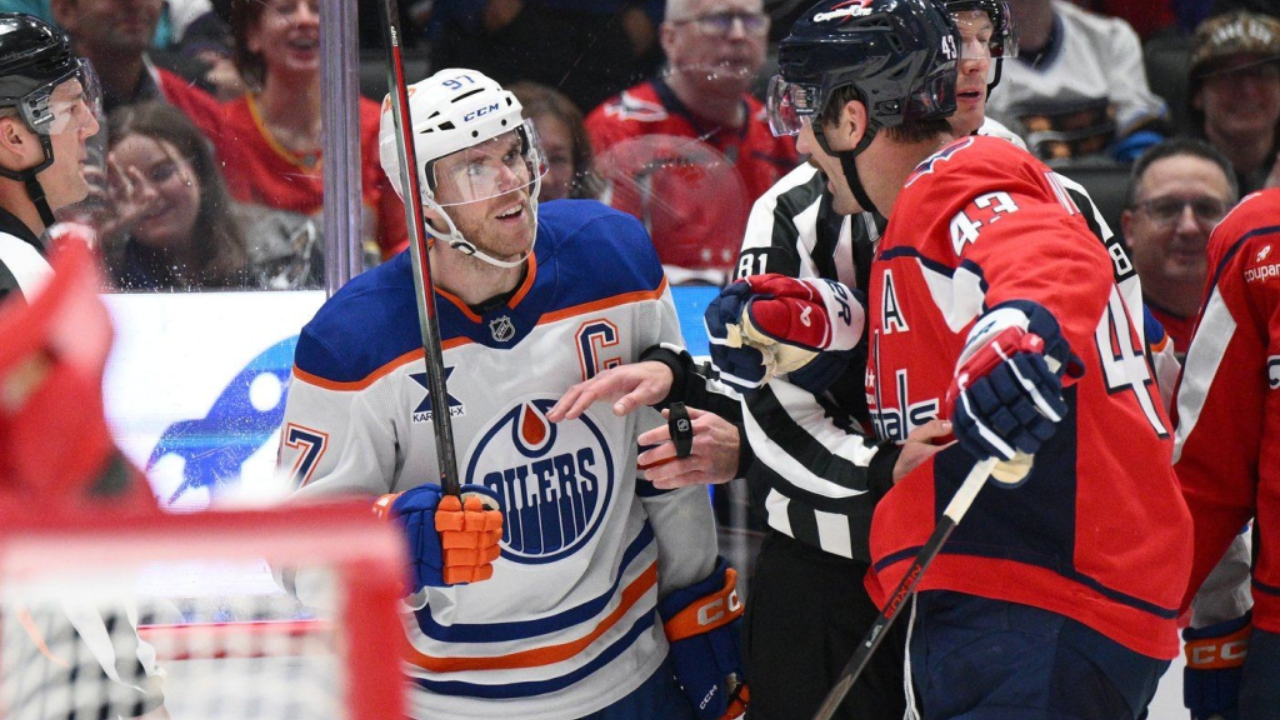
A 7–4 loss to Washington looked like a blowout, but Edmonton’s slow start, risky structure, and shaky goaltending showed deeper issues that define their season.
Edmonton’s 7–4 loss to the Washington Capitals looked like a blowout on the scoreboard. On the ice, the story was far more complicated — and far more familiar.
A disastrous first six minutes set the tone, leaving the Oilers in chase mode all night. They pushed back repeatedly, scored enough to win on most nights, and even drove play in long stretches.
But the same systemic problems that have been present all season re-emerged at key moments: slow starts, defensive breakdowns rooted in their high-risk offensive structure, and goaltending that simply couldn’t bridge the gap.
This wasn’t a one-off collapse. It was a perfect snapshot of what has gone wrong for Edmonton all year.
Chasing From the Opening Drop
For the Oilers, the script is becoming frustratingly familiar. Before they touched the puck with any rhythm, Washington had already banked a 2–0 lead.
Both goals came within the first six minutes, both came on the Capitals’ first handful of shots, and both came from the exact kind of defensive breakdowns that Edmonton has struggled with — forwards leaving the zone early, defensemen stranded below the dots, and opponents exploiting seams with ease.
Edmonton battled back, as they almost always do. Darnell Nurse cut the lead in half with a first-period shot through traffic. The Capitals answered. Leon Draisaitl made it 3–2. Washington answered.
David Tomasek made it 4–3. Washington answered again. By the time Nurse’s second of the night made it 5–4 in the third period, the Oilers had built genuine momentum. They controlled shifts, hemmed the Capitals in their own end, and looked poised to tie the game.
And then, as if on cue, Washington capitalized on the next mistake. One defensive lapse, one quick transition, one high-danger look. Goal. And from there, the game unraveled into two empty-netters that transformed a tight contest into a lopsided final score.
Every time Edmonton closed the gap, Washington found the next goal. That’s not just bad luck — it’s the consequence of structural vulnerability.
Numbers Tell a Different Story
The frustrating thing for Edmonton is that, once the early chaos subsided, the game wasn’t actually a blowout by any underlying metric.
Expected goals were nearly even, hovering around 3.9–3.7 in Washington’s favor. The Oilers generated plenty of offense at five-on-five. They won stretches of the territorial battle. Their power play created meaningful looks. They had extended sequences in the third period where Washington couldn’t get out of their own zone.
This wasn’t a game where Edmonton got outclassed. It was a game where they got out-executed in swing moments.
The 7–4 scoreline is misleading in the sense that it suggests Washington dominated. They didn’t. The problem is that Edmonton played just well enough to lose because they spent the entire night clawing back from their own mistakes. When a team plays from behind, the margins shrink, and every defensive lapse becomes magnified.
And for the Oilers, those lapses stem from something deeper.
The Structural Problem
The heart of Edmonton’s issue isn’t individual players. It’s not even strictly goaltending. It’s the system — or more accurately, the identity the team has leaned into for years: a risk-heavy, transition-first style where forwards exit the zone early in search of rush chances, often before the defense has secured the puck.
This “cheat-for-offense” approach works spectacularly when Edmonton is controlling the flow of the game. When they’re dictating pace, when McDavid and Draisaitl are turning every loose puck into a four-on-three the other way, the Oilers can bury teams under waves of chances.
But when they’re not dictating pace — when the first six minutes spiral, when retrievals get messy, when pressure comes fast — the system exposes every weak point at once.
Against Washington, it was glaring. Edmonton’s forwards flew the zone early on breakouts, leaving the defense to handle forecheckers alone. Puck retrievals that should have been simple turned into rushed rim-arounds and blind clears. Those clears turned into turnovers. Those turnovers turned into slot chances. And those slot chances turned into goals.
It’s not that the defense is fundamentally bad; the personnel (Nurse, Bouchard, Ekholm, Kulak) is more than capable of stabilizing games. But Edmonton’s structure amplifies their weaknesses. It forces defensemen into losing battles behind the net and corner scrums without forward support. It puts the goalie in impossible situations, facing high-danger chances from prime areas on plays where the forwards are already thinking offense.
Ironically, the Oilers play their best hockey when they’re trailing. In the third period of this game, they tightened up their structure, supported the puck, and stopped cheating. They dominated for long stretches.
But that adjustment didn’t erase the early damage. And it’s not a sustainable model.
Goaltending Under Siege
Stuart Skinner’s stat line — five goals on 19 shots — looks ugly. The .737 save percentage looks worse. And Edmonton absolutely needed more out of him.
But context matters. Many of Washington’s goals came off rush plays, lateral movement, or rebounds generated because of defensive scrambling. These are the kinds of chances that punish even elite goaltenders. They are not the kinds of chances you can give up when you’re spotting opponents an early lead.
Skinner didn’t rise above the chaos. But he also didn’t create the chaos.
This is the dynamic that has repeated all year: Edmonton’s structure creates high-danger chances against, the goaltender struggles to bail them out, and the problems compound.
Even a league-average performance might have changed this game. Edmonton didn’t get that. They got the downside of the system.
The Offense Was Good Enough
This is what makes the loss so maddening: the Oilers scored enough to win on most nights.
Four goals should give you at least a point. Nurse, scoring twice from the back end, had one of his strongest games of the season. Draisaitl scored. Tomasek scored. McDavid and Draisaitl both had multi-point nights. The third period saw long stretches where Washington was hanging on and the Oilers were tilting the ice.
The issue wasn’t generating offense. It was converting offense at the exact moments when momentum hung in the balance.
At 4–3, Lindgren made a key save. At 5–4, he made another. Washington scored on their next look after both. That’s the difference between chasing the game and flipping it. Edmonton never found the tying goal that could have forced Washington out of their shell.
They created enough. They just didn’t capitalize when it mattered most.
The Big-Picture Concern
If this were a one-game problem, the Oilers could shrug it off. But this loss fits neatly into a growing pattern: slow starts, defensive gaps created by the transition-heavy offensive identity, reliance on comebacks, and goaltending that doesn’t erase mistakes.
These aren’t isolated breakdowns. They’re structural symptoms.
Edmonton’s margin for error is razor-thin because their system demands that a lot of things go right: clean exits, crisp puck movement, and early goals. When those things happen, the Oilers can look like one of the most dangerous teams in the league. When those things don’t happen — when opponents punch back early, when the forecheck overwhelms their retrievals, when the goaltending sinks below average — the entire identity collapses inwards.
This game had all of it: the early hole, the mid-game pushback, the underlying numbers that suggest competence, and the defensive and goaltending issues that burned them anyway.
Edmonton is too talented to be chasing games this often. They’re too deep to be relying on frantic third-period pushes. And they’re too good to be losing games where they generate four goals.
But until the structural flaws get addressed — until the forwards stay connected to the defense, until the team stops cheating for offense at the wrong times, until the goaltending gets at least baseline support — the Oilers will keep repeating this script.
A closer game than the score suggests. A harder push than the result reflects. And another loss that looks less like a fluke and more like a diagnosis.