
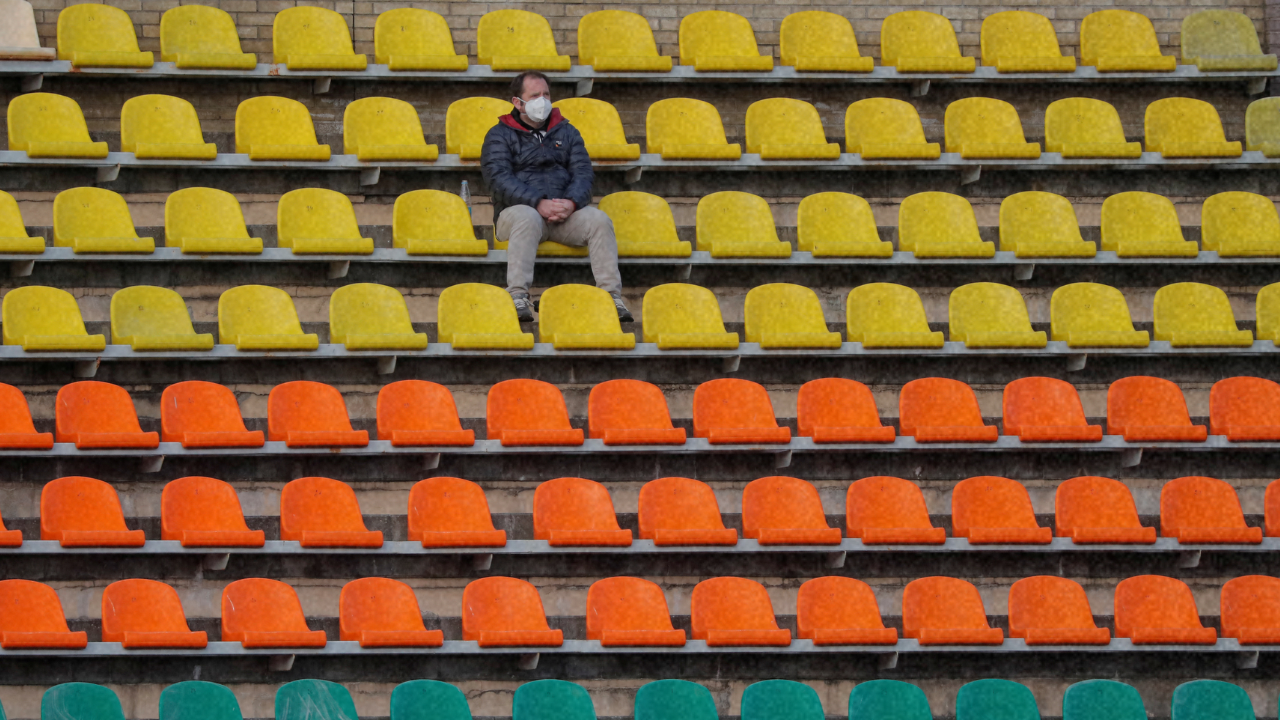
Belarus football coronavirus: the Vysshaya Liga became the last league on earth because Lukashenko decided that stopping it would look like losing control.
By the second week of April 2020, the Vysshaya Liga was one of two professional football leagues still playing anywhere on the planet. The Champions League was suspended. The Euros were postponed. The Olympics were gone. The World Health Organization had recommended that mass gatherings be cancelled, and virtually every football association on earth had complied. In Belarus, the season had opened on schedule in March and the fixtures kept coming, week after week, in stadiums that were technically open to the public.
Asked by ESPN why the league was continuing, Belarus FA general secretary Sergei Zhardetski said there were “currently no reasons” to stop. He added that the federation fully trusted the country’s health care system. Asked what it was like being the only game in town, he said: “it is what it is.”
The president’s medical advice
The decision did not originate with the football federation. Alexander Lukashenko had been running Belarus since 1994 and had spent the early weeks of the pandemic telling the country there was nothing to worry about. He called the global response a “psychosis.” He told state media it was “yet another psychosis, which will benefit some people and harm others,” and said he was more concerned that panic would do more damage than the virus.
He suggested vodka, saunas, and working on a farm as preventative measures. He described the pandemic as “part of a plan to turn everything upside down.” On a state-run outlet, he floated the idea that Belarusians might be immune to what he called Western psychosis. At a meeting on April 7, he acknowledged he could impose quarantine measures within twenty-four hours, then asked what the country would eat if he did.
The Belarus Football Federation followed the line without deviation. Its head, Vladimir Bazanov, told the sports outlet Tribuna that the concern spreading through the public was “some strange stuffing that affects people psychologically,” which he characterized as “a bloated psychological situation.” The federation’s position and the president’s position were the same position, phrased twice.
What the players said, and what they said next
Aleksandr Hleb spent his career at Arsenal and Barcelona and had retired back into Belarusian football. He posted to Instagram that the lack of response in his country was “unbelievable.” Within a short period he had walked it back, writing that since the Presidential Administration did not see a real need for quarantine, the situation was under control, and that if there were a genuine threat to the health of players or spectators he was sure the matches would stop.
That reversal is the most instructive thing any Belarusian footballer said in public that spring. The players who spoke on the record spoke in the government’s cadence. Sergey Kislyak of Brest told reporters his mother worked at a school, classes were continuing as before, and everything was fine. His teammate Artem Milevsky told a Belarusian radio station: “We are paid to play, and the authorities are in control.”
What players said off the record ran the other way. Dissent moved through anonymous polls and private message groups rather than press conferences. Nikolay Zolotov, a Belarusian playing for Ural Yekaterinburg in Russia and therefore outside the reach of the domestic apparatus, told Tribuna the situation reminded him of Chernobyl. Nobody knew how many people were sick, where they were sick, or how they were being treated. He asked whether anything had really changed in thirty-four years.
The stands answered before the league did
Neman Grodno told its own supporters to stay away, posting on social media that fans should stay home, reduce the risks associated with the spread of the virus, and protect themselves and the people they lived with. A club in a state-aligned league was publicly asking people not to attend its own fixtures.
They did not attend. India Today counted them: Neman’s match against Belshina Bobruisk drew 253 people, roughly a sixth of the club’s average the previous season. Organized boycotts were announced by supporters’ groups at ten of the sixteen clubs in the top division, including BATE Borisov, a side that had been a Champions League regular. The fans stopped going before anyone with the authority to cancel the fixtures was willing to consider it.
Maksim Berazinski, chief executive of Tribuna.com, told the New York Times in March that the attitude toward the virus in Belarus was still fairly frivolous, and attributed that partly to the fact that the authorities had not closed borders, schools, or universities and were working to downplay the problem. Many people were still going to matches, he said, and were vocal in opposing any suspension. His own outlet’s position was that the championship should be suspended and that the risk being imposed on people was not justified.
Why the fixtures could not stop
Belarus reported 3,728 cases and 36 deaths in the period the decision was being defended — figures produced by a government that had spent the preceding month describing the pandemic as a foreign hysteria, and that had every reason to keep the number low. The infection rate looked negligible next to Spain or Italy. That comparison was the entire public argument for playing on.
The actual argument was older than the virus. In December 2010, after an election the EU and Western governments called fraudulent, as many as 40,000 people protested in Minsk. Around 700 opposition activists were arrested along with seven presidential candidates. Security forces stormed the offices of the opposition group Charter97 and arrested the entire staff. Social platforms and opposition websites were blocked. A travel ban followed against Lukashenko and 156 of his associates.
In March 2017, roughly 40,000 Belarusians took to the streets against a tax levied on the unemployed. Opposition leaders called for the tax to be cancelled and for Lukashenko to resign. Around 700 people were arrested over two months. The decree was suspended and very little else changed.
A government that has twice met crowds of forty thousand with mass arrests has a specific relationship to any circumstance that would empty its streets and shutter its public life by administrative order. A lockdown in spring 2020 would have been an admission that the state could not manage the thing it had spent a month calling imaginary.
The football was one of the few remaining public demonstrations that ordinary life was proceeding as instructed. Cancelling it would have said the opposite, in a country where the government’s authority rests substantially on never appearing to lose control of anything.
The last league on earth was also the only line
There was a second consequence, and it belonged to the sportsbooks. With virtually every league on the planet suspended, the Vysshaya Liga became one of a tiny handful of markets with live fixtures. Books that had never in their history priced Belarusian domestic football were suddenly posting odds on it. Circa Sports in Las Vegas was putting out numbers on the Belarus Cup.
The handle on those matches ran at levels the league had never seen and was not built to withstand. The integrity infrastructure that surrounds major-league football — monitoring, market-movement alerts, the sheer weight of liquidity that makes a fix expensive — did not exist here at anything like the necessary scale. What existed instead was a small league of modestly paid professionals, in a country where the state controls most avenues of employment and complaint, playing under compulsion in front of empty stands, while unprecedented money moved on the outcomes from thousands of miles away.
Nothing about that arrangement was designed. It was the byproduct of an autocrat’s refusal to close the stadiums, and it produced, for a few weeks, one of the most heavily bet and least supervised football competitions in the world. The 253 people in the stands at Grodno had worked out the risk. The books had worked out the opportunity. The players were the only ones without a choice in the matter.
Sources
- The New York Times — “Soccer in Belarus, Where the Games Go On”; Lukashenko’s “psychosis” remarks, Maksim Berazinski of Tribuna.com on the public attitude and the case for suspension
- ESPN — Belarus FA general secretary Sergei Zhardetski on there being “currently no reasons” to stop the league, and on being the only game in town
- Reuters — “Belarus soccer continues amid virus anxiety and empty stands”; Lukashenko’s April 7 quarantine remarks, Nikolay Zolotov’s Chernobyl comparison, player statements
- India Today — fan boycotts across ten of sixteen top-flight clubs including BATE Borisov; the 253-person gate at Neman Grodno v Belshina Bobruisk
- MarketWatch — “Vodka, saunas and resisting lockdown”; Lukashenko’s recommended preventative measures
- Belarus.by (Belarusian state outlet) — Lukashenko in his own words on why the situation did not require what he called draconian measures
- World Health Organization — technical guidance on points of entry and mass gatherings
- CBC — the December 2010 post-election protests and crackdown in Minsk
- The Guardian — the March 2017 protests against the tax on the unemployed
- ABC News — arrests during the 2017 protest wave