
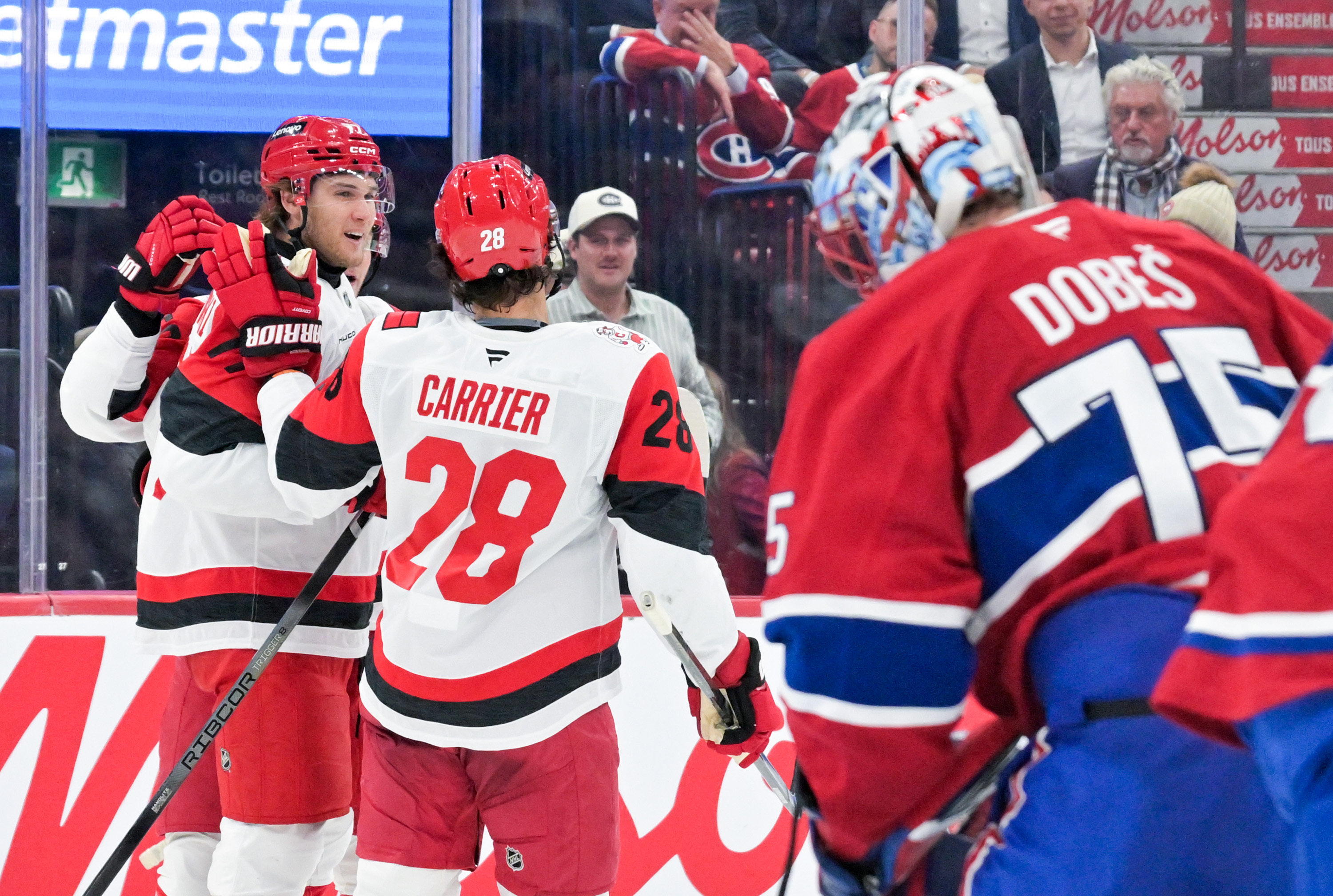
Montreal gave its home crowd a three-goal first period. Carolina answered by turning the next 40 minutes into the kind of game the Canadiens were trying to avoid.
The Canadiens did not spend their home opener looking intimidated by the defending Stanley Cup champions. They answered Carolina’s opening goal almost immediately, scored three times on six first-period shots and carried a 3-2 lead into intermission with the Bell Centre fully engaged.
Then the Hurricanes changed the game. Carolina outshot Montreal 17-4 in the second period, Sebastian Aho tied it on the power play and Mark Jankowski gave the Hurricanes the lead before the period ended. Taylor Hall added his second goal in the third, and Andrei Svechnikov eventually sealed a 6-4 Carolina win into an empty net.
Montreal produced enough offense to make the night competitive without Ivan Demidov and Kaiden Guhle. What it could not do was keep Carolina from repeatedly forcing the next defensive decision. The home opener began with emotion and speed. It ended as another demonstration of why the Hurricanes remain one of the league’s most difficult teams to play once their pressure starts accumulating.
Montreal Gave the Bell Centre the Start It Wanted
Carolina scored first only 2:25 into the game when Hall redirected a spinning Jackson Blake shot in front of Jakub Dobeš. The early goal could have flattened a home opener that had spent the pregame ceremony building toward exactly the opposite emotion.
Instead, Montreal answered in 58 seconds. Zachary Bolduc collected the rebound of a Phillip Danault deflection and beat Brandon Bussi to make it 1-1. Just over a minute later, Chris Kreider found Nick Suzuki and the Canadiens captain beat Bussi for a 2-1 lead.
Eric Robinson tied it again at 9:22 when he redirected Jalen Chatfield’s shot from the point, but Montreal still had another response. Bolduc scored his second of the period on the power play at 12:54, sending the Canadiens into the first intermission ahead 3-2.
Five goals in the opening period made the game look much less like the structured Carolina matchup Montreal had been preparing for. The Canadiens had found speed, finishing and enough special-teams offense to make the champions chase them.
Then Carolina Started Making Montreal Defend
The second period revealed the more important part of the matchup. Carolina did not need to erase the lead with one explosive sequence. The Hurricanes simply began spending more and more of the game in Montreal’s end.
The shot count became 17-4 Carolina in the period. That gap was not just a collection of perimeter attempts. It reflected how often Montreal had to retrieve another puck, attempt another exit and survive another possession before it could create anything going the other way.
Aho tied the game at 3-3 on the power play at 3:56, attacking from the right side after Nikolaj Ehlers found him with space. Jankowski then gave Carolina a 4-3 lead at 13:24, taking advantage of strong forechecking by Robinson before cutting across the front of the net and finishing on the backhand.
Montreal entered the period with the lead and left it trailing despite Dobeš keeping the Hurricanes from creating a larger gap. The scoreboard had only moved by two goals. The territorial balance had moved much further.
The Hurricanes Won the Game in the Repetitions
The central concern before the game was that Carolina could make each Montreal defensive shift contain several separate problems. That became the clearest explanation for the result.
The Canadiens could survive the first forecheck. They could make the first save. They could occasionally move the puck out of immediate danger. The Hurricanes kept recovering enough pucks that those successful defensive plays did not always end the possession.
That is where Carolina’s structure becomes exhausting. A defense does not need to make one mistake. It needs to continue making correct decisions until the Hurricanes finally lose possession. By the second period, Montreal was spending too much time trying to reach that final exit.
The difference showed up in the shot count, but the mechanism came first. Carolina forced Montreal to defend for longer than it wanted, and the longer those shifts became, the less often the Canadiens could attack with the speed that had created their first-period success.
Carolina’s Penalty Kill Protected the Takeover
Montreal still had opportunities to change the game on special teams. Carolina gave the Canadiens enough power-play time that the night could have turned back toward the home side, including two separate five-on-three situations.
The Hurricanes killed both of them.
That mattered because Montreal had already shown what one successful power play could do. Bolduc’s second goal came with the man advantage and restored the Canadiens’ lead late in the first. Another conversion during one of the two-man advantages could have interrupted Carolina’s growing territorial control or forced the Hurricanes to chase again.
Instead, Carolina’s penalty killers preserved the momentum long enough for the five-on-five pressure to resume. Aho also supplied a power-play goal at the other end. On a night full of penalties, four-on-four stretches and unusual special-teams situations, the defending champions handled the most dangerous ones better.
Aho Is Already Driving Carolina’s Best Offense
Aho finished with a goal and two assists, giving him four goals through Carolina’s first four games. His impact went beyond the three points because his goal arrived precisely when the Hurricanes needed to convert control into something tangible.
Carolina had begun the second period pushing Montreal backward. Aho’s power-play finish turned that pressure into a tie, and his later assist on Svechnikov’s empty-net goal finished the night. The Hurricanes did not need him to create every goal himself because Hall, Robinson and Jankowski all supplied offense around him.
That distribution is particularly important while Seth Jarvis remains out. Carolina entered the game without one of its most versatile forwards and still received multi-point performances from five different players. The attack was not dependent on one replacement line trying to imitate what the missing player normally provides.
Aho remained the center of the offense without becoming the only reason it worked.
Taylor Hall Turned Pressure Into Separation
Hall’s first goal gave Carolina its opening lead. His second created the first two-goal margin of the entire night.
With Carolina ahead 4-3 midway through the third, Jaccob Slavin put the puck toward the net and Hall finished the rebound at 12:21. The goal made it 5-3 and gave the Hurricanes enough room to survive Montreal’s final push.
Those were Hall’s first points of the season, and they arrived in two different ways that fit Carolina’s larger game. The opener came through net-front positioning and a deflection. The second came because Carolina generated another shot, another rebound and another chance before Montreal could clear the zone.
Hall did not need to dominate possession individually. He occupied the places where Carolina’s possession eventually sends the puck.
Bolduc Gave Montreal the Missing-Offense Answer for One Night
Demidov’s injury created an immediate question about where Montreal would find the offensive creation and finishing removed from the lineup. Bolduc supplied a strong answer in the first period.
He scored twice, first at even strength and then on the power play, helping Montreal reach three goals before the first intermission. Alexandre Texier assisted on both goals, while Danault and Alex Newhook each contributed to one of them.
That matters because Montreal’s top line did not have to produce everything. Suzuki scored, Kreider contributed two assists over the night and Juraj Slafkovsky later pulled the Canadiens back within one late in the third.
The offensive depth was better than the injury list might have suggested. The problem was not finding four goals. It was finding enough possession between those goals to keep Carolina from producing six.
Dobeš Faced the Version of Carolina the Preview Warned About
Jakub Dobeš made 28 saves on 33 shots before the empty-net goal. Brandon Bussi faced only 20 shots at the other end and stopped 16.
Those numbers do not mean Dobeš simply lost a goaltending duel. They show how different the two workloads became once Carolina started controlling territory. Dobeš repeatedly had to deal with traffic, deflections, rebounds and sequences that continued after his first save.
Bussi had his difficult moments. Montreal scored on three of six first-period shots and made Carolina’s starter look vulnerable early. The Hurricanes responded by reducing how much work he had to do over the next 40 minutes.
That is often the difference between evaluating a goalie and evaluating the environment around him. Bussi allowed four goals and still earned his first win of the season because Carolina eventually stopped asking him to survive the same volume of problems Dobeš was facing at the other end.
Montreal Still Found One Last Push
The game was not completely finished when Hall made it 5-3. Montreal pulled Dobeš for an extra attacker and Slafkovsky scored at 16:57, with Kreider and Suzuki assisting, to cut the deficit back to one.
The goal briefly restored the possibility that the Canadiens could turn another multi-goal deficit into an overtime game, as they had done in Pittsburgh. Carolina never allowed the final sequence to build.
Svechnikov scored into the empty net at 18:45, restoring the two-goal margin and ending the comeback. Montreal had again demonstrated that it can make a game dangerous late. Carolina demonstrated that it is much better than Pittsburgh at preventing that danger from becoming the final result.
The Prediction Got the Winner and Margin Right, Not the Route
Carolina was picked to win 4-2 because its defensive structure and depth appeared more reliable than Montreal’s injury-thinned lineup. The Hurricanes did win by two goals, but almost nothing about the scoring environment followed that projection.
Montreal scored three times in the first period. Bussi did not deliver a low-event goaltending performance. Bolduc supplied exactly the kind of secondary offense Demidov’s absence appeared likely to remove. The Canadiens were dangerous enough to score four and force Carolina to protect a one-goal lead late.
The part that held up was structural rather than numerical. Carolina generated more repeatable possession, forced Montreal through far more defensive work and eventually turned that control into a 34-20 shot advantage. The Hurricanes were also better when the special-teams situations became most dangerous.
The score was higher than expected. The reason Carolina won was still very close to the reason it was favored.
Montreal Can Score With Carolina. It Still Has to Escape Carolina.
The Canadiens leave their home opener with evidence that their offense can survive significant injuries. They scored four without Demidov, received two goals from Bolduc and made the defending champions work until the final two minutes.
They also leave with the same larger problem Carolina presented last spring. Matching the Hurricanes for individual scoring moments is not the same as controlling enough of the game to prevent those moments from being overwhelmed by everything between them.
Montreal led after one period and still spent the second getting buried 17-4 in shots. Carolina survived two-man disadvantages, found contributions throughout the lineup and turned a one-goal deficit into a two-goal victory without requiring one spectacular stretch from its goalie.
The Canadiens host Nashville on Thursday. Carolina returns home to face Vancouver the same night. Montreal has already shown it can score its way back into chaotic games. The next step is learning how to prevent teams like Carolina from creating the chaos in the first place.
Sources
NHL, October 7, 2026 — Hurricanes 6, Canadiens 4 game recap | Carolina Hurricanes, October 7, 2026 — postgame recap and special-teams notes | Montreal Canadiens, October 7, 2026 — home-opener game recap | NHL, October 6, 2026 — projected lineups and injury status