
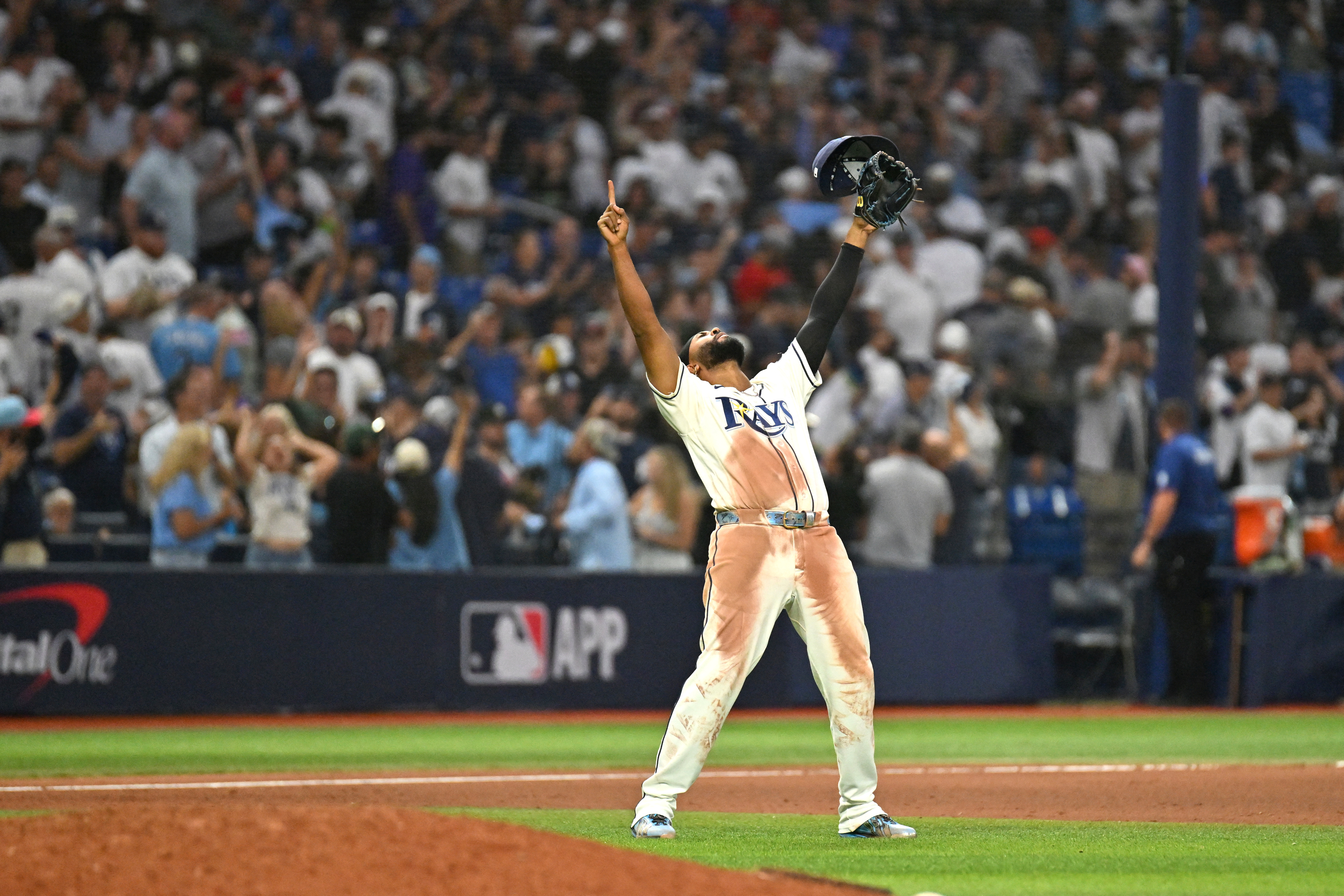
The Yankees brought Cam Schlittler to Tampa Bay hoping one dominant pitcher could reset the ALDS. The Rays turned the game into something one pitcher could not control.
New York committed four errors. Tampa Bay kept putting the ball in play. By the time a four-run fifth inning ended, a 1-1 game had become a 5-1 Rays lead and one of baseball’s best pitchers was watching from the dugout.
The final was 5-2, giving Tampa Bay a 2-0 series lead before the ALDS moves to Yankee Stadium. Ben Rice supplied both New York runs with solo homers, but the Yankees managed only four hits one game after Drew Rasmussen held them to one. Through 18 innings of this series, an offense that scored 18 runs in the Wild Card round has produced two.
Game 2 therefore answered the central question from the preview in a way that went beyond the score. Schlittler was supposed to be the individual advantage capable of overriding everything Tampa Bay had accumulated around him. Instead, the Rays demonstrated why this matchup was always about more than which team could put the better starting pitcher on the mound.
The Rays Made Schlittler Pitch Through Chaos
Schlittler did not suddenly become a bad pitcher Monday night. His velocity remained intact, he attacked the zone and much of the damage against him emerged from plays that never appear in a pitching arsenal.
Tampa Bay put the leadoff hitter aboard in four of Schlittler’s five innings. The first began when Ryan McMahon failed to handle Yandy Díaz’s ground ball. Jonathan Aranda followed with a single, and New York’s defense continued to deteriorate from there. Jazz Chisholm Jr. made an errant throw during a force play and Austin Wells was called for catcher interference as the Yankees committed three errors before the first inning was over.
Only one run scored, which initially made the damage look survivable. Schlittler kept Tampa Bay from turning the inning into something much worse and worked through traffic again in the innings that followed. New York had therefore made the game difficult without yet making it unrecoverable.
That changed in the fifth.
Tampa Bay’s Fifth Inning Was the Entire Rays Formula
The decisive inning did not begin with some overwhelming display of power. It began with Tampa Bay doing what Schlittler and the Yankees knew it would do: creating baserunners, forcing defenders to make plays and refusing to let clean contact be the only route to offense.
Aranda opened with a single and Junior Caminero doubled, putting Schlittler immediately under pressure. Liam Hicks brought home the go-ahead run on a ground ball. Chandler Simpson followed with another ball on the ground that New York could not turn into the out it needed.
Schlittler’s night ended after 4 1/3 innings with six hits allowed, four runs charged to him and only two earned. Brent Headrick entered and briefly appeared capable of containing the damage, but another defensive failure kept the inning moving before Richie Palacios drove a two-run single into center field.
What had been 1-1 was suddenly 5-1.
That sequence is why reducing Tampa Bay’s offense to traditional measures of dominance misses what makes the Rays difficult. They do not require every hitter to drive a ball into the gap. A grounder that forces an infielder to move quickly matters. Speed matters. A throw made under pressure matters. Extending an inning by one plate appearance matters.
Against a clean defensive team, several of those balls become routine outs. Against New York on Monday, they became the infrastructure of a four-run inning.
The Yankees’ Defense Became Part of Tampa Bay’s Offense
New York’s four errors tied the second-highest total in Yankees postseason history. The number is ugly enough on its own, but it still does not fully capture the problem.
Tampa Bay’s style requires opponents to complete defensive sequences. The Rays put enough balls into play, use enough speed and create enough movement that ordinary outs become decisions. An infielder has to field cleanly before choosing a base. A middle infielder has to finish the throw. A catcher has to maintain position. A defense does not get to skip those steps simply because the opposing hitter failed to square the ball up.
The Yankees repeatedly failed those tests Monday. Some were officially scored as errors. Others were simply balls that a cleaner defensive club might have converted into outs.
That made Schlittler’s line unusually revealing. He allowed four runs, but only two were earned. He also struck out only two, his lowest total of the season, which meant Tampa Bay continually forced New York’s fielders into the game rather than allowing Schlittler to remove them from it.
For the Rays, that was not incidental to the offense. It was the offense functioning as designed.
Freddy Peralta Didn’t Need to Match Schlittler’s Reputation
The pregame matchup placed enormous attention on Schlittler because his season had earned it. Peralta’s job was different. Tampa Bay did not need him to outpitch the Yankees ace for seven innings. It needed him to prevent New York from controlling the game before the Rays could begin applying pressure elsewhere.
Peralta gave Tampa Bay 4 2/3 innings, allowing three hits and one run while striking out three. Rice’s fourth-inning homer tied the game, but Peralta prevented it from becoming the beginning of a larger rally. When Cody Bellinger came up with the bases loaded in the fifth, Cam Booser entered and got the fly ball that kept the score tied.
The Rays scored four times in the bottom half.
That sequence changed the burden on the rest of Tampa Bay’s staff. Ian Seymour could enter with room to attack instead of protecting a one-run game from the moment he touched the mound. He covered three innings, and Bryan Baker handled the ninth for his second save in as many games.
Through the first two games, Tampa Bay’s pitching plan has done more than suppress New York’s offense. It has kept Kevin Cash from needing to exhaust the bullpen to do it.
Ben Rice Is Producing Almost All of New York’s Offense
Rice prevented Game 2 from becoming another shutout. He homered off Peralta in the fourth to tie the game and went deep again against Seymour in the eighth. Those two swings accounted for every Yankees run Monday.
That is both encouraging and alarming for New York.
Rice has shown that Tampa Bay’s pitching is not untouchable. The Yankees finally broke through after being held to one hit in Game 1, and they put runners in position to do more damage when Bellinger came up with the bases loaded in the fifth.
But two solo home runs from one hitter are not enough when the rest of the lineup is producing almost nothing. New York has four runs fewer than Tampa Bay in this series despite receiving exactly the kind of individual power capable of changing a short game.
Aaron Judge’s absence remains impossible to ignore, but the problem now extends beyond replacing one hitter. The Yankees have to create innings. Tampa Bay has repeatedly done that without relying on one swing. New York has mostly waited for someone to hit the ball over the wall.
The Low-Scoring Script Lasted Until Tampa Bay Broke It
Before Game 2, almost everything pointed toward another compressed game. Schlittler had been dominant away from Yankee Stadium, Peralta had allowed almost nothing over the final weeks of the season and Tampa Bay’s bullpen was rested after Rasmussen worked eight innings in the opener.
For four innings, that expectation looked correct. Tampa Bay scored an unearned run in the first, Rice tied the game in the fourth and neither starter had allowed the opponent to create sustained separation.
The fifth inning demonstrated the weakness in treating run prevention as exclusively a pitching question. Schlittler could make quality pitches and still require the defense behind him to finish the play. Once New York stopped doing that consistently, the game escaped the narrow scoring environment that had defined the series.
Seven total runs were eventually scored, but the game still did not feel like an offensive explosion. Tampa Bay had eight hits and New York had four. The separation came from how efficiently the Rays converted pressure into runs and how often the Yankees gave them another opportunity.
Tampa Bay Is No Longer Making the Series Uncomfortable
The original preview described Tampa Bay as making the series uncomfortable for New York. That framing is already outdated.
The Rays are now one win from the American League Championship Series.
Teams that have taken a 2-0 lead in best-of-five postseason series have advanced 83 of 93 times. Under the current Division Series 2-2-1 format, teams winning the first two at home have advanced in 33 of 36 series.
There is one piece of history New York can use. The most recent team to recover from a 2-0 deficit in a best-of-five was the 2017 Yankees, who lost the first two games in Cleveland and then won three straight.
History gives them precedent. Tampa Bay has given them very little else.
Game 3 Changes the Setting, Not the Problem
The series moves to Yankee Stadium on Wednesday night with Max Fried scheduled against Nick Martinez. Home field gives New York a change of environment, and Fried gives the Yankees another starter capable of controlling a postseason game. He has a 1.81 ERA in seven career starts against Tampa Bay.
Martinez brings a different kind of stability. Tampa Bay went 22-9 in his starts this season, and he posted a 2.38 ERA across 16 road appearances. The Rays have also reached Game 3 without leaning heavily on most of their traditional high-leverage relievers, giving Cash considerable flexibility behind him.
The early numbers for Game 3 again give New York the traditional favorite’s position at home, even after Tampa Bay won the first two games. That framing is becoming increasingly difficult to separate from reputation. The Rays have now beaten the Yankees eight times in 15 meetings this season and postseason combined, and the first two games of this series have shown two completely different ways they can do it.
Game 1 was almost sterile: one run, one Yankees hit and very little chaos. Game 2 was the opposite. Tampa Bay put runners on, forced New York to defend and waited for small mistakes to accumulate into something decisive.
The Rays did not need the same formula twice. That may be the most uncomfortable part for New York now.
The Rays Have Turned New York’s Margin Into Zero
Two days ago, the Yankees could reasonably argue that Tampa Bay’s 1-0 opener was one exceptional pitching performance and one Aranda home run. Game 2 removed that explanation.
The Rays beat New York when their starter carried a no-hitter into the eighth. Then they beat New York when their starter did not complete five innings, when the Yankees’ ace was on the mound and when the game was tied entering the fifth.
Tampa Bay has now won with pitching dominance and with offensive pressure. The Yankees have scored only two runs in the series, committed four errors in Game 2 and head home needing three consecutive wins before the Rays find one.
Schlittler was supposed to change the series Monday.
Instead, Tampa Bay changed what the Yankees have left.
Sources
MLB, October 6, 2026 — Yankees-Rays ALDS Game 2 recap and box score | MLB, October 6, 2026 — Rays Game 2 recap | Reuters, October 6, 2026 — Tampa Bay 5, New York 2 | MLB, October 6, 2026 — Rays-Yankees Game 3 preview and probable pitchers | Sparked Sports Yankees-Rays Game 2 preview, October 5, 2026 | Sparked Sports MLB postseason analytical data