
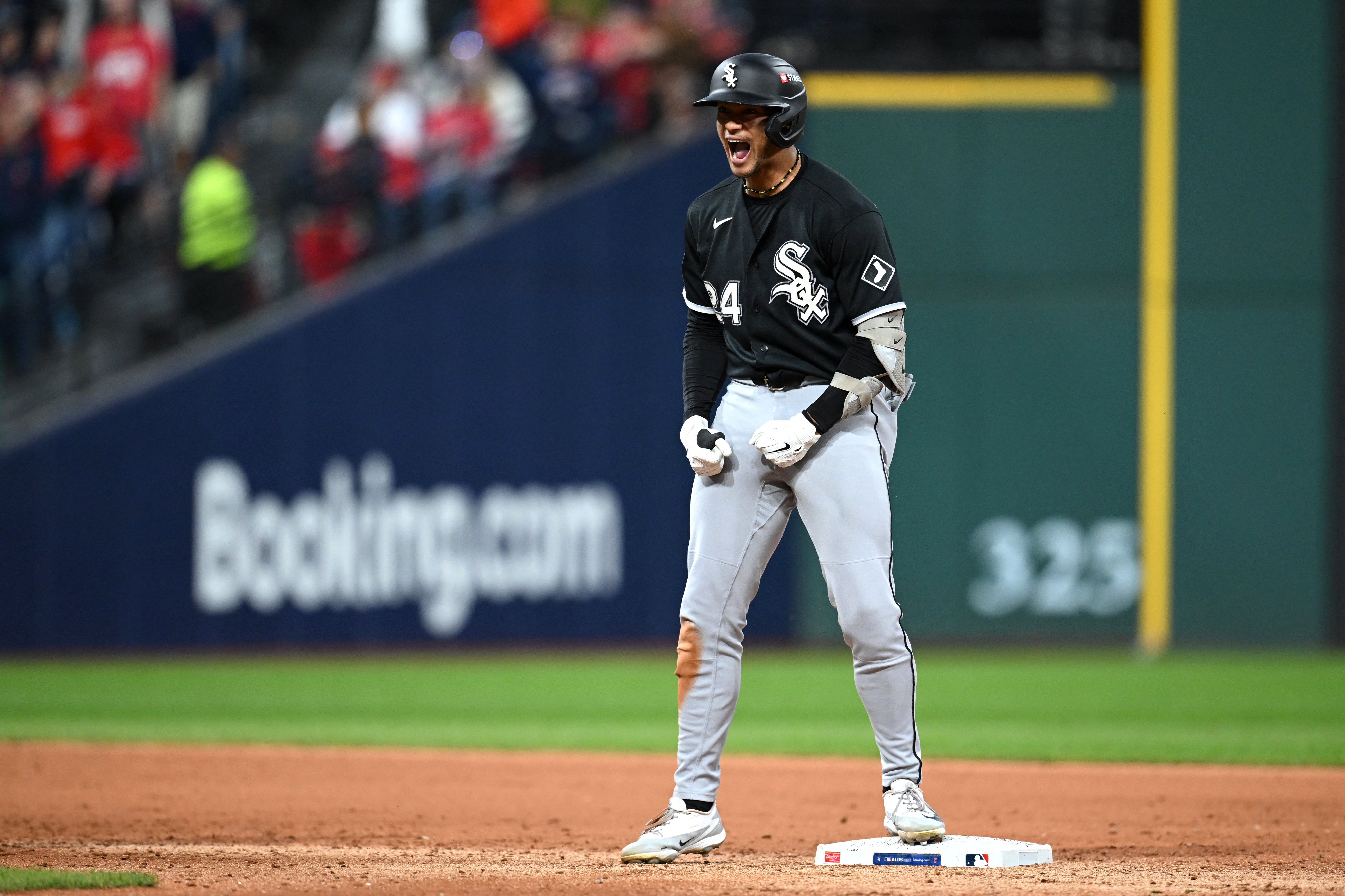
Cleveland finally got the early lead and dominant starting pitching it needed. Chicago absorbed both and left with another win.
The first game allowed Cleveland to wonder what might happen if the Guardians could simply score first. Game 2 answered the question, and the answer was worse.
Cleveland scored twice in the opening inning. Gavin Williams struck out 11 White Sox hitters and carried a 2-1 lead into the sixth. Progressive Field finally had the version of this series the Guardians were supposed to control.
Chicago won anyway.
Braden Montgomery’s two-run double turned the game in the sixth, Chase Meidroth added another run moments later and Sean Burke held Cleveland to one hit across 5 1/3 innings of relief. The White Sox survived one final scare and won 4-3, taking both games at Progressive Field and carrying a 2-0 ALDS lead back to Chicago.
The result matters beyond the obvious mathematics of a five-game series. Cleveland used home field, its best available matchup advantage and one of the strongest starts Williams has ever delivered. Chicago still found the inning it needed.
Cleveland Finally Put Chicago Behind
The White Sox entered Monday having spent almost the entire postseason playing from in front. Cleveland changed that immediately. The Guardians scored twice in the first inning against Chicago’s opening combination of Anthony Kay and Sean Newcomb, forcing the White Sox into their first deficit of these playoffs.
Through Chicago’s first 27 postseason innings, the White Sox had led for 24 and had not trailed at all. Cleveland’s early burst therefore represented something more useful than a 2-0 score. For the first time this October, Chicago had to demonstrate that its pitching structure and young lineup could function after the game moved against them.
The response was not immediate. Williams made sure of that.
Instead of allowing Chicago to answer with another quick swing, he turned the middle innings into a showcase of velocity and command. Williams reached 11 strikeouts, became only the third Cleveland pitcher to record double-digit strikeouts in a postseason game and repeatedly kept Chicago from converting baserunners into a larger inning.
This was the version of Williams the Guardians needed after losing Game 1. He did not merely keep Cleveland ahead. He made a one-run margin feel like it might be enough.
Sean Burke Turned the Game Back Into Chicago’s Kind of Baseball
The White Sox entered Game 2 with an unconventional pitching plan by traditional postseason standards. Kay opened, and Burke was supposed to handle the bulk innings behind him. Cleveland’s two-run first could have forced Chicago away from that structure before it had a chance to work.
Burke made sure that did not happen.
He worked 5 1/3 innings, allowed one hit and one earned run, struck out six and retired 13 consecutive hitters during the middle of his appearance. Cleveland had spent the first inning creating the exact kind of pressure Chicago was trying to avoid, then largely disappeared once Burke took control.
That is what made his outing more significant than a conventional relief appearance. Burke did not enter after a starter completed five innings. He effectively became the game’s primary pitcher after the opening plan had already encountered trouble, then stabilized it long enough for Chicago’s offense to wait out Williams.
The preview argued that the Kay-Burke structure could keep Cleveland from getting comfortable with one look for an entire game. Cleveland solved the first piece of it quickly. It never really solved the second.
Williams Dominated Until the Decision Moved Beyond Him
The sixth inning is where Game 2 will probably remain in Cleveland’s memory.
Williams entered the inning with a 2-1 lead and 11 strikeouts. Miguel Vargas led off with a single, pushing Williams to 98 pitches with Munetaka Murakami due next. Stephen Vogt went to left-hander Erik Sabrowski rather than asking Williams to navigate another portion of the inning.
The decision was defensible on workload and matchup grounds. It was also the moment the game escaped Cleveland.
Murakami moved Vargas over, Randal Grichuk drew a walk and a wild pitch advanced both runners. Sabrowski nearly escaped after getting Tommy Pham to lift a short fly ball, but Montgomery lined an opposite-field double down the right-field line to bring home two runs. Chicago had gone from trailing 2-1 to leading 3-2 on one swing.
Hunter Gaddis entered and Meidroth immediately drove in another run, extending the lead to 4-2. Williams had spent five innings demonstrating why Cleveland could control the game with elite starting pitching. Chicago needed only a few minutes against the bullpen to erase all of it.
That does not automatically make Vogt’s decision wrong. Williams had already reached 98 pitches, and Cleveland’s bullpen finished the regular season with one of the American League’s better ERAs. The deeper problem is that Cleveland had almost no margin for the bullpen to be anything less than excellent because its offense had stopped adding runs.
Braden Montgomery Found the Swing Chicago Needed
Montgomery’s double did not come in the kind of situation usually associated with a comfortable postseason rally. Chicago had been overwhelmed by Williams for most of the evening, had only just moved two runners into scoring position and was one out away from seeing Cleveland escape the inning with its lead intact.
The rookie changed all of it by going the other way.
Instead of trying to manufacture a home run in a moment that seemed to demand one, Montgomery stayed through the pitch and drove it down the right-field line. Vargas and Grichuk scored, Chicago took the lead and a game that had belonged to Williams suddenly belonged to the White Sox bullpen.
It also continued an emerging theme in Chicago’s postseason. The White Sox have not needed one established star to carry every game. Murakami supplied the defining swing in Game 1. Montgomery and Meidroth did it in Game 2. Against Houston, Meidroth had already delivered the three-run homer that broke open the Wild Card clincher.
For a team that entered October without the conventional heavyweight résumé of several clubs around it, that distribution matters. Chicago is becoming difficult to eliminate because the opponent cannot simply remove one hitter and assume the dangerous part of the lineup has passed.
Cleveland Still Had One More Chance
The game was not over after Chicago’s three-run sixth. Cleveland finally broke Burke’s run of control in the eighth, and Jo Adell came within a few feet of tying the game.
Grant Taylor entered after Chase DeLauter singled with two outs. Adell attacked Taylor’s first pitch and drove a ball to left-center that became an RBI triple, cutting Chicago’s lead to 4-3 and briefly making Progressive Field believe the game had turned again. Nathaniel Lowe followed with a line drive to left, where Sam Antonacci made the running catch that ended the inning.
Taylor then finished the ninth for his second save of the series. The workload deserves attention because he had already thrown four innings in Game 1. Chicago has treated pitcher roles as situational throughout the season, and October has only intensified that approach.
The White Sox are not asking whether someone is technically a starter, bulk pitcher, setup arm or closer before using him. They are asking which outs need to be recorded and who is best positioned to record them.
So far, the lack of traditional role boundaries has looked less like experimentation than an advantage.
The Pregame Numbers Underestimated Cleveland’s Real Problem
The pregame environment still described Cleveland as the more conventional favorite. Williams gave the Guardians exactly the kind of performance that could justify that view, and Cleveland finally produced the early scoring that was missing from Game 1.
Chicago nevertheless continued the season-long pattern that had made the matchup more complicated than the price suggested. The White Sox entered Game 2 having produced stronger returns over the full season despite finishing behind Cleveland in the division, and the internal Game 2 model again treated Chicago as more dangerous than the surrounding assumptions did.
The result landed almost exactly on the underlying argument. Chicago was not the team with the cleaner traditional setup, but it was the team better equipped to survive a game that stopped following the traditional setup.
The 4-3 final also moved beyond the extremely compressed scoring expectation without becoming a genuinely high-scoring game. Cleveland’s two-run first and Chicago’s three-run sixth accounted for most of the offense. Between those bursts, Burke and Williams controlled nearly everything.
That is a more useful explanation than treating seven runs as evidence that pitching suddenly failed. Most of Game 2 was a pitchers’ game. Chicago simply won the inning in which the structure broke.
Cleveland’s Home-Field Advantage Is Gone
The Guardians won the AL Central by one game and earned the right to begin this series in Cleveland. Two games later, that advantage has disappeared completely.
Chicago won both games at Progressive Field and now returns to Rate Field needing one victory to reach the ALCS. In best-of-five postseason series, teams taking a 2-0 lead have advanced 83 of 93 times. Teams winning the first two games on the road under the current Division Series format have advanced 17 of 19 times.
Cleveland does have one historical reminder that the series is not technically over. The 2017 Yankees dropped the first two games of an ALDS in Cleveland and then won three straight. The 2015 Blue Jays are the most recent club to lose the first two at home and still recover in a best-of-five.
Those examples describe what is possible. They do not solve Cleveland’s immediate problem, which is that the Guardians have scored three runs in two games and now have to win three consecutive games against a team that has not lost this postseason.
Game 3 Flips the Pressure Entirely
Wednesday’s Game 3 at Rate Field changes the geography and almost everything about the pressure surrounding it. Chicago finally gets a home postseason game after opening October with four consecutive road wins. Cleveland gets no transition period at all. One more loss ends its season.
The early numbers reflect how much has shifted. Chicago is now being treated as the slight home favorite rather than the substantial road underdog it was in Game 2, while the expected scoring range has moved upward toward 7.5. The early internal read actually gives Cleveland some support at the new price, but that view remains heavily dependent on a starting-pitching plan that has not yet been finalized.
That distinction is important because Game 2 showed exactly how much pitcher deployment can define this matchup. Cleveland received 11 strikeouts from Williams and still lost after one bullpen sequence. Chicago’s opener struggled, and Burke turned the remaining innings into one of the best pitching performances of the series.
The names attached to “starter” may matter less Wednesday than which manager gets the matchups behind them right.
Chicago Didn’t Just Change the Series. It Took Control of It.
Game 1 demonstrated that Chicago could win when Cleveland never scored. Game 2 demonstrated something more valuable.
The Guardians scored first. Williams dominated. Chicago trailed for the first time all postseason. Cleveland reached the sixth inning with its best pitcher having struck out 11 and a lead still intact.
The White Sox did not need any of those advantages to disappear. They needed one inning in which Cleveland became vulnerable, and they were ready when it arrived.
Burke gave them the time. Montgomery supplied the swing. Meidroth added the insurance run. Taylor survived Cleveland’s last serious counterattack.
Now the series moves to Chicago, where the White Sox can reach the ALCS with one more win. Cleveland spent the regular season finishing one game ahead of them.
Two postseason games have made that difference irrelevant.
Sources
MLB, October 5-6, 2026 — White Sox-Guardians Game 2 recap, Gavin Williams analysis and Game 3 FAQ | Reuters, October 6, 2026 — Chicago 4, Cleveland 3 | Sparked Sports White Sox-Guardians Game 2 preview, October 5, 2026 | Sparked Sports MLB postseason Edge Sheets, October 5-6, 2026