
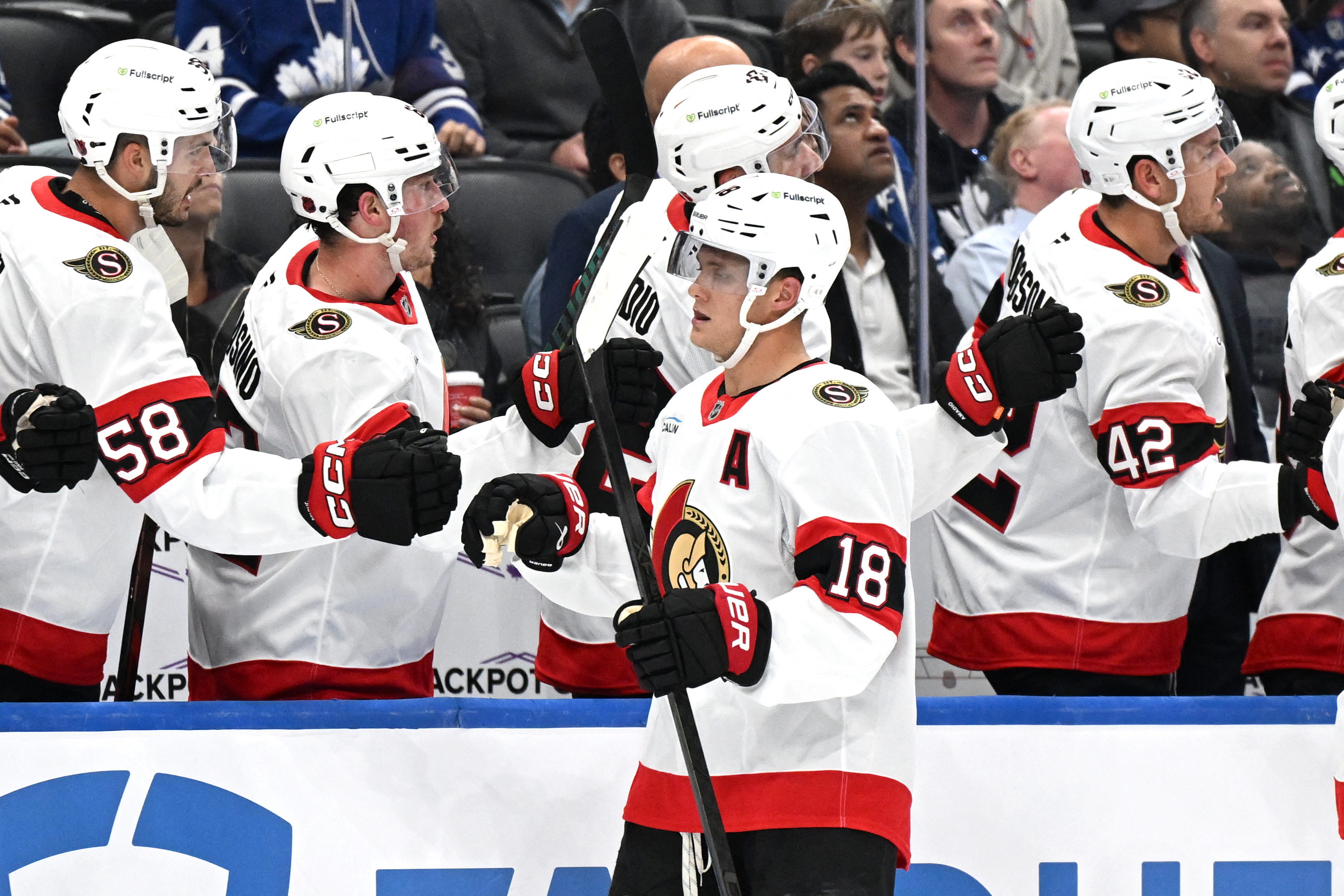
Ottawa is 2-0 after winning in Toronto and Boston. Detroit may provide the better test of how much of that start can survive injuries, travel and tired legs.
The Senators reached Detroit with almost everything a team wants from the beginning of a season. They have two road wins, Tim Stützle already looks dangerous and a reconstructed defense just helped hold Boston to one goal despite Jake Sanderson and Artem Zub both being unavailable.
They also arrive for their third game in four nights, on the second half of a back-to-back, with Sanderson still absent and uncertainty around Linus Ullmark after he left Monday’s 4-1 win in Boston following a crease collision. Samuel Ersson is projected to start, which means Ottawa will probably ask a different goalie to work behind the same depleted defense less than 24 hours after its most demanding game of the young season.
Detroit enters from the opposite direction. The Red Wings are 0-2, but Dylan Larkin is expected to return after missing the first two games with an upper-body injury. That does not repair every hole in Detroit’s lineup, with Marco Kasper, Mason Appleton and J.T. Compher still unavailable, but it restores the player around whom much of the offense is supposed to organize itself.
Two games are nowhere near enough to declare Ottawa transformed or Detroit broken. Tuesday is more interesting because the circumstances are beginning to test the machinery underneath those records.
Ottawa Already Passed One Version of This Test
The immediate concern after Sanderson was injured in Toronto was not simply that Ottawa had lost its best defenseman. Sanderson touches almost every part of the Senators’ structure. He moves the puck, handles difficult defensive minutes and can be used in virtually every game state.
Boston was supposed to expose that absence. The Senators instead held the Bruins to 19 shots, killed all four Boston power plays and produced a shorthanded goal of their own. Thomas Chabot, Jordan Spence, Tyler Kleven, Carter Yakemchuk, Cameron Crotty and Nikolas Matinpalo did not replace Sanderson individually. They distributed the work well enough that his absence never became the organizing fact of the game.
Detroit presents a different challenge because Ottawa does not get the recovery time that followed the opener in Toronto. The same defensive group that spent Monday night managing David Pastrnak and Boston’s forwards now has to turn around and deal with another team before its legs have fully reset.
That is where depth stops being an abstract roster quality. Ottawa has already shown it can survive without Sanderson for one night. Tuesday asks whether the replacement structure can hold together again without rest.
Ersson Changes What Ottawa Can Ask From Its Defense
Ersson’s expected start is a normal back-to-back decision made less normal by what happened to Ullmark in Boston.
Ullmark stopped all 10 shots he faced through two periods Monday before leaving after a collision in the crease. Ersson handled the third and stopped eight of nine shots while protecting a lead that was already 4-0 when he entered. The Senators therefore know he can step into a game without warning. Starting one from the opening faceoff creates a different responsibility.
Ottawa cannot build its plan around asking Ersson to erase a tired team’s mistakes. The cleaner path is to reduce how many difficult saves he has to make in the first place. That means shorter defensive-zone shifts, cleaner exits and fewer turnovers through the middle, particularly during the opening period when Detroit should have every incentive to test Ottawa’s legs.
The Senators recalled Jonas Johansson before the game after Ullmark’s injury, giving them another goaltending option on the trip. That roster move reinforces how quickly Ottawa’s margin has narrowed even while the results remain perfect.
Detroit Gets Larkin Back at Exactly the Right Time
The Red Wings have scored only twice through their opening two games. That makes Larkin’s expected return more important than simply adding another recognizable name to the lineup.
Larkin is expected to skate between Viktor Arvidsson and Lucas Raymond, immediately returning one of Detroit’s most important puck carriers and transition players to the center of the offense. His presence should also change the power play and reduce the amount of offensive creation being pushed onto Alex DeBrincat and Raymond while Detroit waits for the rest of its injured forwards to return.
The timing gives Detroit an obvious way to attack Ottawa. Larkin can force the Senators’ weakened defense to defend through the middle rather than simply protect the perimeter. Raymond and DeBrincat can punish failed exits, and John Gibson gives the Red Wings enough experience in goal that they should not need to turn the night into a track meet to win it.
Detroit remains incomplete. Kasper and Appleton are out, while Compher is day to day and unavailable Tuesday. Larkin’s return therefore makes the Red Wings more coherent without suddenly making them whole.
Stützle Is Giving Ottawa More Than Goals
The easiest explanation for Ottawa’s start would be that Stützle has four points through two games and scored twice in Boston. That is true, but the useful part of his start is how those points are being created.
His first goal Monday came shorthanded after Ottawa turned Boston’s power play into an odd-man rush. His second followed another transition sequence less than two minutes later. Later, his defensive-zone pressure created the turnover that sent Drake Batherson away for a breakaway goal.
That is important on a back-to-back because transition offense can reduce the amount of sustained offensive-zone work Ottawa needs to generate. The Senators do not have to grind through 45 seconds of possession every time they want a scoring chance if Stützle, Batherson, Dylan Cozens and William Eklund can turn one mistake into an immediate rush.
Detroit’s best response is to make Ottawa earn its offense from a stationary position. If the Red Wings manage the puck cleanly through the neutral zone and avoid feeding the Senators transition chances, the schedule begins to matter more. Chasing tired defenders around the defensive zone is much harder than attacking off a turnover.
Ottawa’s Scoring Depth Has Reduced the Injury Damage
The Senators are also surviving because the offense has not depended on one line producing everything.
Stützle has been the headline player, but Michael Amadio already has two goals and three points. Shane Pinto and Claude Giroux have been distributing the puck, Batherson scored in Boston and Stephen Halliday supplied the winner in Toronto. Even with Andre Burakovsky unavailable, Ottawa has been able to move offense through multiple lines rather than waiting for one combination to carry the entire night.
That becomes more valuable during the third game of a road trip. Green can shorten shifts without automatically reducing the attack to one scoring line. He can move combinations if someone looks tired, and Detroit cannot use last change simply to identify one group that must be stopped.
The weakness remains on the back end, where Sanderson and Zub are more difficult to replace by committee. Ottawa’s forward depth has helped keep that problem from spreading by forcing opponents to defend rather than allowing them to spend entire periods attacking the reconstructed blue line.
The First Ten Minutes Belong to Detroit
If Detroit cannot make Ottawa look tired early, the schedule advantage becomes much less useful.
The Red Wings should have the freshest legs, the home crowd and potentially the emotional lift of getting their captain back. That creates an obvious opening-period assignment: pressure Ottawa’s defense before it settles into another structured road game.
Forcing Chabot and Spence to retrieve pucks repeatedly is different from allowing them to move through the neutral zone under control. Making Kleven, Yakemchuk, Crotty and Matinpalo absorb forechecking pressure is more useful than exchanging low-danger perimeter possession. Detroit needs to make Ottawa’s missing defensemen visible in the way Boston failed to do.
Ottawa’s goal should be almost the opposite. Get through the opening stretch without turning the puck over, keep the game even and force the Red Wings to confront their own 0-2 start as the night progresses.
A scoreless opening period probably helps the Senators more than the Red Wings. Detroit needs to turn its situational advantage into something before Ottawa has time to settle.
Two Games Are Evidence, Not Identity
Ottawa’s perfect record and Detroit’s winless start are useful because they tell us what has happened. They are much less useful if they are treated as declarations of what these teams are going to be for the next six months.
The Senators have played well, but they have already lost major pieces from the lineup and are asking a shortened defensive group to complete a difficult road back-to-back. Detroit has started poorly, but getting Larkin back changes the center of its lineup while home ice gives Todd McLellan control over matchups that he did not have during either Ottawa road win.
The current market reflects that tension. Detroit is only a slight favorite despite Ottawa’s schedule disadvantage and injury list, with the NHL’s current board showing the Red Wings around -118 and Ottawa close to even. That is less a declaration that Detroit is better than recognition that Tuesday’s circumstances are considerably tougher for the Senators than their 2-0 record makes them look.
Ottawa’s opening results deserve respect. They do not remove fatigue, injuries or goaltending uncertainty from the equation.
Detroit Has the Better Spot. Ottawa May Still Have the Better Structure.
The Red Wings have almost every situational reason to expect a better night than their first two. They are home, rested, getting Larkin back and facing an opponent that played in Boston less than 24 hours earlier without two of its best defensemen.
The Senators’ case is less about circumstances and more about what they have already shown inside difficult circumstances. Their defensive group remained connected in Boston. Their forwards have generated offense across multiple lines. Their penalty kill turned Boston’s power play into an Ottawa scoring chance, and Stützle has been creating offense without requiring the entire game to revolve around him.
Detroit should make this harder than Boston did. Larkin’s return gives the Red Wings a player capable of attacking the exact areas where Ottawa is most vulnerable, while Ersson is being asked to start behind a group playing on tired legs.
But the Senators do not need another dominant performance. They need the game to remain organized long enough for their forward depth to create a few decisive moments.
Prediction: Ottawa Senators 3, Detroit Red Wings 2. Detroit’s schedule and lineup situation should make this Ottawa’s hardest game of the opening trip, but the Senators have shown enough defensive structure and enough scoring depth to survive an ordinary Ersson start if they keep the game from becoming chaotic early.
Ottawa has already proven it can win without being healthy.
Tuesday asks whether it can do it without being rested too.
Sources
NHL, October 6, 2026 — Senators-Red Wings projected lineups and goaltenders | Ottawa Senators, October 6, 2026 — Jonas Johansson recall and road-trip roster update | NHL Status Report, October 5-6, 2026 — Jake Sanderson, Dylan Larkin and Detroit injury updates | NHL Gamecenter, October 6, 2026 — current game and team data