
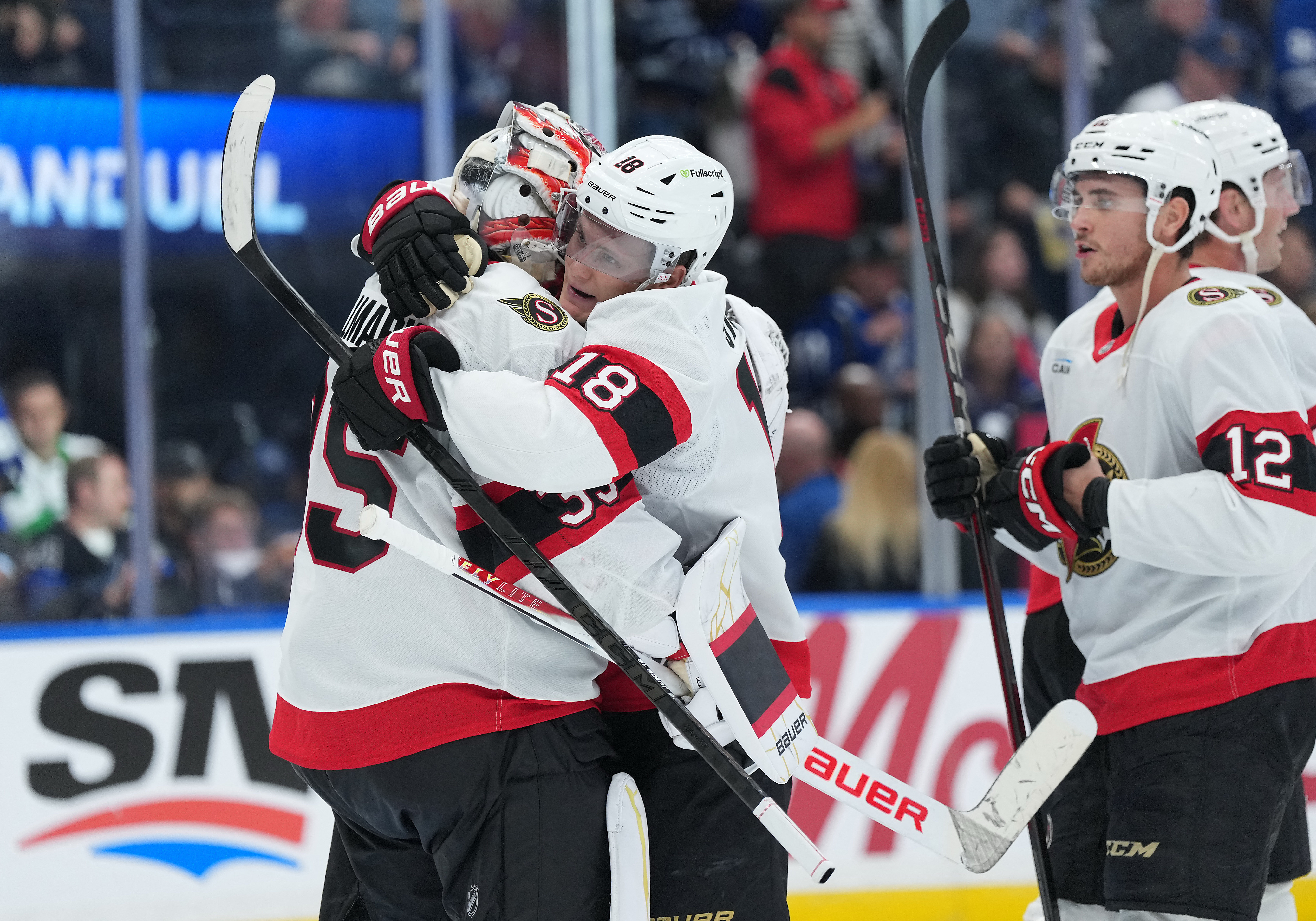
Ottawa beat Boston 4-1 without Jake Sanderson as Tim Stützle scored twice and the Senators turned special teams into an advantage.
The question entering Monday night was how long Ottawa could survive without Jake Sanderson and Artem Zub against a Bruins lineup with enough forward depth to keep attacking beyond the top pairing.
The Senators answered by making Boston’s offensive pressure almost irrelevant.
Tim Stützle scored twice in 1:43 during the first period, Drake Batherson made it 3-0 early in the second and Michael Amadio extended the lead to four before Boston had found a goal of its own. Ottawa went into TD Garden without two major defensemen and came out with a 4-1 win that was considerably more comfortable than the injury situation suggested it should have been.
Boston finished with only 19 shots. Its power play went 0-for-4. Ottawa scored shorthanded before the Bruins managed anything with the extra skater.
Sanderson’s absence mattered. It simply did not matter in the way Boston needed it to.
Stützle Broke the Game Open in 1:43
Ottawa did not wait long to change the matchup.
The Senators’ first goal came while Boston was supposed to have the advantage. Michael Amadio intercepted the puck during a Bruins power play and created a 2-on-1, sending a backhand pass across to Stützle for a one-timer that beat Jeremy Swayman at 7:39.
Boston’s power play expired less than two minutes later. Three seconds after it did, Stützle struck again.
He stole a pass, attacked on another odd-man rush, initially fanned on his shot and still recovered quickly enough to beat Swayman short side. Ottawa had scored twice in 1:43, with both goals emerging from sequences in which Boston either had or had just finished having the manpower advantage.
That changed the entire structure of the game. Ottawa no longer needed to ask its shortened defense to protect a tie while Boston rolled through its forward depth. The Bruins had to chase instead.
Boston’s Power Play Became Ottawa’s Opportunity
The preview identified special teams as one of the areas where Sanderson’s absence could hurt Ottawa most. He is not simply one of the Senators’ best five-on-five defensemen. His minutes normally reach into nearly every situation Ottawa has to manage.
Instead, the Senators’ penalty kill became one of their most effective weapons.
Boston went 0-for-4 with the power play, extending its season-opening drought to 0-for-10. Ottawa did more than survive those minutes. Stützle’s first goal came shorthanded, and the Bruins repeatedly struggled to turn their extra possession into sustained danger.
That is a more important result than simply saying Ottawa overcame an injury. The Senators had to redistribute Sanderson’s defensive and special-teams responsibilities among Thomas Chabot, Jordan Spence, Tyler Kleven, Carter Yakemchuk, Cameron Crotty and Nikolas Matinpalo. Boston knew exactly where the lineup had been weakened and still failed to exploit it.
The Bruins’ problem was not a lack of opportunity. They received four power plays. Ottawa kept turning those situations back against them.
Ottawa Didn’t Need Chabot to Do Everything
One concern after Sanderson left the Toronto game was that Ottawa would simply transfer an unsustainable workload onto Chabot.
There was always going to be some redistribution. Chabot is the captain, the most experienced defenseman remaining in the lineup and the obvious player to absorb difficult minutes. The more important question was whether the rest of Ottawa’s defense could keep those additional responsibilities from becoming a one-man assignment.
Boston’s 19 shots suggest the group did considerably more than survive.
Crotty entered the lineup for Sanderson. The Senators protected the middle of the ice well enough that Boston never generated the sustained territorial pressure that seemed possible before the game, and Ottawa’s forwards repeatedly helped turn defensive plays into transition opportunities.
Batherson’s goal early in the second period demonstrated that connection. Stützle forced a turnover in his own zone, immediately sent Batherson away on a breakaway and watched him beat Swayman on the backhand.
The defense did not need to imitate Sanderson. Ottawa needed the lineup around his absence to remain connected enough that one missing player did not deform everything else.
Ottawa’s Depth Scoring Wasn’t a One-Night Toronto Story
The opening win in Toronto had already suggested Ottawa might be able to distribute its offense more broadly this season.
Chabot, Amadio and Stephen Halliday scored the three goals that night. Stützle and Batherson did not need to dominate the scoresheet for Ottawa to win.
Boston produced the other version of that idea.
Stützle was the best player on the ice, finishing with two goals and an assist. Batherson scored. Amadio added a goal and an assist. Shane Pinto created Amadio’s second-period finish after Boston failed to clear its zone.
The Senators therefore opened their season with consecutive road wins without requiring the same players to provide every decisive moment.
That matters more in the current lineup because Ottawa is already missing offensive pieces as well. Andre Burakovsky remains unavailable, and Sanderson’s absence removes a defenseman capable of generating offense from the back end. Ottawa cannot afford to become dependent on one line while waiting for the roster to get healthier.
Ullmark’s Boston Return Ended Earlier Than Planned
Linus Ullmark’s return to TD Garden was one of the obvious stories before the game. It ended with a different question.
Ullmark stopped all 10 shots he faced through two periods, keeping his former team scoreless while Ottawa built its 4-0 lead. Late in the second, Bruins forward JJ Peterka collided with Ullmark in the crease.
Ottawa did not send him back out for the third period.
Travis Green described the decision as precautionary after Ullmark tweaked something on the collision. Samuel Ersson replaced him and stopped eight of nine shots in his Senators debut.
Boston’s only goal came at 3:30 of the third when James Hagens capitalized after Ersson misplayed the puck near the corner. It made the score 4-1 but never turned the game into a serious comeback attempt.
For Ottawa, the larger consequence is what happens next. Ullmark had already become more important because the Senators were trying to compensate for defensive injuries. Any uncertainty around him therefore matters more than it would with a full blue line in front of him.
Swayman’s Early Numbers Couldn’t Protect Boston
Jeremy Swayman entered Monday as one of Boston’s clearest advantages.
He had won his first two starts with a .947 save percentage and a shutout. Michael DiPietro had taken the Bruins’ loss in Minnesota, meaning Swayman returned against Ottawa rested rather than carrying the previous night’s workload.
Ottawa made those numbers largely irrelevant before the second period was six minutes old.
The Senators did not beat Swayman through sheer volume. He faced 24 shots and made 20 saves. They beat him by creating high-value opportunities from Boston’s mistakes: odd-man rushes, turnovers, a breakaway and a failed breakout that left Amadio open for the fourth goal.
That was the difference between this game and the low-scoring contest Boston appeared capable of creating before puck drop. Ottawa did not need to solve Swayman repeatedly through sustained offensive-zone possession. The Senators made Boston’s mistakes expensive enough that four goals arrived anyway.
The Bruins Have a Special-Teams Problem
Four games are nowhere near enough to define a season, but Boston’s power-play problem is no longer invisible.
The Bruins entered Monday without a power-play goal and left the same way. Ten opportunities have now passed without one.
That would already be frustrating. Allowing Ottawa’s opening goal while Boston had the extra skater made the problem more damaging.
The Bruins still have Pastrnak, Peterka, Elias Lindholm and enough skill to expect that drought to end. Charlie McAvoy’s suspension also removes an important part of the unit, so this is not Boston’s final special-teams structure.
What Monday showed is that the absence cannot excuse every failure. Ottawa was missing Sanderson and Zub from its penalty-killing options and still looked more dangerous during Boston’s power-play minutes than Boston did.
For one night, the supposedly depleted unit dictated the matchup.
Sanderson’s Absence Changed the Game Without Deciding It
The original preview was built around a reasonable concern. Ottawa had lost Sanderson after six shifts in Toronto, Zub was already unavailable and Boston had the forward depth to attack the reconstructed defense repeatedly.
That concern did not disappear because Ottawa won.
Sanderson has returned to Ottawa for testing and has already been ruled out for the remainder of the road trip, including Tuesday’s game in Detroit. Green has said the injury does not appear as serious as initially feared, but the Senators still have another game to play with the same structural problem.
What changed Monday is how Ottawa should understand that problem.
The Senators no longer have to wonder whether the defense can function for one night without Sanderson. They have done it twice: first protecting a one-goal lead after he left early in Toronto, then controlling Boston without him from the opening faceoff.
That does not make Ottawa better without one of its best players. It shows that losing him does not automatically force the rest of the lineup into survival mode.
Boston was supposed to find the weak point.
Instead, Ottawa found Boston’s.
Sources
NHL, October 6, 2026 — Senators-Bruins game recap | Ottawa Senators, October 6, 2026 — Senators-Bruins recap | NHL, October 5, 2026 — Senators injury and lineup status | Reuters, October 6, 2026 — Ottawa 4, Boston 1 | Original Sparked Sports Senators-Bruins preview, October 5, 2026