
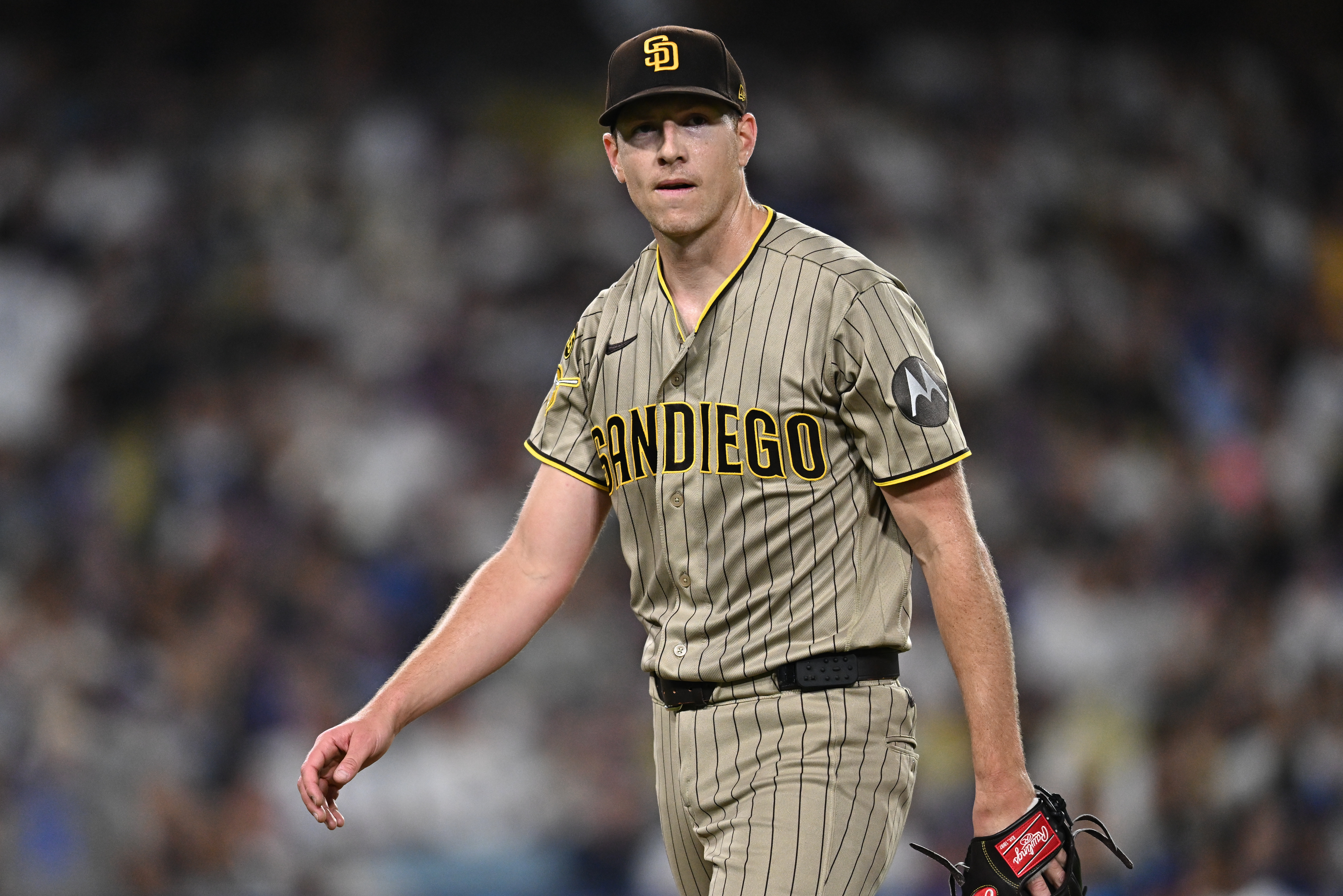
Brewers vs Padres Game 3 gives San Diego the cleaner starting-pitcher matchup and Milwaukee something more important: three chances to win once.
The Brewers arrive at Petco Park one victory from the National League Championship Series after spending the first two games demonstrating how little a postseason game cares about the matchup that looks cleaner before first pitch.
San Diego had Michael King on the mound in Game 2. It carried a lead into the ninth. Mason Miller was one strike away from finishing the game. Jackson Chourio still lined a two-run single into center field and Milwaukee walked off with a 4-3 win.
Now the matchup looks tilted toward the Padres again.
Nick Pivetta enters Game 3 with a 2.86 ERA and has been excellent since returning from a flexor strain in September. Dustin May finished the regular season at 4.70 and struggled badly over the final stretch after joining Milwaukee.
The pregame numbers reflect that difference. San Diego is being treated as the stronger team Tuesday night despite trailing the series 2-0, while the expected scoring range sits around seven runs.
That makes sense if Game 3 is considered in isolation. The problem for San Diego is that the series no longer exists in isolation. Milwaukee has already created the only advantage that cannot be modeled away: the Padres have to win every remaining game. The Brewers only have to win one.
San Diego Had Game 2 Until It Didn’t
The Padres should not need much convincing that Milwaukee can survive a game in which San Diego appears to have done enough.
Game 2 provided the demonstration.
Milwaukee committed three errors. Its offense produced almost nothing for most of the night. San Diego’s pitchers repeatedly kept the Brewers from building innings, and Miller entered with a chance to protect the lead using the kind of overpowering velocity that normally makes a postseason game feel finished before the final out is recorded.
It still was not enough.
Chourio came to the plate with two outs in the ninth and Milwaukee down to its final strike. Miller was still throwing harder than 100 mph. Chourio stayed through the pitch and sent a two-run single into center, turning a likely 1-1 series into a 2-0 Milwaukee lead.
That sequence matters entering Game 3 because San Diego cannot approach Tuesday as though correcting a few small mistakes will automatically restore control. The Padres played most of Game 2 well enough to win and still lost it.
Milwaukee has made that kind of survival one of its defining traits.
Dustin May Doesn’t Need to Beat Nick Pivetta
The obvious starting-pitcher comparison favors San Diego.
Pivetta returned from nearly five months on the injured list and immediately looked like one of the Padres’ most reliable starters. Including his Wild Card appearance against Chicago, he has posted a 1.64 ERA since returning in September. His first postseason start lasted only 3 1/3 innings, but he allowed one run and San Diego was able to turn the game over to its bullpen from a position of strength.
May reaches October from the opposite direction. He allowed only three earned runs across his first 13 innings with Milwaukee, then went 1-2 with a 7.61 ERA over his final eight outings. The Brewers are not pretending the last several weeks did not happen.
They also do not need May to imitate Pivetta.
Milwaukee has Robert Gasser, Shane Drohan and Kyle Harrison available behind him, while its primary late-inning relievers enter Game 3 after Monday’s travel day. May’s assignment can therefore be narrower than the word “starter” suggests. He needs to keep San Diego from creating immediate separation and get the Brewers into the part of the game where their pitching depth can take over.
There is also matchup history working in his favor. May has a 3.14 career ERA against San Diego and allowed only a 1.23 ERA across three starts against the Padres this season.
The season-long number says San Diego should prefer Pivetta. The head-to-head history gives Milwaukee a reason to believe May can keep the disadvantage manageable.
Milwaukee’s Bullpen Has Quietly Controlled the Series
The biggest pitching story through two games has not belonged to either Game 3 starter.
Milwaukee’s bullpen has thrown nine scoreless innings in the series.
That changes how Pat Murphy can handle May. The Brewers do not have to remain committed to him because removing a starter early feels like surrendering an advantage. They have already spent two games demonstrating that changing pitchers can be part of the plan rather than evidence that the plan failed.
Trevor Megill, Abner Uribe and Aaron Ashby have all worked scoreless baseball in the first two games. The travel day gave that group additional recovery time before Game 3, while Milwaukee’s extra starters remain available if May cannot provide length.
San Diego’s bullpen is rested too, and that matters because Pivetta may not be asked to work deep after spending so much of the season recovering from an elbow injury. Both managers therefore have options.
The difference is what those options are protecting. San Diego’s bullpen is trying to extend the season. Milwaukee’s is trying to end it.
Jackson Chourio Is Becoming Milwaukee’s October Constant
Chourio’s Game 2 winner was dramatic enough to stand alone. It becomes more interesting when placed beside what he has already done in October.
At 22, he is already Milwaukee’s career postseason home-run leader with five and sits one RBI behind Ryan Braun for the franchise postseason record. The scale of those numbers says as much about Brewers history as it does about Chourio, but that is part of the point.
Milwaukee has reached the postseason regularly in recent years without consistently turning those appearances into deep runs. Chourio has arrived during the most successful sustained stretch in franchise history and is already producing the moments that previous Brewers teams often lacked.
His ninth-inning single Sunday was not a case of Milwaukee’s best hitter waiting for the perfect pitch. Miller was throwing triple digits and had Chourio down to the final strike. The Brewers needed a difficult at-bat won against one of baseball’s most overwhelming relievers.
Chourio won it.
That makes San Diego’s Game 3 problem larger than figuring out how to keep one hitter from producing another highlight. The Padres have to prevent the game from remaining close enough for Chourio, William Contreras, Christian Yelich or somebody else to decide it late.
San Diego’s Advantage Has to Become Runs Early
If the Padres are going to turn this series around, the cleanest path begins before Milwaukee can start cycling through its bullpen.
May’s 4.70 ERA makes the opening innings the obvious place for San Diego to attack. Fernando Tatis Jr., Manny Machado and Jackson Merrill should not want Game 3 drifting into the sixth inning at 1-1 while Milwaukee begins choosing matchups from a rested relief group.
That is also why the possibility of an early run is more compelling here than in several of Tuesday’s other postseason games. Pivetta gives San Diego legitimate run prevention on one side of the matchup, but May’s late-season struggles create a route for the Padres to change the game’s shape before the deeper pitching plan begins.
An early lead would allow Pivetta to attack Milwaukee without carrying the burden of needing to be perfect. It would let Mike Shildt choose when to deploy his best relievers instead of waiting for Milwaukee to create the crisis first.
Most importantly, it would give San Diego its first real chance to make Milwaukee play Game 3 instead of the series.
Seven Runs Doesn’t Make This a Pitchers’ Duel
The expected scoring range around seven suggests another relatively tight game, but this is not Yamamoto against Sale in Atlanta.
There is considerably more uncertainty here.
May’s recent form creates an obvious path toward San Diego scoring early. Pivetta’s workload history creates uncertainty about how many innings the Padres can reasonably demand from him. Both bullpens are capable of controlling the late game, but both managers may be forced to reach those bullpens earlier than they would prefer.
The seven-run expectation therefore feels less like a prediction that both starters will dominate and more like recognition that neither offense has consistently turned this series into a high-scoring game.
The first two meetings have produced six and seven combined runs. Game 2 reached seven despite three Milwaukee errors and the kind of ninth-inning finish that could easily have produced more.
Another close game would not be surprising. Assuming it will stay quiet simply because the first two did is more difficult to justify.
San Diego Is Favored Because Game 3 Is Built for San Diego
There is nothing irrational about treating the Padres as the stronger team Tuesday night.
They are home. They have the better starting pitcher on current form. Pivetta has allowed almost nothing since returning from the injured list. May struggled through the end of the regular season. San Diego won 53 home games and has a bullpen capable of turning a lead after five innings into a very short game.
If this were a single regular-season game without context, that would probably be enough to end the discussion.
It is not.
Milwaukee won 105 games. It finished 48-33 away from home and spent the season repeatedly producing better results than the assumptions surrounding it. That pattern has continued into October, where the Brewers have already taken two different types of games from San Diego.
The first required controlling the Padres. The second required surviving their own mistakes, staying close and finding one final swing against Miller.
Game 3 asks them to survive another obvious disadvantage.
At this point, that is less unusual for Milwaukee than it sounds.
The Pressure Is Entirely San Diego’s Now
A 2-0 lead creates one of the strangest asymmetries in postseason baseball.
Milwaukee can lose Tuesday and still wake up Wednesday one victory from advancing. San Diego cannot lose an inning at the wrong time without risking the end of its season.
That does not mean the Padres will play scared, and desperation does not automatically make a team worse. It changes the consequences attached to every decision.
How long does Shildt leave Pivetta in if Milwaukee puts two runners aboard in the fifth? How quickly does he reach Miller after asking him for 40 pitches in Game 2? How aggressively does San Diego run the bases if a marginal opportunity appears? How much patience does an offense maintain when every scoreless inning brings elimination closer?
Milwaukee has versions of those questions too. None of them carry the same penalty for getting the answer wrong.
Milwaukee Doesn’t Need the Better Matchup
Game 3 begins with San Diego holding the advantages most people usually look for.
Pivetta over May. Petco Park instead of American Family Field. A rested home bullpen. An offense that gets the first chance to attack the shakier starter.
The Brewers’ argument is not that those advantages are imaginary. It is that Milwaukee has spent an entire season making individual matchup disadvantages less decisive than they appear.
The Brewers have bullpen depth behind May. They have already won twice in the series. They have a lineup capable of turning one late opportunity into the entire game, and they can make decisions knowing another game exists tomorrow if Tuesday goes wrong.
San Diego has the better starting point.
Milwaukee has the larger margin for imperfection.
Prediction: Milwaukee Brewers 3, San Diego Padres 2.
A 3-2 Milwaukee win would fit the series better than a dominant performance from either starter. May does not need to silence San Diego for seven innings. He needs to keep the Padres close enough for Milwaukee’s deeper pitching plan to engage, and the Brewers need one offensive sequence to matter more than everything surrounding it.
They have already done that twice.
One more time ends the series.
Sources
MLB, October 6, 2026 — Brewers-Padres Game 3 FAQ and probable pitchers | MLB, October 6, 2026 — NLDS Game 3 storylines | MLB, October 4-5, 2026 — Game 2 result, Chourio walk-off and series context | Sparked Sports MLB postseason Edge Sheet, October 6, 2026