
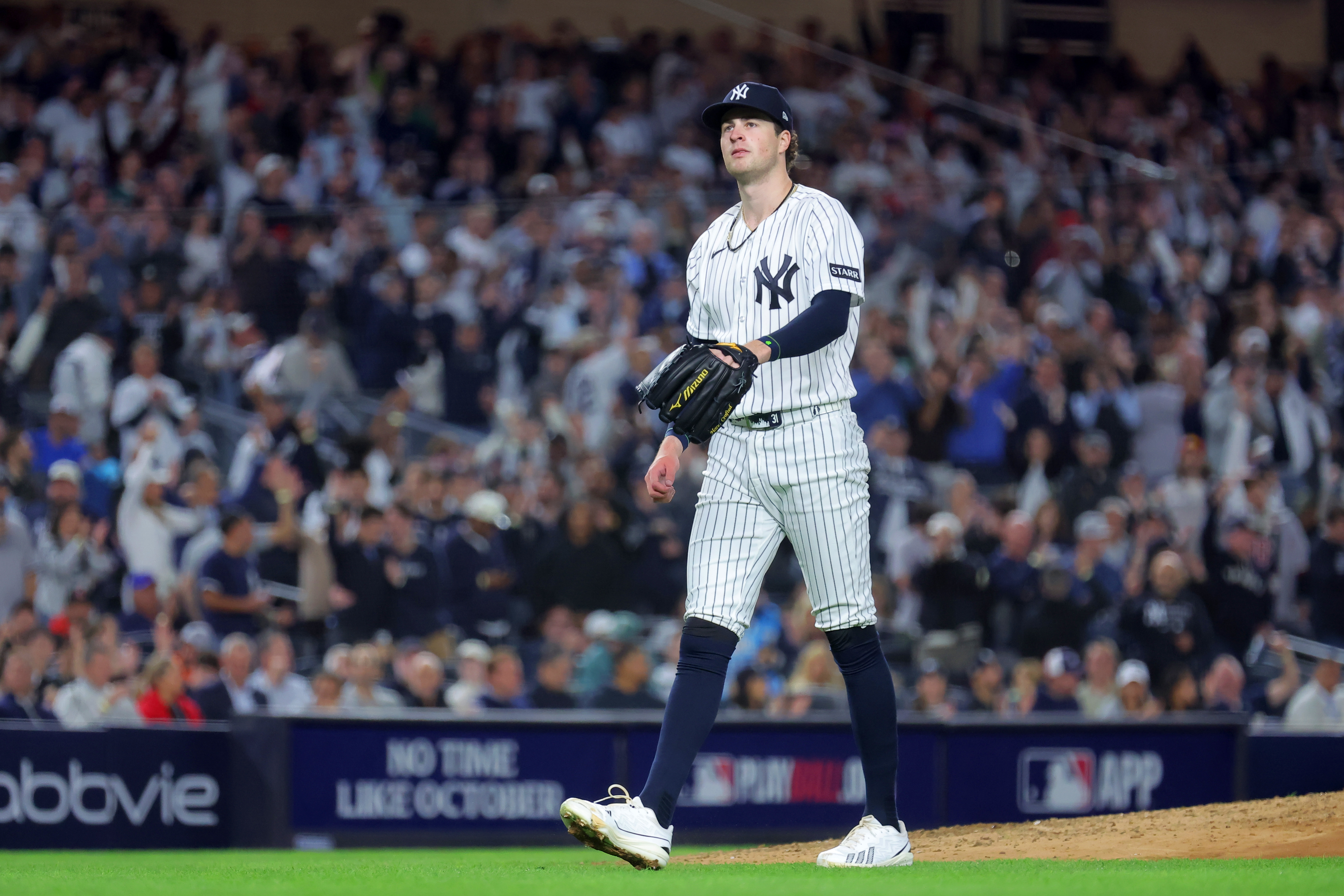
Yankees vs Rays Game 2 begins with Tampa Bay ahead, New York coming off a one-hit shutout and one of baseball’s best pitchers trying to change the series by himself.
The Yankees scored 18 runs while sweeping Boston in the Wild Card round. Then they arrived at Tropicana Field and produced one hit.
Drew Rasmussen carried a no-hitter into the eighth inning Saturday, Jonathan Aranda provided the game’s only run and Tampa Bay opened the ALDS with a 1-0 win that looked exactly like the kind of baseball the Rays have been built to play. They did not overwhelm New York. They made one run sufficient.
Monday night presents a different problem. Cam Schlittler gives the Yankees an immediate way to reset the series, while Freddy Peralta gives Tampa Bay a pitcher who has been performing nothing like his full-season numbers for more than a month.
The pregame numbers capture the tension. New York is still being treated as a slight road favorite despite trailing the series against a Tampa Bay team that finished 98-64, went 55-26 at home and won seven of 13 meetings between the clubs during the regular season. Expected scoring remains compressed around 6.5 runs.
That tells us something useful even without turning the game into an argument about wagering. Tampa Bay has accumulated almost every contextual advantage available to it. Schlittler is still powerful enough to make people hesitate.
Game 1 Did Not Look Like the Yankees Team That Arrived
New York entered the Division Series with its offense moving in the opposite direction. The Yankees had scored 18 runs in two games against Boston, including enough damage to make the Wild Card round feel brief rather than stressful.
Rasmussen erased all of it.
He struck out 10, allowed two walks and held the Yankees without a hit until Austin Wells doubled with two outs in the eighth. Wells was thrown out trying to stretch the double into a triple, which meant New York’s first hit also became the final out of its best scoring opportunity.
The Yankees finished with the fewest hits they have ever recorded in a postseason game.
That does not mean one night has exposed some permanent weakness in the lineup. It does mean Tampa Bay has already changed the terms of the series. New York now needs to solve another right-hander while playing without Aaron Judge, who remains off the ALDS roster as he works back from a calf injury.
A 1-0 series deficit is manageable. Another night spent waiting for the offense to arrive would create an entirely different problem, because Games 3 and 4 move to New York with Tampa Bay needing only one more win if it leaves the Trop up 2-0.
Cam Schlittler Changes the Shape of the Game
The Yankees’ answer is about as convincing as an answer can be.
Schlittler finished the regular season 14-6 with a 1.95 ERA, but even those numbers undersell what he did away from Yankee Stadium. Across 17 road starts, he went 8-2 with a 1.16 ERA. He led the majors on the road in ERA, strikeouts, opponent batting average, opponent on-base percentage, opponent OPS and WHIP.
Tropicana Field did not bother him during the regular season either. Schlittler faced Tampa Bay three times and finished with a 2.81 ERA. His July 6 start at the Trop was one of his best performances of the year: eight innings, one run, eight strikeouts and no walks.
That gives New York something it did not have in Game 1: a realistic chance to make Tampa Bay’s offense feel the same pressure Tampa Bay just imposed on the Yankees.
The Rays do not need much offense if Peralta is sharp. The Yankees may not need much either if Schlittler is himself. That is how a game with two dangerous lineups ends up carrying expectations usually reserved for a much more obvious pitching duel.
Freddy Peralta’s Season Line Is Almost Useless Now
Reading Peralta’s full-season 4.42 ERA without context gives the wrong picture of the pitcher Tampa Bay is sending out Monday.
The Rays acquired him from the Mets in August. Over his final six starts, Peralta went 5-0 with a 0.79 ERA and earned American League Pitcher of the Month honors for September. He has been even better inside Tropicana Field, posting a 1.69 ERA and 0.75 WHIP across four home starts since joining Tampa Bay.
The change matters because the original version of this matchup looked like a contrast between New York’s ace-level starter and a Tampa Bay pitcher with ordinary season-long numbers. That is not really the matchup anymore.
Schlittler has been extraordinary for months. Peralta has been extraordinary much more recently.
Tampa Bay also enters Monday with the bullpen positioned about as well as Kevin Cash could have hoped. Rasmussen gave the Rays eight innings in Game 1 and Bryan Baker handled the ninth, leaving virtually the entire relief group untouched despite the intensity of the opener.
If Peralta gets Tampa Bay through five or six innings without New York breaking the game open, Cash has considerably more freedom than a manager normally expects two games into a postseason series.
Tampa Bay Has Already Earned the Home-Field Advantage People Keep Forgetting
The strange part of Monday’s setup is that Tampa Bay still feels like the team being asked to prove itself.
The Rays finished with the best record in the American League. They spent 133 days atop the AL East, led the division for the final three months and finished 42-22 from July 20 through the end of the regular season. At Tropicana Field, they went 55-26.
They also won the season series against New York 7-6.
None of those numbers makes the Yankees an impostor. New York was excellent away from home and possesses the stronger run differential. Schlittler may be the single biggest advantage belonging to either team Monday night.
But the continued assumption that New York should be slightly stronger requires treating Tampa Bay’s body of work as something less persuasive than its name recognition. The Rays have spent six months making that assumption difficult to defend.
Saturday only added another piece of evidence. Tampa Bay did not require a fluke rally or a collection of defensive mistakes. It won the game the way a 98-win club is supposed to be capable of winning: pitching, one decisive swing and no unnecessary openings.
Six and a Half Runs Tells You What Kind of Game This Could Become
The expected scoring range is unusually narrow for two teams that combined for 1,475 regular-season runs.
That is not a judgment on the offenses as much as it is respect for the pitching environment. Schlittler can dominate a lineup for seven innings. The version of Peralta Tampa Bay has seen over the last six weeks can do the same thing. Behind him sits a rested bullpen that barely had to participate in Game 1.
That makes the first run disproportionately important.
If Tampa Bay scores first again, New York could find itself chasing the game while wondering how many opportunities Schlittler is going to need to preserve. If the Yankees score first, Schlittler can attack the strike zone knowing every clean inning increases the pressure on Peralta.
One early run does not necessarily open the game. In this environment, it can do the opposite. It can allow the team ahead to become more selective about which relievers it uses, which matchups it attacks and how aggressively it needs to create additional offense.
Game 1 showed the extreme version of that logic. Aranda homered in the third inning. Tampa Bay never needed another run.
The Yankees Need to Prove Schlittler Is Enough
New York may have the best individual pitcher in Game 2. Tampa Bay may have almost everything else.
The Rays have the series lead, the home field, the better regular-season record, the season-series advantage, a rested bullpen and a starter who has allowed almost nothing for six weeks. The Yankees have Schlittler and an offense with far more ability than Saturday’s one-hit line suggests.
That creates a game where the conventional hierarchy feels upside down. The club that finished first in the American League and just won Game 1 at home is still being treated as though it needs to overcome the stronger team.
Maybe Schlittler is good enough to justify that. His season provides plenty of evidence that he could be.
But Tampa Bay has provided an entire season’s worth of evidence on the other side, and Peralta’s recent transformation closes what initially looked like the largest gap between the teams.
Prediction: Tampa Bay Rays 3, New York Yankees 2.
A 3-2 game would fit both the pitching matchup and the shape the series has already taken. New York should create more than it did Saturday, but Tampa Bay does not need another one-hit masterpiece. It needs Peralta to keep Schlittler’s margin small enough for one or two moments to decide the night.
Sources
Supplied Winners & Whiners Yankees-Rays Game 2 preview and market data | MLB, Yankees-Rays ALDS Game 2 FAQ, October 4, 2026 | MLB, Yankees ALDS Game 1 recap, October 3, 2026 | MLB, 2026 Division Series matchup preview and official regular-season standings