
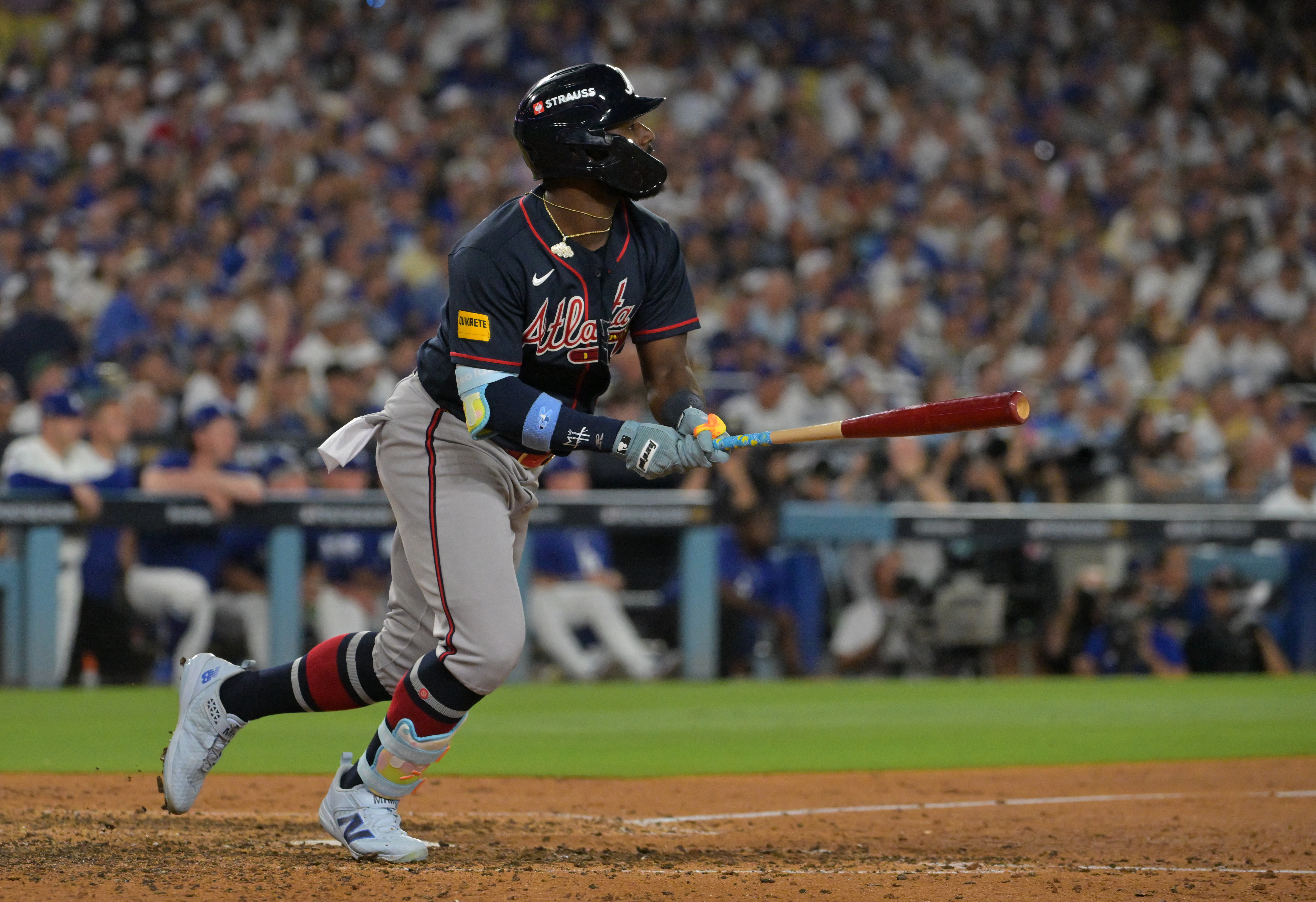
Atlanta beat Los Angeles 3-2 to even the NLDS. Chris Sale now faces Yoshinobu Yamamoto in Game 3 with the series shifting to Atlanta.
Atlanta went into Game 2 needing to steal a road game without using Chris Sale as its starter. The Braves did exactly that.
Michael Harris II collected three hits, Ray Kerr and Didier Fuentes carried an improvised pitching plan deep into the game, and Atlanta beat Los Angeles 3-2 Sunday night to send the National League Division Series back to Truist Park tied 1-1.
The original Game 2 call had Atlanta winning 4-3. The Braves landed on the right side at +125, with one fewer run for each team. More important for the series, Atlanta earned the split while giving Sale enough time to make a conventional Game 3 start.
That leaves Atlanta with Sale on Tuesday, Yoshinobu Yamamoto across from him, two games at home and a season-long performance profile that has continued to hold up against the Dodgers.
Harris Drove the Atlanta Offense
Harris finished 3-for-5 with a single, triple, double, RBI and a run scored. His triple in the fifth put Atlanta in position to break through against Blake Snell, and he scored on a wild pitch. Harris added an RBI double in the seventh that brought Matt Olson home and gave the Braves a 3-1 lead.
Los Angeles never found the hit that could flip the game. The Dodgers finished 0-for-8 with runners in scoring position and managed six hits. Freddie Freeman homered earlier in the game, and Max Muncy made the ninth inning uncomfortable with a solo shot that cut Atlanta’s lead to one.
Raisel Iglesias entered for the final out and finished the 3-2 win.
The result also continued a strong postseason for Harris. He had already homered in Atlanta’s Wild Card clincher against Philadelphia and has become one of the Braves’ most productive hitters during their run through the first two rounds.
Atlanta’s Pitching Plan Worked Again
Walt Weiss used an opener for the third consecutive postseason game and again got what he needed from it.
Kerr gave Atlanta 2 2/3 scoreless innings, striking out four and allowing two hits. That came only three days after he threw 3 1/3 scoreless innings against Philadelphia in the Wild Card round.
Fuentes followed with 3 2/3 innings and carried the Braves into the later innings without allowing the Dodgers to create a sustained rally. Atlanta used six pitchers in total.
That pitching plan had a second purpose. Sale recorded the final four outs of Atlanta’s Wild Card clincher Thursday, which made another immediate start an awkward proposition. Holding him back Sunday allowed Atlanta to give its ace a normal recovery window and still leave Los Angeles with a split.
The gamble has already paid once. Game 3 is where the larger payoff becomes available.
Sale and Yamamoto Get Game 3
Tuesday’s pitching matchup is about as good as a tied Division Series can produce.
Sale finished the regular season 14-9 with a 2.16 ERA and 200 strikeouts. He posted a 1.96 ERA over his final 24 regular-season starts and was especially good against Los Angeles, allowing a 1.13 ERA across two starts.
His last meeting with the Dodgers came August 27 in Atlanta. Sale threw a complete-game shutout, struck out 11 and beat Yamamoto 1-0.
Yamamoto enters Game 3 at 14-9 with a 2.53 ERA and 182 strikeouts. His postseason record is already substantial: 7-1 with a 2.25 ERA through 10 appearances, including nine starts.
Atlanta also won five of six regular-season meetings with Los Angeles, including a three-game sweep at Truist Park in August.
The Market Has Game 3 Nearly Even
The early Game 3 market reflects how much the series changed Sunday.
Atlanta is currently around -109, with Los Angeles approximately -101 and the full-game total at 6. The Game 2 market had made the Dodgers roughly -150 at home against Atlanta’s opener-based pitching plan.
Moving to Atlanta and replacing that plan with Sale has erased the Dodgers’ favorite status.
The season-long results support a close price. Atlanta is 97-70 in games covered by the current moneyline sample, producing an 8.90-unit profit and a 3.90% return. At home, the Braves are 54-30 with a 7.74% return.
Los Angeles has won even more games, going 101-63, while its prices have required a much higher win rate. The Dodgers have returned -4.95% on the moneyline overall. Their road return sits at -1.92%.
Atlanta has also been stronger against the run line, returning 5.90% overall and 9.81% at home. Los Angeles has returned -13.20% overall.
Early Runs Have Been Expensive
A total of 6 is unusually low for a modern MLB game. Sale and Yamamoto give the market a reason to start there.
The larger postseason environment points in the same direction. Since MLB adopted the current playoff format in 2022, Division Series games have regularly rewarded lower-scoring first-five outcomes. The first-five Under 3.5 has gone 24-19 for a 13.70% return, while Under 4.5 has gone 28-15 for a 12.65% return.
This year’s Division Series has started the same way. Five of the first six games finished the fifth inning with three runs or fewer.
Atlanta and Los Angeles have contributed to that pattern themselves. Game 1 was scoreless through three innings before the Dodgers finally got to Atlanta’s bullpen. Game 2 reached the middle innings with both pitching staffs limiting sustained offense.
The first-five market for Game 3 is especially interesting because Atlanta has produced one of the stronger team profiles there. The Braves are 89-78 on the first-five run line overall, with a 10.58% return at home. Los Angeles is 78-86 overall in the same market, with a -11.47% return.
The early Game 3 expectation fits a tight game built around Sale and Yamamoto before either bullpen becomes the central variable.
Atlanta Changed the Series in Los Angeles
A 1-1 series normally looks neutral. Atlanta arrives home with more than the score alone.
The Braves lost Game 1 against Tarik Skubal, then won Game 2 without spending Sale. They now get their ace in Game 3 at a park where they swept Los Angeles less than six weeks ago. Tyler Mahle is lined up behind him for Game 4.
Los Angeles still has the deepest starting-pitching group in the matchup. Skubal already won Game 1, Yamamoto starts Tuesday, and the Dodgers have enough power to turn any low-scoring game with one mistake. Freeman and Muncy demonstrated that Sunday even in defeat.
Atlanta has forced the Dodgers into a best-of-three and earned home field for the next two games. The Braves also have the pitcher they spent Game 2 protecting ready for the first one.
Game 3 Could Decide the Shape of the Series
The winner Tuesday moves one victory from the NLCS.
An Atlanta win would put Sale’s start together with home field and a 2-1 series lead. Los Angeles would have to win Game 4 in Atlanta simply to get the series back to California.
A Dodgers win would restore the advantage they surrendered Sunday and leave Atlanta facing elimination the following night.
Sale’s recent work against Los Angeles, Atlanta’s 5-1 regular-season record in the matchup and the Braves’ stronger home market performance give them enough to hold a small edge. Yamamoto and the Dodgers’ lineup keep the margin narrow.
Game 3 prediction: Atlanta Braves 3, Los Angeles Dodgers 2.
Sources
MLB, Braves-Dodgers NLDS Game 2 recap | MLB, Dodgers-Braves Game 3 preview and probable pitchers | Reuters, Braves-Dodgers Game 2 recap | Los Angeles Dodgers, 2026 NLDS series information | EVAnalytics, 2026 MLB market results | MLB postseason results and market history since 2022