
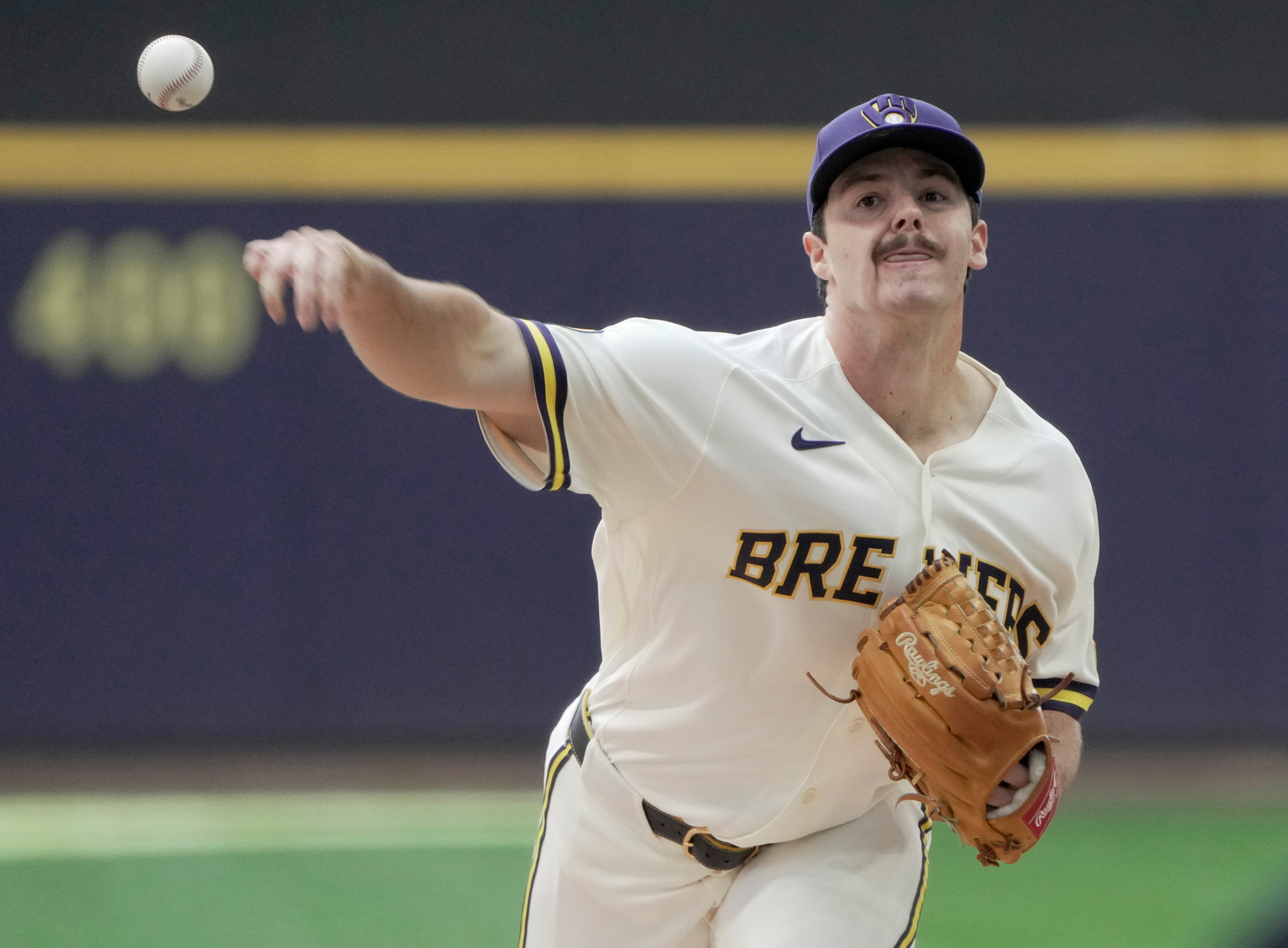
Michael King starts Game 2 after seven scoreless innings as San Diego tries to even the NLDS against Milwaukee.
Milwaukee has the series lead. San Diego left Game 1 looking considerably closer to the Brewers than a 1-0 deficit might suggest.
The Padres collected nine hits, drew four walks and put runners on base throughout Saturday’s 3-2 loss. They forced Jacob Misiorowski out after four innings, reached Milwaukee’s bullpen repeatedly and finished with 12 runners left on base. The Brewers won because Jackson Chourio and William Contreras supplied the two swings that San Diego never found.
Game 2 gives the Padres a chance to run a similar game with a stronger starting-pitching advantage on their side. Michael King faces rookie Logan Henderson at American Family Field with San Diego trying to avoid going home down 2-0 in the best-of-five series.
Game 1 Was Closer Than the Series Score
Milwaukee deserved the opener. Chourio punished a Robbie Ray fastball for a two-run homer in the third, Contreras beat Adrian Morejon with two outs in the seventh and the Brewers repeatedly escaped innings where San Diego had runners positioned to change the game.
The Padres still created more traffic. They outhit Milwaukee 9-7 and pushed Misiorowski to 88 pitches in four innings. Manny Machado left the bases loaded in the second, Jackson Merrill failed to convert another bases-loaded opportunity in the seventh and Fernando Tatis Jr. struck out with runners at the corners in the eighth.
Even the bizarre Ty France roof play in the ninth came with the tying run aboard. San Diego spent most of the night one clean swing from changing the score. Milwaukee found its swings first.
That makes Game 2 feel less like an attempt to solve a superior opponent and more like another chance to finish the situations San Diego already created Saturday.
King Changes the Shape of Game 2
King enters Sunday after one of the strongest starts of the postseason. He carried a no-hitter into the seventh inning against Chicago in the Wild Card round and finished seven scoreless innings with one hit allowed and eight strikeouts.
That performance fits a longer October pattern. King is 3-0 with a 2.05 ERA, 0.73 WHIP and 27 strikeouts across 22 career postseason innings. He has already shown that he can work deep enough into playoff games to keep San Diego’s bullpen fresh rather than asking the relief corps to begin covering innings in the fourth or fifth.
His regular season was strong without being as overwhelming as his first playoff start. King went 12-10 with a 3.21 ERA across 185 innings, then reached another level against the Cubs once October began. Milwaukee now has to deal with the version of King who just reduced a playoff lineup to one hit.
Milwaukee Has Its Own Young Starter
Logan Henderson hardly represents a soft place in the Brewers rotation. The 24-year-old finished his rookie season 11-3 with a 2.47 ERA, 0.84 WHIP and 110 strikeouts over 98 1/3 innings. Among pitchers with at least 90 innings, his WHIP was the second-lowest in baseball.
Henderson became even more difficult to reach late in the season. He went 5-1 with a 1.93 ERA and 0.76 WHIP over his final seven starts, allowing only 24 hits in 42 innings. His entire major-league career has now begun with 23 consecutive starts allowing three runs or fewer, matching Zac Gallen for the longest such streak to begin a career since the mound moved to its current distance in 1893.
His challenge comes from circumstances as much as San Diego’s lineup. Henderson has not pitched in a competitive game since September 23, giving him 11 days between starts. Sunday will also be his first postseason appearance, with Milwaukee needing considerably more length after using five relievers behind Misiorowski in Game 1.
San Diego Can Make Henderson Work Too
The Padres’ best offensive work Saturday came through accumulation. They extended at-bats, fouled off pitches and refused to let Misiorowski turn elite stuff into quick innings. Thirty foul balls through the first four innings helped push Milwaukee’s ace out earlier than expected.
That same approach has value against Henderson. His 0.84 WHIP shows how rarely he allowed sustained traffic during the regular season, and his command helped him keep innings compact. San Diego can disrupt that advantage by forcing longer counts even when the first few trips through the order do not produce runs.
Tatis, Machado, France, Merrill and Bogaerts already demonstrated that Milwaukee’s pitching can be forced into stressful innings. Turning those runners into runs becomes the next step. Twelve stranded runners cannot become a recurring feature of a short playoff series.
Mason Miller Changes the Late Innings
San Diego used four relievers for 5 1/3 innings in Game 1, but its most dangerous bullpen arm never entered. Mason Miller watched the entire game from the bullpen while Morejon, Bradgley Rodriguez, Jason Adam and the rest of the group handled Milwaukee.
Miller enters Game 2 on three days of rest after pitching one inning in the Wild Card round. That creates an obvious path if King carries a lead into the seventh. Craig Stammen can get aggressive earlier than usual rather than saving Miller exclusively for three outs in the ninth.
The Padres built their bullpen for exactly that type of game. King does not need to throw another seven shutout innings if he can get San Diego deep enough into the afternoon with the score under control. A lead in the seventh could shorten the game very quickly.
Milwaukee Needs More Length From Henderson
The Brewers face the opposite bullpen calculation. Misiorowski’s four-inning start forced Milwaukee to cover five innings with relief pitching Saturday. The bullpen delivered five scoreless frames, but repeating that workload one day later would put considerably more pressure on Pat Murphy’s options.
Henderson therefore has two jobs. He needs to keep San Diego from converting the baserunners that disappeared in Game 1, and he needs to carry the game farther than Misiorowski did. Five innings might be enough if Milwaukee creates an early lead. Six would fundamentally change how Murphy can manage the final third.
His regular-season efficiency suggests he can do it. The uncertainty comes from the 11-day layoff and the first postseason environment of his career. Game 2 asks a rookie who has been excellent almost every time he has taken a major-league mound to deliver that same stability in a situation he has never experienced.
Another Low-Scoring Game Fits Both Teams
Game 1 finished with five runs despite 16 hits and constant traffic from San Diego. Milwaukee needed two home runs to score three times. The Padres needed three consecutive productive plate appearances in the second to score their only two.
Sunday brings two starters capable of shrinking that environment even further. King has allowed two earned runs or fewer in four of his five career postseason appearances. Henderson held opponents to a .183 batting average during the regular season and allowed three runs or fewer in every major-league start he has made.
Both clubs also possess bullpens capable of erasing the middle innings once the starter leaves. San Diego showed that throughout the Wild Card round and again Saturday. Milwaukee answered with five scoreless relief innings in Game 1.
Another game decided in the final few at-bats fits what these teams have shown far better than expecting either offense to suddenly create separation.
Milwaukee’s Home Edge Is Already Banked
The Brewers did what a 103-win team with home-field advantage is supposed to do Saturday. They survived a difficult start from their ace, found two home runs and protected a one-run lead through repeated San Diego pressure.
Game 2 gives San Diego considerably more urgency. A loss sends the Padres home needing three consecutive victories to survive. A win turns the series into a best-of-three with the next two games at Petco Park, where the atmosphere during the Wild Card round gave San Diego an obvious home-field advantage of its own.
That makes King’s start particularly valuable. San Diego has one of the few pitchers in the postseason capable of controlling six or seven innings by himself, and it has its most dominant reliever rested behind him. The Padres could not design a much better pitching setup for the game they need to win.
Game 2 Should Stay Close
Milwaukee remains difficult to beat at American Family Field, and Henderson’s rookie season gives the Brewers every reason to trust him with Game 2. His command, WHIP and late-season form make him much more than a temporary second starter behind Misiorowski.
King gives San Diego the stronger individual October track record. The Padres also showed Saturday that they can create baserunners against Milwaukee, while Miller remains completely unused after Game 1. Converting one or two more of those opportunities can change the result without requiring San Diego’s offense to play dramatically better.
Prediction: San Diego Padres 3, Milwaukee Brewers 2. King gives the Padres the best chance to control the opening six or seven innings, while a rested Miller gives them a way to compress the end of the game. Henderson should keep Milwaukee close, setting up another afternoon where one late swing decides everything.
Sources
MLB, Padres-Brewers NLDS Game 2 probable pitchers | MLB, NLDS Game 2 storylines | MLB, Michael King postseason statistics | MLB, Michael King’s Wild Card start against Chicago | MLB, Logan Henderson 2026 statistics | Baseball Savant, Logan Henderson pitching profile | MLB, Logan Henderson postseason preview | MLB, Padres-Brewers Game 1 recap