
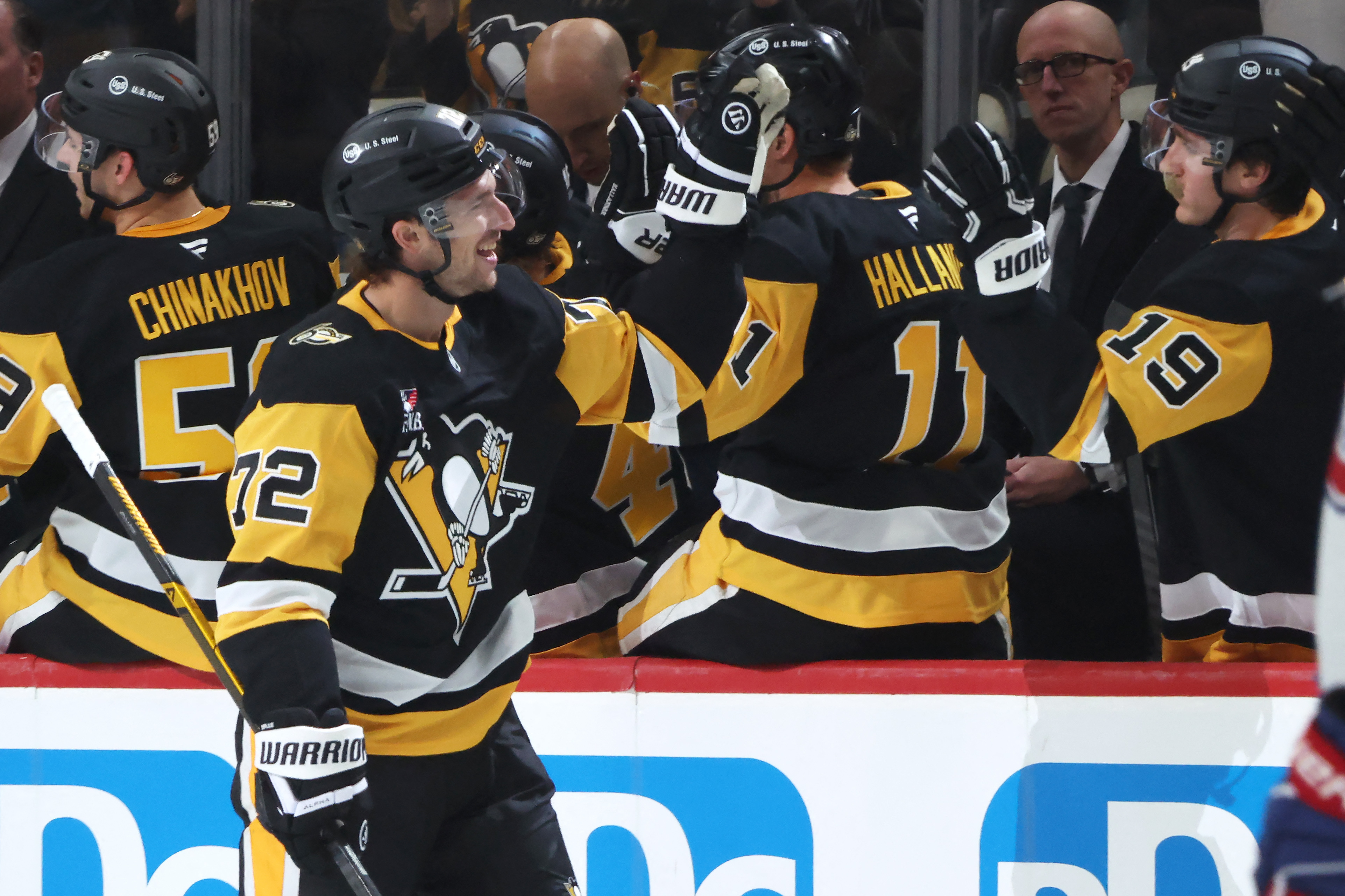
Pittsburgh blew a 5-1 lead but beat Montreal 6-5 in overtime after the Canadiens scored three times in the third period.
Montreal went to Pittsburgh looking for a better measure of itself after beating Toronto on opening night. It got one, although the answer changed several times before Tommy Novak finally ended the game 1:33 into overtime.
The Penguins beat the Canadiens 6-5 after building a 5-1 lead in the second period, watching Montreal erase all of it, then recovering before the comeback became a win. Cole Caufield scored twice, Nick Suzuki had a goal and three assists, Chris Kreider and Ivan Demidov scored 24 seconds apart in the final 68 seconds of regulation, and Montreal still left Pittsburgh with only one point.
Caufield Opened the Night Quickly
Montreal’s first line gave the Canadiens the start they wanted. Caufield scored 3:49 into the game from Suzuki and Lane Hutson, immediately testing a Pittsburgh defense that had barely been challenged during its 7-0 season-opening win over Philadelphia.
The goal also gave an early look at why Montreal represented a much different offensive problem. Suzuki and Caufield were able to create through the middle of the ice, while Chris Kreider’s presence on the line gave Pittsburgh another body to account for around the net. Montreal generated more meaningful pressure in the opening minutes than Philadelphia had created through long stretches of the Penguins’ first game.
Pittsburgh answered before the period ended. Mike Matheson’s interference penalty put the Penguins on the power play, and Evgeni Malkin tied the game at 14:07 from Kris Letang and Hendrix Lapierre. The first period ended 1-1, with both teams having already shown a route to offense.
The Second Period Got Away From Montreal
The game changed almost immediately after intermission. Declan Carlile scored 32 seconds into the second, Samuel Girard made it 3-1 at 7:59, and Montreal began losing the defensive structure that had held through the first period.
Girard’s goal came after a failed Montreal zone exit left the Canadiens scrambling in their own end. Sidney Crosby moved the puck from behind the net, Girard found open space in the slot and Pittsburgh converted a sequence that began with Montreal having a chance to clear the zone. Those mistakes become expensive quickly against a lineup that still has Crosby and Malkin directing play even as younger pieces take on larger roles.
Tommy Novak stretched the lead to 4-1 at 14:01, then Ben Kindel scored on the power play 91 seconds later after Montreal was called for too many men. Pittsburgh had scored four times in the period and turned a tied game into a four-goal lead before the Canadiens had found any way to slow the momentum.
Dobes Could Not Repeat the Toronto Game
Jakub Dobes had been one of Montreal’s most important players in the opening win over Toronto, stopping 26 of 28 shots and keeping the Canadiens steady through several stretches where the Maple Leafs controlled play. Pittsburgh presented a much harsher second game.
The Penguins scored six times on 30 shots, with four goals coming during the second period and two coming on the power play. Several goals were created by defensive mistakes in front of Dobes, but the Canadiens also never received the kind of goaltending that could erase those breakdowns. A team that survived Toronto partly because its goalie bought it time did not get the same margin in Pittsburgh.
Arturs Silovs had his own problems at the other end. After opening the season with a 19-save shutout, he allowed five goals on 25 Montreal shots and nearly watched a four-goal lead disappear completely. The matchup that looked capable of staying relatively controlled before puck drop instead became a night where neither goaltender could settle the game.
Suzuki Gave Montreal Something Before Intermission
Montreal’s comeback began before the second period ended. Suzuki scored at 18:46 from Hutson and Noah Dobson, cutting the deficit to 5-2 and giving the Canadiens a reason to keep attacking rather than simply trying to survive the final 20 minutes.
That goal became much more important once Montreal came out for the third. Caufield scored his second of the night at 3:31 from Kreider, bringing the Canadiens within two and putting Pittsburgh in a game state it had never experienced against Philadelphia.
The Penguins had spent their opener protecting a massive lead against an opponent that never seriously threatened it. Montreal kept enough skill on the ice to make every failed clearance and every lost defensive assignment matter. The lead remained 5-3 for most of the third, but Pittsburgh never completely regained control.
Montreal Scored Twice in 24 Seconds
The final two minutes turned a strong Montreal response into a full comeback. Kreider scored at 18:52 from Suzuki and Demidov, cutting Pittsburgh’s lead to 5-4 with 68 seconds remaining.
Montreal then needed only 24 more seconds. Demidov scored at 19:16 from Suzuki and Hutson, completing the comeback and sending a game the Canadiens had trailed 5-1 into overtime. Suzuki had assisted on both late goals, giving him four points for the night, while Hutson finished with three assists.
The two goals also showed exactly what Pittsburgh’s first game had left unanswered. Philadelphia never forced the Penguins to protect a lead against a top unit capable of creating repeatedly under pressure. Montreal did, and the Penguins’ defense came apart late enough that a four-goal advantage disappeared before regulation ended.
Novak Stopped the Comeback in Overtime
Montreal had all of the momentum entering overtime, but the comeback never became a second win. Novak scored 1:33 into the extra period from Malkin and Letang, giving Pittsburgh a 6-5 victory and his second goal of the night.
Novak finished with two goals and an assist, while Malkin had a goal and two assists. Pittsburgh’s production again came from several parts of the lineup rather than one dominant scoring unit, continuing one of the clearest themes from the 7-0 win over Philadelphia.
The veterans remained important within that structure. Malkin was involved in three goals, Letang helped create the opening power-play goal and the overtime winner, and Crosby assisted on Girard’s second-period goal. Pittsburgh’s younger and newer players supplied the scoring depth around a core that can still move the game when given space.
Montreal’s Top Line Passed Its Test
The Canadiens lost the game, but the Caufield-Suzuki-Kreider combination gave Montreal plenty to carry forward. Caufield scored twice, Suzuki produced four points and Kreider finished with a goal and an assist. All three were involved in the third-period comeback.
That matters because the line is still a new construction. Kreider is being asked to fit beside two players with years of established chemistry, giving Suzuki and Caufield another direct net-front and transition option without changing what already works between them.
Pittsburgh’s defense was supposed to provide the first serious test of that configuration after an excellent opener. The Canadiens created five goals and turned a 5-1 deficit into a tie. Whatever Montreal has to fix defensively, its best offensive players showed that the new line can create against a much stronger opponent than the one Pittsburgh had just shut out.
Pittsburgh’s 7-0 Opener Wasn’t a Fluke
The pregame article treated Pittsburgh’s 7-0 win over Philadelphia cautiously because one dominant opening night can hide as much as it reveals. Montreal provided the better opponent, and the Penguins still scored six.
The offense again came from throughout the lineup. Malkin, Carlile, Girard, Novak and Kindel all scored in regulation before Novak added the overtime winner. Pittsburgh scored at even strength and twice on the power play, while defensemen and depth forwards contributed alongside the veteran core.
The defensive side of Pittsburgh’s opener did not survive the tougher test nearly as well. Philadelphia managed only 19 shots and no goals. Montreal scored five times on 25 shots, repeatedly created through its top line and erased a four-goal deficit in the third. Pittsburgh’s offense looks real after two games. Its defensive ceiling remains far less settled.
Montreal’s Penalty Kill Became a Problem
The Canadiens spent practice time during the week trying to clean up their penalty kill after the Toronto opener, but Pittsburgh still found two power-play goals. Malkin tied the game on Montreal’s first penalty, and Kindel made it 5-1 after the too-many-men call in the second period.
That second goal was especially damaging because it arrived during the stretch where the game was escaping Montreal. Defensive breakdowns at five-on-five had already produced three second-period Pittsburgh goals, and an avoidable bench penalty created another opportunity immediately afterward.
Montreal eventually overcame the four-goal deficit, although asking the offense to erase that kind of special-teams and defensive damage is not a sustainable way to win. The comeback earned the Canadiens a point. The second period explains why they needed it.
The Bigger Test Exposed Both Teams
The pregame article projected a 4-2 Montreal win and expected the Canadiens’ deeper lineup to expose more of Pittsburgh than Philadelphia had. Montreal did expose the Penguins, scoring five times and nearly completing one of the early season’s biggest comebacks. The prediction missed how much Pittsburgh’s own offense would punish Montreal in return.
The Canadiens leave Pittsburgh at 1-0-1 rather than 2-0, with a point earned from a game that looked dead at 5-1. Their top line produced, Demidov scored a major late goal and Hutson again drove offense from the blue line. They also allowed six goals, surrendered four in one period and gave Pittsburgh two power-play conversions.
Final: Pittsburgh Penguins 6, Montreal Canadiens 5 in overtime. The Penguins proved their opening-night offense could survive a much tougher opponent. Montreal proved its offense could drag a terrible second period all the way back to even. Novak’s overtime goal left Pittsburgh with the extra point and both teams with considerably more useful information than either got from its opener.
Sources
NHL Gamecenter, Canadiens-Penguins | Montreal Canadiens, pregame coverage and lineup | Pittsburgh Penguins, home-opener coverage | NHL, projected lineups | Pittsburgh and Montreal game records | Journal de Québec, Canadiens-Penguins game coverage