
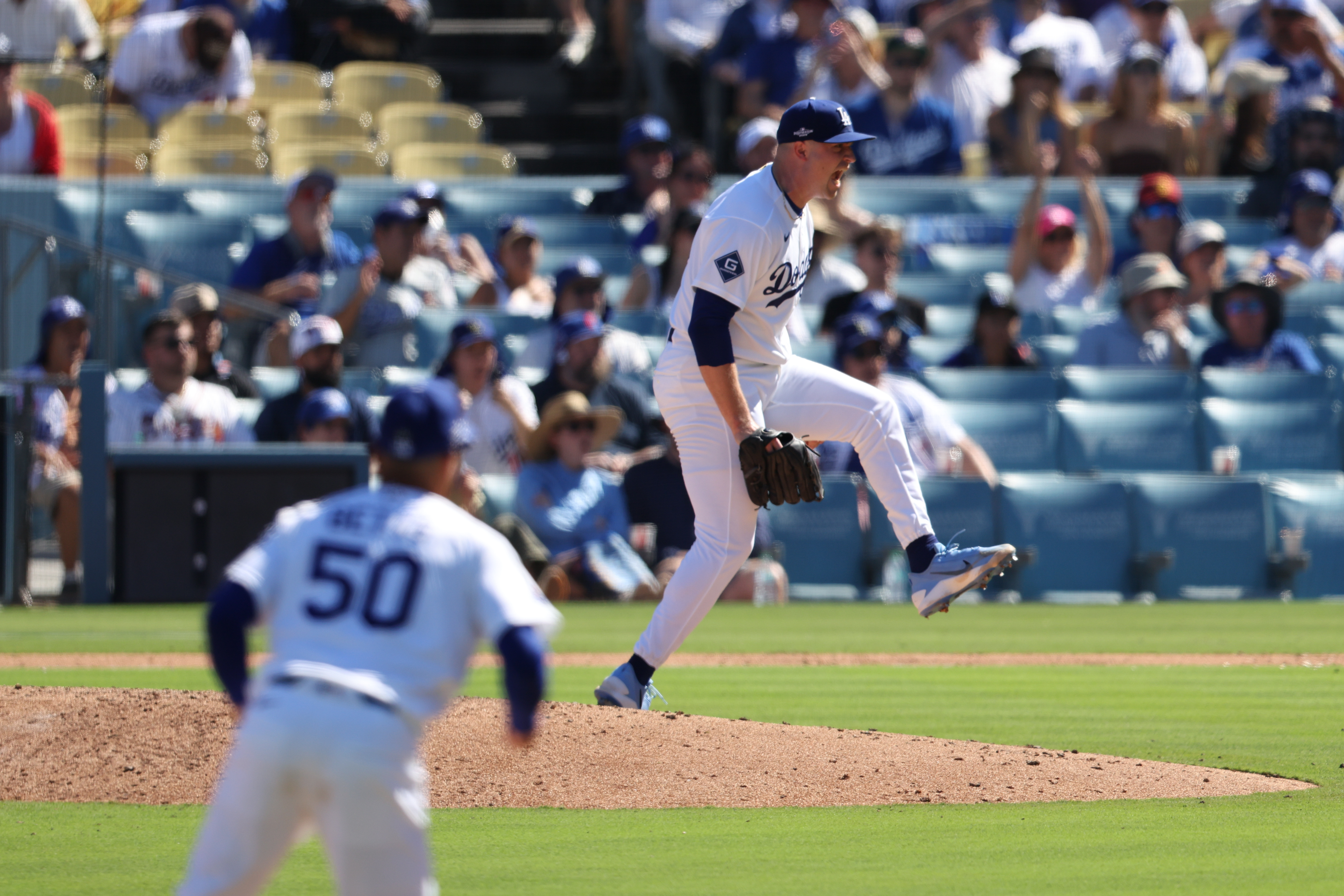
Tarik Skubal allowed one run in six innings as the Dodgers beat Atlanta 5-3, turning a successful Braves opener into a bullpen problem.
Atlanta spent the regular season proving it knew how to play the Dodgers. For three innings Saturday afternoon, that knowledge still looked useful. Dylan Dodd opened the National League Division Series with three scoreless innings, Los Angeles struggled to convert its enormous lineup advantage into anything tangible, and the Braves carried a scoreless game into the part of the afternoon where their pitching plan had to become more complicated.
The Dodgers eventually found the complication. Teoscar Hernández hit a two-run homer off Victor Mederos in the fourth, Kyle Tucker and Max Muncy went deep against AJ Smith-Shawver in the sixth, and Los Angeles beat Atlanta 5-3 to take Game 1. Tarik Skubal supplied the stability on the other side, holding the Braves to one run and two hits over six innings while striking out seven.
Dodd Did Exactly What Atlanta Needed
Atlanta entered Game 1 without the conventional rotation setup a team would choose for an October afternoon at Dodger Stadium. Chris Sale had already worked twice during the Wild Card round, Tyler Mahle had started Game 2 against Philadelphia, and the Braves turned to Dodd as an opener against a Los Angeles lineup stacked with left-handed power.
Dodd rewarded the decision. The left-hander worked three scoreless innings against Shohei Ohtani, Mookie Betts, Freddie Freeman and the rest of the Dodgers order, giving Atlanta exactly the opening segment it needed. A bullpen game becomes manageable when the opener removes nine outs without leaving damage behind, and Dodd handed the Braves a 0-0 game when his assignment ended.
That start also reinforced what Atlanta had done against Los Angeles all season. The Braves won five of six regular-season meetings while holding the Dodgers to a .580 OPS, and Dodd immediately recreated some of that frustration. Los Angeles had all of its stars, six days of rest and home field, yet the first third of Game 1 looked remarkably similar to the matchup Atlanta had controlled during the summer.
The Fourth Inning Changed the Structure
The trouble began with the first transition. Victor Mederos replaced Dodd in the fourth and Teoscar Hernández turned one swing into a 2-0 Dodgers lead, hitting a two-run homer before Mederos could finish the inning. The opener had succeeded, but the first pitcher behind him could not preserve the score Dodd handed over.
That sequence captured the central risk of Atlanta’s plan. Dodd only had to solve the lineup once. Every pitcher who followed entered with a different collection of hitters waiting for him, and Dave Roberts could keep using the depth of his lineup against whichever arm Atlanta selected next. The Braves needed several pitching decisions to work in succession while Los Angeles could keep waiting for one of them to fail.
Hernández has made a habit of finding those moments in October. His fourth-inning homer was his seventh home run in eight postseason games as a Dodger, giving Los Angeles its first real opening after Dodd had spent three innings keeping the game flat.
Skubal Made Two Runs Feel Much Larger
Atlanta’s larger problem was that Los Angeles had no corresponding pitching puzzle to solve. Skubal allowed a leadoff single to Drake Baldwin, then retired 15 consecutive Braves hitters. He struck out seven over six innings and carried a one-hit shutout into the sixth before Sean Murphy finally reached him.
Murphy’s solo homer cut the deficit to 2-1 and briefly brought Atlanta back into the game. Skubal finally showed some vulnerability after the homer, issuing two walks during a 28-pitch sixth inning, but he still escaped with the lead intact. Matt Olson flew out with two runners stranded, ending Atlanta’s best chance to turn the inning into something larger.
Skubal finished with one run allowed on two hits and two walks. The Dodgers entered the series with the luxury of choosing between Skubal, Yoshinobu Yamamoto and the rest of a deep rotation. Game 1 showed what that luxury buys in October: six innings where almost every other decision can wait.
The Sixth Inning Exposed the Gap
Atlanta had reduced the game to 2-1 when AJ Smith-Shawver took the mound in the bottom of the sixth. The opportunity to carry a one-run game toward the late bullpen disappeared within minutes. Kyle Tucker hit a two-run homer, and Max Muncy followed two batters later with a solo shot that stretched the Dodgers’ lead to 5-1.
Those three runs supplied the separation Los Angeles had been searching for all afternoon. Dodd had handled the top of the order. Mederos had been punished once. Smith-Shawver then had to survive another trip through a lineup where Tucker and Muncy could appear after Ohtani, Betts, Freeman and Will Smith had already forced him to work.
The Dodgers did not overwhelm Atlanta with constant offense. They finished the decisive work through three home runs spread across two innings. Their lineup depth allowed them to keep presenting dangerous hitters until the Braves finally reached a pitcher and matchup they could exploit.
Atlanta’s Familiarity Still Showed
A 5-1 deficit could have turned the afternoon into a routine Dodgers finish, but Atlanta kept enough of its regular-season resilience to make the ninth uncomfortable. Ozzie Albies hit a two-run homer off Tanner Scott, cutting the margin to 5-3 and forcing Roberts to bring Evan Phillips into the game with two outs.
Phillips then walked Mauricio Dubón, bringing the tying run to the plate with Austin Riley batting. Riley grounded to shortstop, ending the comeback and leaving Atlanta two runs short. The Braves never erased Los Angeles’ sixth inning, though they made the Dodgers use another reliever and put the tying run at the plate before the game ended.
That late push fits the season series better than the final result alone. Atlanta has repeatedly played Los Angeles without behaving like an overmatched opponent. The Braves found a way to make a rested Dodgers team uncomfortable again, even after falling four runs behind. Their problem Saturday came from sustaining the pitching plan long enough for that resistance to matter.
The Opener Wasn’t the Problem
Dodd’s performance should keep Atlanta from treating the opener concept itself as a failure. Three scoreless innings against this lineup is an excellent result, especially from a pitcher who did not start once during the regular season. Ray Kerr had already demonstrated the same idea against Philadelphia, and Dodd showed that Atlanta can still manufacture useful innings from unconventional assignments.
The difficulty comes from how many innings remain. Atlanta needed six more after Dodd left, and Los Angeles eventually reached both Mederos and Smith-Shawver. A postseason bullpen game demands enough quality arms to survive repeated transitions without giving one of baseball’s deepest lineups the matchup it wants.
Los Angeles had to make far fewer calculations. Skubal carried the game through six, the Dodgers built a four-run lead behind him, and the bullpen entered with room for a mistake. Scott surrendered Albies’ two-run homer in the ninth and the Dodgers still had Phillips available to finish the final out.
Three Homers Supplied the Difference
Los Angeles did not need Ohtani or Freeman to dominate the box score. Hernández, Tucker and Muncy drove in all five Dodgers runs with three home runs, demonstrating the depth that makes the lineup difficult to navigate with a relay of specialists. An opposing staff can execute against the names at the top and still reach a hitter capable of deciding the game several spots later.
Tucker’s sixth-inning homer was particularly important because Murphy had just made it 2-1. Atlanta had finally put pressure on Skubal, and the game had returned to one swing. Tucker immediately restored the three-run margin before Muncy extended it to four.
The sequence gave Skubal’s outing more room than he actually needed. He had already limited Atlanta to two hits, and the Dodgers bullpen entered with enough cushion to survive the ninth-inning rally without allowing the game to become tied.
The Series Now Turns Toward Sale
Atlanta leaves Game 1 having learned something useful and something uncomfortable. Its opener strategy can work against Los Angeles, and Dodd proved it under postseason pressure. The innings behind that opener remain difficult to assemble against a lineup capable of punishing the smallest drop in quality.
Chris Sale could become available for Game 2 after starting the Wild Card opener and returning from the bullpen in Atlanta’s clincher against Philadelphia. His availability would give the Braves something they lacked Saturday: a pitcher capable of absorbing a conventional starter’s share of the game while allowing the bullpen to return to normal roles.
Los Angeles already owns that stability throughout its rotation. Skubal provided it Saturday, and the Dodgers turned six dominant innings plus three home runs into a 1-0 series lead. Atlanta knows this matchup well enough to make the series competitive. Game 1 showed how much harder that becomes when one club can hand the ball to an ace and the other has to construct nine innings piece by piece.
Sources
MLB, Braves-Dodgers NLDS Game 1 recap | MLB, Atlanta bullpen-game analysis | MLB, Tarik Skubal Game 1 performance | MLB Gameday, Braves-Dodgers Game 1 | Reuters, Dodgers 5-3 Braves Game 1 recap