
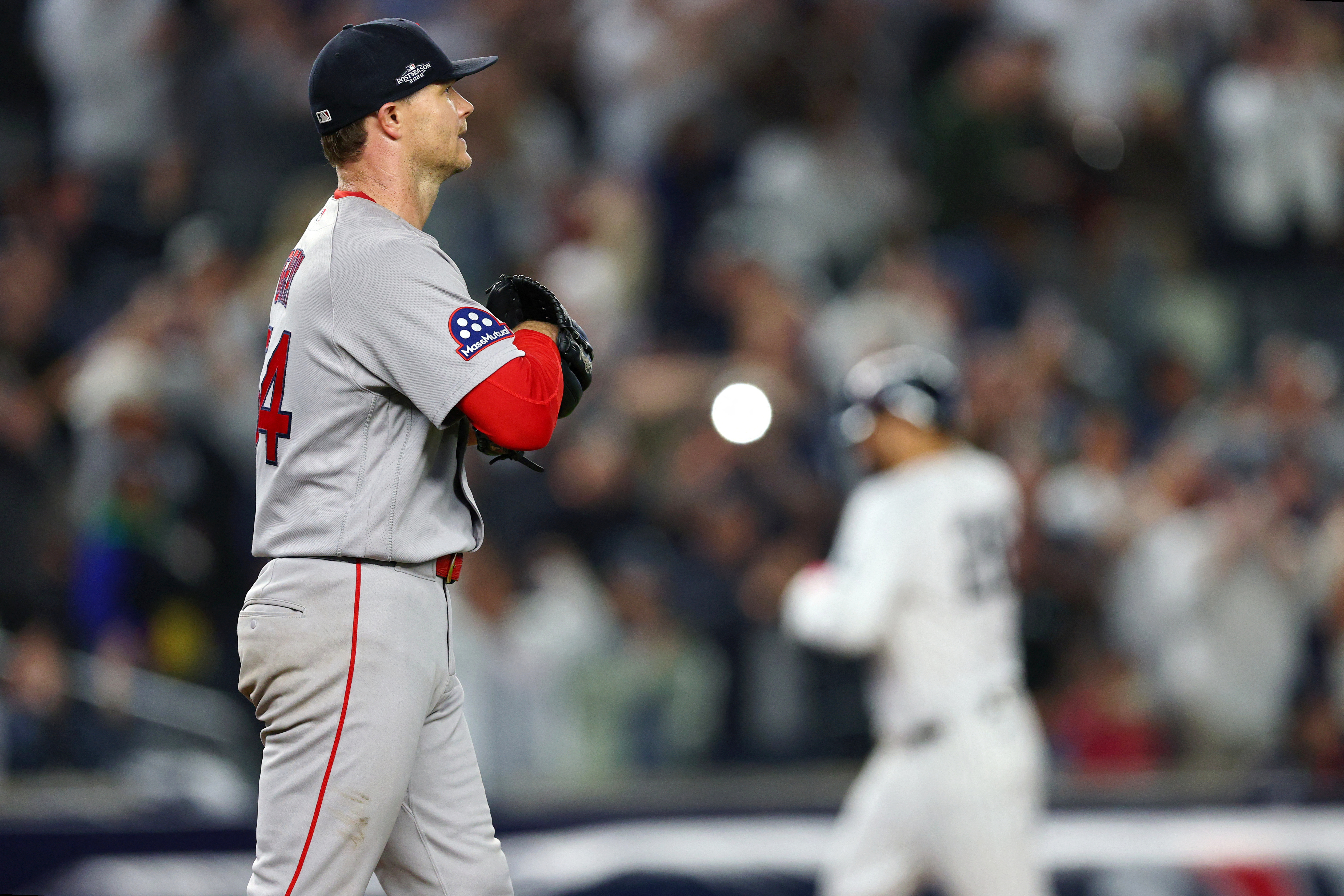
Red Sox vs Yankees Game 2 begins with Boston one loss from elimination and a 9-0 final that was considerably closer before New York reached the Boston bullpen.
The final score from Game 1 makes the opener look like nine innings of Yankees domination. It was not. Boston trailed only 1-0 when Payton Tolle left in the fifth inning and was still down just 2-0 entering the bottom of the seventh. New York then scored seven times over its final two offensive innings, turning a competitive postseason game into a rout after the matchup moved away from the two starting pitchers.
That distinction matters because Game 2 gives Boston a different way to build the night. Sonny Gray does not need to erase what happened Tuesday or somehow outclass Max Fried. He needs to keep the contest inside the part of Boston’s roster that gives the Red Sox their best chance to survive. If Gray can carry six or seven innings, Boston can reduce the number of bullpen decisions between itself and a deciding Game 3. If he leaves early, the same structural problem that turned 2-0 into 9-0 will be waiting again.
Game 1 Was Close Until Ben Rice Took It Apart
Tolle did enough to give Boston a chance in his first postseason start. The rookie worked 4⅔ innings, allowed five hits and only one earned run and struck out four. New York’s first run came in the second, when George Lombard Jr. singled in his first postseason plate appearance and Austin Wells eventually drove him home. Tolle kept the rest of the Yankees lineup from turning that early traffic into a larger inning, and Boston remained within one run when manager Chad Tracy went to the bullpen.
Ben Rice immediately began changing the game once Tolle was gone. Rice homered off Erik Miller in the fifth to make it 2-0, his first of four hits on the night. Boston still remained within striking distance because Cam Schlittler was carrying the other half of the game rather than New York’s offense overwhelming the Red Sox. Schlittler allowed only two hits and one walk over 6⅓ scoreless innings while striking out 10, forcing Boston to remain almost perfect on the mound simply to stay close.
The game finally separated in the seventh. Rice singled home another run as New York pushed the lead to 3-0, and the Yankees added another before the inning ended. The eighth became the avalanche. Wells added a sacrifice fly before Rice came up with the bases loaded against Brayan Bello and hit a grand slam, completing a six-RBI night and pushing the score to 9-0. A game that had been 1-0 when Boston’s starter departed became a rout because the Red Sox could not keep the same level of control once the innings were distributed across the bullpen.
New York’s pitching plan never faced the same problem. Schlittler recorded 19 outs himself, and Paul Blackburn and John Schreiber finished the shutout without forcing Aaron Boone to exhaust his highest-leverage relief options. That gives the Yankees another advantage entering Game 2: their best late-inning arms remain available while Boston has already seen what happens when its starter cannot carry the game deep enough.
Sonny Gray Gives Boston a Different Kind of Game
Gray finished 18-5 with a 2.72 ERA, giving Boston exactly the kind of starter it needs in an elimination game. He does not rely on the Red Sox scoring early enough to protect him. He gives them the chance to keep the game compressed while the offense searches for whatever it can create against Fried.
There is also specific evidence that Gray can handle this lineup. He went 1-0 with a 1.98 ERA in two starts against New York during the regular season, striking out 12 over 13⅔ innings, and Boston won both games. That history does not guarantee another strong outing, but it gives the Red Sox something more substantial than hoping Gray’s overall season translates to Yankee Stadium. He has already faced this opponent successfully.
Length is almost as important as run prevention. Six innings from Gray allows Boston to organize the final nine outs around its best available matchups. Four innings creates the same problem Game 1 exposed, where every additional pitching change creates another opportunity for New York to find the one reliever it can attack. The Red Sox do not need Gray to throw a shutout. They need him to prevent the game from becoming a bullpen endurance test.
Max Fried Has Already Made Boston Look Like This
The difficult part for Boston is that Fried offers New York almost the same stability from the other side. He enters Game 2 with a 2.80 ERA and has been especially difficult for the Red Sox throughout his career. Fried owns a 1.93 regular-season ERA in seven career starts against Boston and held the Red Sox to one run across 11⅔ innings in two meetings this season.
That makes Boston’s offensive assignment substantially different from simply bouncing back after being shut out. Schlittler did not catch the Red Sox on one bad night and accidentally produce 10 strikeouts. Boston entered Game 2 after scoring an MLB-low 71 runs during September, and New York is following one dominant starter with another pitcher who has consistently suppressed this particular lineup.
The Red Sox therefore need productive plate appearances even when they do not immediately produce runs. A seven-pitch out is more useful than a first-pitch rollover if enough of those at-bats force Fried’s pitch count upward. Boston’s best route may be less about beating Fried for four runs and more about preventing him from controlling seven innings the way Schlittler controlled Game 1.
Boston Also Lost Roman Anthony
The challenge became more difficult after Game 1. Roman Anthony left the opener after his right hand and wrist began bothering him again, an especially concerning development after the same injury had already cost him nearly four months. Imaging revealed additional muscle damage, and Boston replaced him on the Wild Card roster with Curtis Mead before Game 2. Anthony cannot return during this series and would remain unavailable until at least the AL Championship Series if Boston advances that far.
That removes one of Boston’s more dangerous offensive pieces at the exact moment the lineup is trying to solve Fried. It also forces Tracy to alter the top of the order against a left-handed starter rather than simply giving the same group another opportunity after Tuesday’s shutout. In a game where three runs may be enough to win, losing one impact bat changes the number of realistic paths Boston has to create them.
New York Is Still Doing This Without Aaron Judge
The Yankees have an important absence of their own. Aaron Judge is not on the Wild Card roster because of the right calf strain he suffered in September. He had returned from a fractured rib earlier in the month but was not healthy enough for New York to carry him in the opening round.
Game 1 demonstrated why New York can survive that absence for a short series. Rice supplied six RBIs. Lombard collected three hits in his postseason debut. Wells drove in a run before adding another with his eighth-inning sacrifice fly. New York did not need its most famous hitter because production came from several places in the lineup once Boston’s bullpen began losing control.
That makes Gray’s assignment different from simply avoiding one superstar. There is no obvious point where Boston can pitch around Judge and accept the next matchup. Gray has to keep the bases clean throughout the lineup because the Yankees just demonstrated that Rice, Lombard, Wells and the hitters around them can create enough offense without their captain.
Six and a Half Runs Leaves Almost No Room for Waste
The expected scoring environment around 6.5 runs fits the starting matchup far better than Tuesday’s 9-0 final does. Gray and Fried both finished with ERAs below 3.00, both have specific histories of success against Wednesday’s opponent and both give their managers a credible path toward limiting the number of bullpen innings required.
A game in that range changes the value of individual mistakes. A leadoff walk can become disproportionately expensive because one extra-base hit may account for half the runs a team needs. A defensive mistake cannot simply disappear inside a five-run inning later. If Gray and Fried pitch close to their season profiles, both offenses may receive only a handful of opportunities where multiple runners reach in the same frame.
That is the environment Boston needs. The Red Sox do not want another game where New York creates enough separation to expose every weakness in the bullpen. They want a contest where the difference between advancing and forcing Game 3 can be one swing, one missed location or one reliever winning a matchup with runners aboard.
The First Inning Is Not Automatically Quiet
Gray and Fried make an early pitchers’ duel the intuitive expectation, but recent Yankees postseason history provides a reason not to assume the first inning will simply disappear. Ten of New York’s 17 home postseason games from 2022 through 2025 included a first-inning run in the supplied historical sample, and the frequency was similar when the Yankees entered those games in the stronger pregame position.
Boston’s recent postseason history and the broader Wild Card round point in the opposite direction, while the overall scoring expectation for Game 2 sits low enough that neither starter should be expected to concede much. That conflict makes the first inning interesting for a different reason. One run would not require either Gray or Fried to pitch poorly. One walk, one extra-base hit or one mistake inside Yankee Stadium can create an early score even if the rest of the night belongs to the pitchers.
For Boston, the opening inning carries additional value because scoring first would immediately change the conditions Gray works under. For New York, an early lead would allow Fried to attack a struggling Red Sox offense without needing to protect against every baserunner becoming the tying run. In a game expected to stay compressed, the first run can shape several innings after it.
Boston’s Road Record Matters Less Than What Gray Can Preserve
Boston was a credible road team throughout the regular season, while New York was less dominant at Yankee Stadium than its reputation might imply. The Yankees also went 9-8 in home postseason games from 2022 through 2025 in the supplied historical sample. Those numbers are useful because they push against the idea that Tuesday’s rout establishes what this series always had to become.
But Boston’s strongest case is not historical. It is standing on the mound Wednesday. Gray’s season, his two successful starts against New York and the similarity between his numbers and Fried’s give the Red Sox a way to make Game 2 fundamentally different from Game 1. They do not need to explain away nine runs. They need to prevent the Yankees from getting another extended look at the vulnerable part of their pitching staff.
The same logic explains why the modest pregame separation between the teams is more revealing than the 9-0 score. New York enters with the series lead, the fresher bullpen and an offense that just erupted late. Boston still has a starter good enough to keep all of those advantages from appearing at once.
Game 2 Has to Stay in Sonny Gray’s Hands
The Yankees enter Game 2 in the stronger position. Fried has repeatedly handled Boston, New York did not have to exhaust its best bullpen arms Tuesday and the Red Sox arrive without Anthony after a month in which their offense produced fewer runs than any other team in baseball. None of those advantages disappears because Boston has a good starting pitcher.
Gray does give the Red Sox a way to prevent those advantages from compounding. He has already pitched well against New York twice this season, and six or seven strong innings would allow Boston to shorten an elimination game rather than asking the bullpen to survive nearly half of it. The Red Sox do not need to reverse every part of the matchup. They need to keep the scoreboard close enough that one offensive sequence can extend the season.
Prediction: Boston Red Sox 3, New York Yankees 2. That score requires a very different game from Tuesday, but the starting matchup gives Boston a credible way to create one. If Gray keeps New York from stacking runners, Boston forces Fried to work and the game reaches the seventh without the Yankees creating separation, the 9-0 opener stops mattering. Game 2 becomes what the season-level numbers suggest it can be: a low-scoring rivalry game decided by one mistake rather than another late avalanche.