
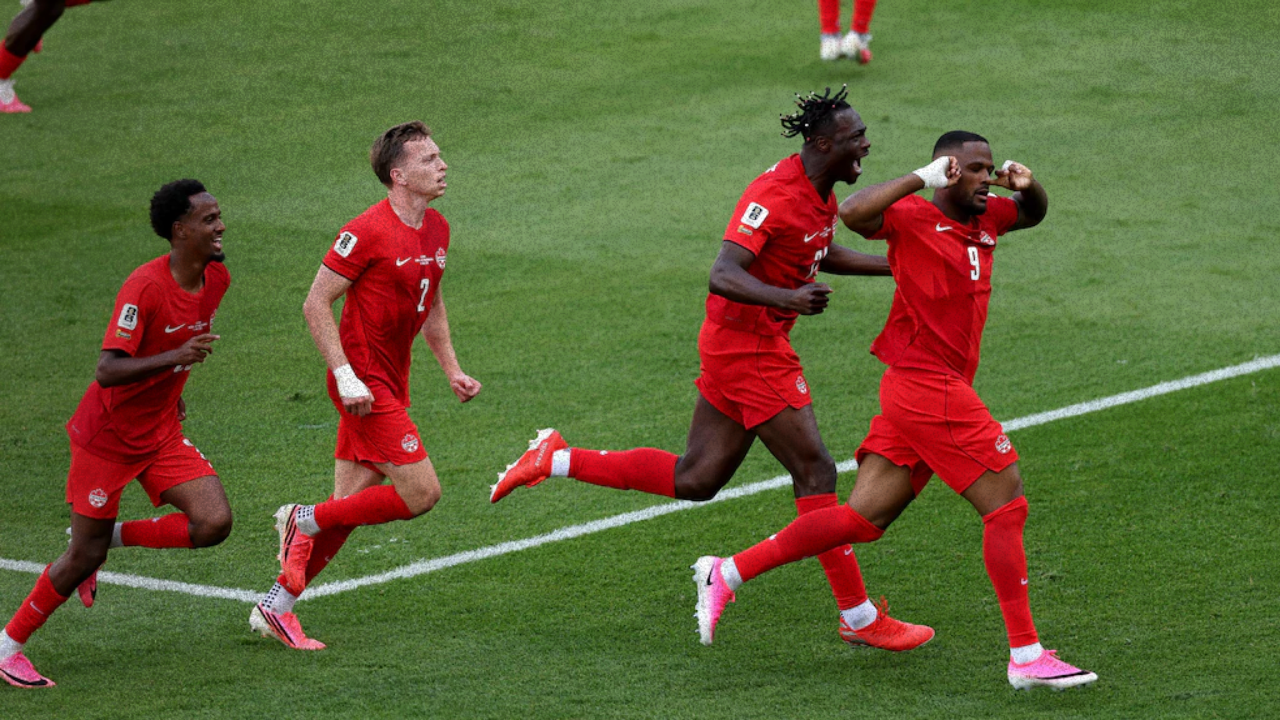
Canada made history in Toronto, but its 1-1 draw with Bosnia looked more like a rescued failure than a breakthrough.
Canada earned the first World Cup point in the history of its men’s program on Friday.
That is the historical fact.
The performance requires a less celebratory reading.
Canada drew Bosnia and Herzegovina 1-1 in Toronto after trailing for most of the match, struggling to turn territorial control into clear opportunities and needing two substitutes to rescue the result in the 78th minute.
The point ended a run of six consecutive defeats across Canada’s appearances in 1986 and 2022. It also prevented the first men’s World Cup match held on Canadian soil from becoming another entry in the program’s collection of energetic losses.
That matters. It is not nothing.
But Canada entered the match at home, with the stronger attacking reputation and a realistic chance to record the first World Cup victory in program history. Bosnia still led for 57 minutes and came within stoppage time of leaving Toronto with all three points.
Canada made history. It did not make the statement it wanted.
Bosnia Scored the Simple Goal
Canada’s problems began with the kind of goal that turns possession statistics into decoration.
Bosnia won a corner in the 21st minute. Ivan Bašić delivered to the near post, Sead Kolašinac flicked the ball across the six-yard area and Jovo Lukić headed it past Maxime Crépeau from close range.
It was Lukić’s first international goal, scored in Bosnia’s first World Cup match since 2014 and in front of a stadium expecting Canada to produce the historic moment.
The routine was not complicated. It did not need to be. Bosnia attacked the first contact, won the second and turned one clean set piece into a lead it protected for most of the afternoon.
Canada responded with volume. It pushed Bosnia deeper, accumulated corners and kept most of the first half in the visitors’ end. The pressure looked impressive until the final action arrived.
Jonathan David met one of Canada’s best openings with a first-time shot directly at Nikola Vasilj. Tani Oluwaseyi created space inside the area and sent another opportunity over the bar. Crosses arrived without clean finishes. Corners produced noise without an equalizer.
Canada controlled where the match was played. Bosnia controlled what counted.
Territory Was Not Control
The match exposed the difference between territorial dominance and actual command.
Canada spent long stretches around Bosnia’s penalty area. It moved the defensive block from side to side, attacked through Richie Laryea and Tajon Buchanan and tried to use Oluwaseyi’s movement to pull defenders out of position.
Bosnia accepted most of that pressure because Canada rarely made it decisive.
The hosts played quickly without always playing clearly. The final pass was late, high or forced. Attacks ended in blocked shots, crowded crosses and corners Bosnia was prepared to defend. Canada had the ball in dangerous areas but did not consistently make Vasilj solve dangerous shots.
Bosnia created less, but its opportunities carried weight.
Early in the second half, Ermedin Demirović broke through one-on-one with a chance to make it 2-0. He failed to finish, giving Canada the opening it needed to remain in the match.
At the other end, Laryea appeared to have beaten Vasilj after a sharp Canadian move. Kolašinac recovered across the goalmouth, deflected the shot and sent it crashing off the crossbar.
Those two moments revealed a match much more balanced than Canada’s territorial advantage suggested. Each team had a clear chance to change the result. Neither starting attack took it.
The Starting Attack Failed
Jesse Marsch did not wait for the original plan to repair itself.
In the 61st minute, he removed Jonathan David, Buchanan and Liam Millar together. Promise David, Ali Ahmed and Jacob Shaffelburg entered in their places.
The triple change was aggressive, but it was also an admission. Canada’s starting attacking group had produced movement and pressure without producing the goal the match demanded.
Jonathan David remains Canada’s most accomplished finisher. Buchanan remains one of its most dangerous transition players. Neither imposed himself on the opener. Millar helped advance the ball but could not turn those positions into enough danger.
The substitutes immediately changed Canada’s physical profile. Promise David gave Bosnia’s centre-backs a stronger body to defend. Ahmed added direct running from the right. Shaffelburg stretched the pitch and attacked space without needing several touches to begin the move.
The substitution worked because it made Canada simpler. The hosts stopped trying to solve every possession through circulation and began attacking Bosnia’s defenders more directly.
That should concern Marsch as much as it encourages him. Canada found the correct adjustments. It also required those adjustments because the planned starting attack failed to finish the work created around it.
Larin Rescued the Result
The decisive change came later.
Cyle Larin replaced Oluwaseyi in the 76th minute. Two minutes later, Ismaël Koné carried the ball through midfield and found Promise David, whose flick released Larin inside the penalty area.
Larin turned and struck. The shot took a deflection and beat Vasilj.
Canada was level. The first point was alive. The stadium finally received the moment it had been waiting for since kickoff.
The goal validated Marsch’s substitutions. Promise David helped create it. Larin finished it almost immediately after entering. Koné, later named Canada’s player of the match, drove the move forward.
It also underlined the failure of the original attacking setup. Canada needed the bench to produce the combination, physicality and finish its starters had not supplied.
Canada pushed for the winner after the equalizer. Bosnia retreated further, defended its penalty area and forced the hosts to find one more clean action through a crowded box.
The final chance fell to Larin in stoppage time. He found space close to goal, but Tarik Muharemović blocked the shot and preserved Bosnia’s point.
Canada had rescued the result. It could not complete the recovery.
Better Than 2022 Is Not the Standard
There is a legitimate positive in the way Canada responded.
The 2022 team repeatedly allowed difficult moments to become decisive ones. Belgium survived Canada’s pressure and won 1-0. Croatia turned an early Canadian goal into a 4-1 defeat. Morocco scored twice before Canada could settle into the match.
This time, Canada absorbed the setback. It stayed in the match, changed the attack and found an equalizer. Marsch’s bench improved the performance rather than merely adding fresh legs. Larin produced when the opportunity arrived.
That is progress.
It is not a breakthrough.
Canada was not facing one of the tournament’s established powers. It was facing a Bosnia team built to defend, survive and punish mistakes. Canada had the home field, most of the initiative and the clearest expectation to win.
Bosnia scored first from a set piece, created a major chance to double the lead and defended well enough to leave with the same number of points.
The distinction matters because home-tournament narratives can turn any milestone into proof of arrival. The first point will be shown in highlight packages. Larin’s goal will become part of Canadian World Cup history. The comeback will be presented as resilience.
All of that is true.
It is also true that Canada missed its best early opportunity to take control of Group B.
The First Win Is Still Missing
The draw changes Canadian World Cup history without changing the central task.
The program no longer has zero points. It still has zero wins.
That difference should define the response to the opener. Canada does not need to reject the significance of the result. It needs to keep the celebration proportional to what was actually achieved.
A point rescued from a halftime deficit is useful. A point at home against Bosnia is also an opportunity left behind.
Canada showed it could survive a bad game state. It did not show it could control a World Cup match it was expected to win. The substitutes delivered. The starting attack did not. The pressure produced chances, but not enough precision.
Canada made history in Toronto.
The breakthrough will have to wait.
Sources
- Canada Soccer – Canada 1-1 Bosnia and Herzegovina match report, June 12, 2026
- Associated Press – Larin scores to rally Canada to 1-1 draw with Bosnia and Herzegovina, June 12, 2026
- The Guardian – Canada 1-1 Bosnia and Herzegovina live report and match timeline, June 12, 2026
- Sportsnet – Canada earns first-ever World Cup point in draw with Bosnia and Herzegovina, June 12, 2026
- FIFA Match Centre – Canada vs. Bosnia and Herzegovina, June 12, 2026