
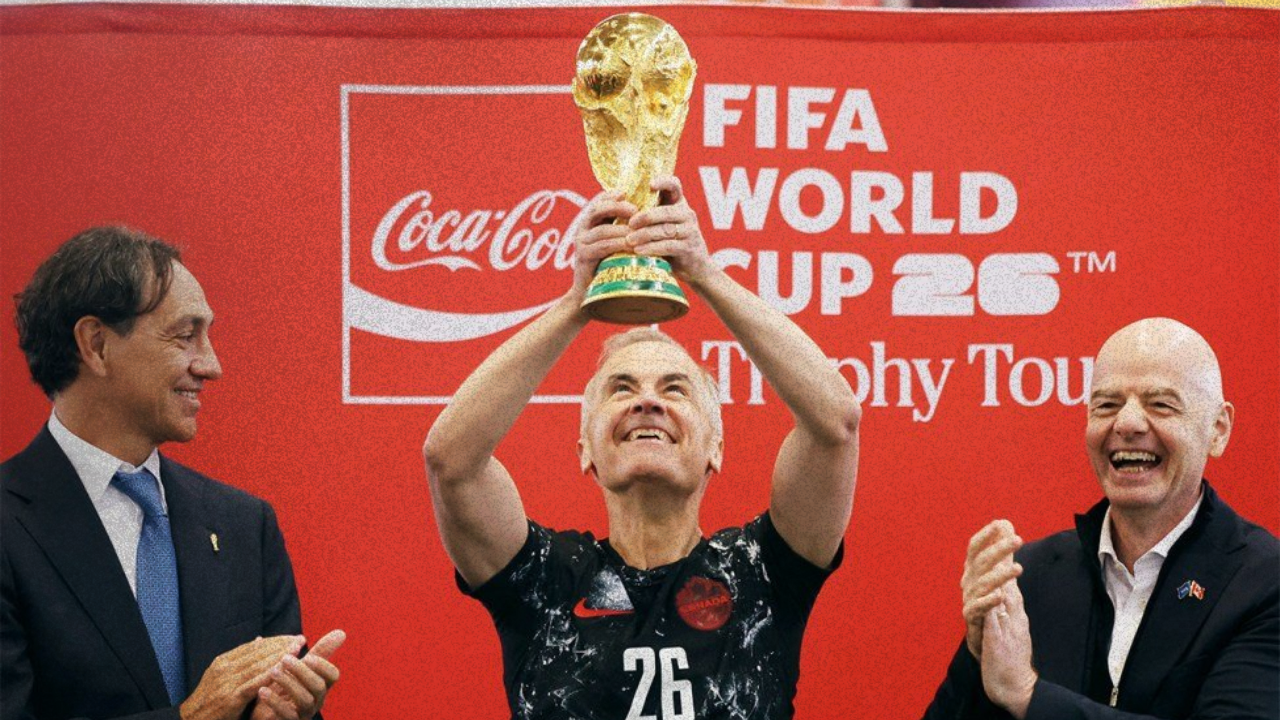
Canada Soccer wants the World Cup glow without responsibility for the spectacle it helped legitimize. That is why a Canadian failure would not feel like tragedy. It would feel like the tournament coughing up a little truth.
A Canadian World Cup collapse would not be the tragedy Canada Soccer wants fans to imagine.
Not because the players deserve contempt. They do not. The players are not the authors of this machine. They are workers inside it, faces placed in front of it, emotional content used to make the rest of it feel clean.
A Canadian failure would matter because Canada Soccer wants the glow of the World Cup without the stain of the World Cup. It wants the anthem, the scarves, the broadcast packages, the fan festivals, the multicultural montage, and the once-in-a-generation story of a country arriving on the global football stage. What it does not want is responsibility for the structure it helped sell.
There is a version of this World Cup that Canada wants everyone to believe in. It is warm, historic, harmless, and patriotic. It is children in red jerseys, packed plazas in Toronto and Vancouver, immigrant families watching the national team together, and commentators telling the audience Canadian soccer has finally arrived. It is the country standing shoulder to shoulder with Mexico and the United States as co-host of the biggest World Cup ever staged. It is supposed to feel like proof that Canada belongs.
That story deserves to break.
An underdog embarrassment would ruin the montage. It would force the federation to sit with the humiliation. It would collapse the soft-focus national packaging before the tournament could turn itself into another sanitized Canadian memory.
The target is not Alphonso Davies, Jonathan David, Tajon Buchanan, or any player who spent his life trying to reach the biggest tournament in the sport. The target is Canada Soccer. The target is FIFA. The target is the host-state machinery around the tournament. The target is the border regime, the security operation, the corporate pricing model, the tourism pitch, the nationalist branding, and the command that fans suspend disbelief because football is happening.
Canada Soccer has stood by while the United States has turned its role as World Cup co-host into an unprecedented farce. But Canada is not merely watching from a distance. Canada is inside the host structure. Canada is staging matches, selling the event, welcoming the cameras, and laundering the same spectacle through a softer accent.
For that reason, a Canadian failure would not feel like tragedy. It would feel like clarity.
The Players Are the Alibi
The easiest response is also the laziest one: why punish the players?
That response works only if the players and the institution are treated as the same thing. They are not. The players can be talented, committed, and personally admirable while the federation that uses them remains cowardly and compromised. Those things can exist at the same time.
A national team is not just eleven players on a field. It is also a governing body, a commercial apparatus, a broadcast product, a political symbol, and a marketing surface. By the time the anthem plays, the shirt is already carrying more than sport. It carries the federation’s branding, the state’s image, the sponsor’s logo, the broadcaster’s narrative, and the host country’s desire to be seen as generous, modern, open, and important.
That is why the players become useful to the spectacle. Their labour is real. Their sacrifice is real. Their joy is real. Their families’ pride is real. Precisely because all of that is real, the machine puts them at the front.
FIFA does not sell immigration policy. It sells the child crying during the anthem. Canada Soccer does not sell ticket inflation. It sells Davies, David, multicultural unity, and the idea that the country has finally become a football nation. Host governments do not sell surveillance, policing, border discretion, and security coordination. They sell hospitality.
The players make the event emotionally legible. They make it possible for people to look away from the conditions surrounding it.
This is not about hating the players. It is about refusing to let the players be used as the moral alibi for everyone else.
Canada Soccer Chose the Host Machine
Canada Soccer wants to be treated as a passenger in this tournament. It is not.
Canada is a co-host. Toronto and Vancouver are not neutral viewing parties. They are official host cities. Canada is staging 13 matches, building fan zones, promoting the tournament, selling the national story, and presenting the World Cup as a civic and sporting achievement. The federal government has framed the event as a national opportunity. Canada Soccer has wrapped itself in the glow of the moment.
That glow comes with responsibility.
When the tournament becomes tied to U.S. travel restrictions, visa denials, inflated ticket prices, severe-weather disruptions, climate criticism, security planning, corporate hospitality, and FIFA’s endless hunger for scale, Canada Soccer does not get to pretend the dirty work belongs somewhere else.
Silence is not neutral when an institution is part of the host apparatus. Silence is cooperation. Silence is permission. Silence is the mechanism that lets every institution collect the benefits of the spectacle while avoiding responsibility for the cost.
Canada Soccer wants the anthem without the politics. It wants the home crowd without the border. It wants the historic moment without the structure that made the moment possible. It wants to sell the tournament as a national celebration while avoiding the obvious fact that this World Cup is not merely a football event. It is a state-backed commercial operation with a football tournament attached.
That is the real indictment. Canada Soccer did not need to invent the farce to be part of it. It only needed to keep smiling while the farce unfolded.
That is what Canadian institutions are often best at. Canada does not always need to be the loudest manager of empire, capital, or state power. Often, Canada’s role is to make the arrangement look more humane than it is. It supplies the polite face. It supplies the diversity language. It supplies the soft branding. It tells the audience that whatever is happening cannot be that ugly, because Canada is involved too.
That is why Canada Soccer’s silence matters. It is not the silence of an outsider. It is the silence of a partner.
The World Cup Is a Border Event
The official story of the World Cup is that the world is coming together.
The material reality is that the world is being filtered through border politics, visa systems, security priorities, passport hierarchy, and state discretion.
The tournament says welcome. The host state says vetting.
The tournament says global celebration. The border says conditional entry.
The tournament says football belongs to everyone. The ticketing model says it belongs first to people who can survive the prices.
This contradiction is not incidental. It is the tournament now.
The United States is not merely hosting matches. It is absorbing the World Cup into its own security-state logic. The White House created a FIFA World Cup task force to coordinate federal planning for the tournament. Trump has spoken about making sure the “right people” come into the country. His administration has carved out sports-event exceptions while still making the visa system part of the spectacle’s political frame.
The language is always hospitality, safety, tourism, economic growth, and national pride. But that combination tells the truth. A mega-event is not just a party. It is a managed zone. It is a state operation. It is a flow of bodies to be screened, routed, priced, watched, moved, approved, and contained.
Fans see flags. Governments see risk categories.
That is why the visa issue is not a side story. It cuts directly into the ideological center of the event. If the World Cup claims to welcome the world, then the ability of the world to actually attend matters. If fans, staff, referees, journalists, or players from certain countries are told they may not enter, may enter only under narrow exceptions, or may apply with little realistic expectation of approval, then the tournament is not universal. It is global only as branding.
The labour can enter when the show needs it. The ordinary people who make the World Cup what it is can be excluded because the border ranks them differently.
This is the ugly joke at the center of a North American World Cup: the event needs the image of the world, but the host states reserve the right to reject actual people from it.
Modern sport works as infrastructure for capital and state power because the event never ends at the field. The World Cup extends through airports, databases, visa offices, hotel blocks, police planning, stadium perimeters, sponsors, transit corridors, tourism boards, and federal task forces. The match is the visible part. The system is the event.
Canada Is Not Outside the Border
It would be easy to turn this into a simple anti-American argument. That would also be a mistake.
Canada is not the moral alternative to this World Cup. Canada is one of its managers.
Canada also decides who enters. Canada also polices movement. Canada also turns sport into national branding. Canada also has cities where public money, private development, policing, tourism, and spectacle move together.
The Canadian visa refusal for Ghana midfielder Thomas Partey ahead of Ghana’s opening match against Panama made that structure visible. This is not a defense of Partey, who is facing serious sexual-offence allegations in the United Kingdom and has denied the charges. It is a structural point about the tournament. FIFA can stage the show, but host states control entry. The World Cup’s universalism stops at immigration law.
That is why Canada’s self-image is so useful to the tournament. The U.S. side of the event looks openly imperial, security-heavy, and commercially obscene. Canada’s side makes the whole thing feel more benign. It softens the edges. It reassures people that this is still a celebration, still multicultural, still friendly, still about the game.
Canada is not the conscience of this World Cup. It is the public-relations department.
Toronto presents itself as a global city. Vancouver sells scenery, cosmopolitanism, and a softer West Coast version of belonging. The federal pitch is that Canada is welcoming the world. But a welcome controlled by immigration departments, security agencies, ticket algorithms, hotel prices, police planning, and sponsor packages is not simple hospitality. It is managed access.
Canada Soccer does not need to control every decision to help launder the tournament. It only needs to participate in the national myth-making. It only needs to present the event as historic and unifying while leaving the deeper structure untouched.
Canada’s job is to make the farce look civilized.
The People’s Game Got Priced Like a Luxury Product
Football is sold as the people’s game until the people try to buy a ticket.
Early in the tournament, visible empty seats already became part of the story, with reporting tying the backlash to FIFA’s pricing strategy. Hotels and airlines that expected a World Cup boom have faced weaker demand as high costs, visa hurdles, and logistics made travel less attractive. That is not a cosmetic issue. It is structural.
The World Cup has become a hospitality product pretending to be a public festival. The match is the content. The extraction is the business model. The stadium becomes a showroom for sponsors, official partners, resale platforms, premium packages, tourism boards, broadcasters, and the class of fans who can absorb the cost.
Every mega-event claims to be for everyone. Then it prices itself for corporations, tourists, and elites.
The empty seat is powerful because it is the spectacle failing in public. It is not a protest sign. It is not a chant. It is not a manifesto. It is an absence. It shows the gap between demand as FIFA describes it and the lived reality of a tournament being stretched beyond ordinary access.
The official story wants the world overflowing with love for the game. The empty seat says the game has been surrounded by price points the world cannot always meet.
That is what FIFA has built: not a global commons, but a scarcity machine wrapped in flags.
The Climate Bill Is Part of the Tournament
Then there is the physical absurdity of the thing itself.
This is the biggest World Cup ever: 48 teams, 104 matches, 16 host cities, three countries, and a continent-wide travel map. It is an event built for scale, not sanity. It asks teams, fans, workers, journalists, support staff, broadcasters, and officials to move through one of the largest tournament geographies in football history during a climate crisis.
FIFA will use the language of sustainability because every institution now uses the language of sustainability. But the structure of the event tells the real story. More teams. More matches. More flights. More distance. More hotels. More broadcast inventory. More sponsor activation. More everything.
That is the logic. Expansion first. Climate language after.
Le Monde reported that the 2026 World Cup is projected to generate at least 9 million metric tons of CO₂, roughly double the Qatar tournament and far beyond the Paris Olympics, with air travel driving most of the emissions. Weather has already entered the tournament story too, with Toronto canceling its fan festival because of severe-weather risk just as the event was trying to sell public celebration.
A tournament like this does not accidentally become grotesque. It becomes grotesque because every incentive points in the same direction: more games, more markets, more inventory, more host cities, more VIP access, more security, more tourism, more flights, more money.
The United States did not create all of that by itself. FIFA built the model. But North America gives the model its most honest form: border power, corporate pricing, state security, climate denial by logistics, nationalist spectacle, and commercial excess, all wrapped in the language of welcome.
That is not the beautiful game. That is a checkpoint with a mascot.
Rooting for Canada Is Part of the Trap
The standard position will be familiar.
Yes, FIFA is corrupt. Yes, ticket prices are obscene. Yes, the tournament is bloated. Yes, the politics are ugly. Yes, the host structure is compromised. But come on. It is Canada. Support the boys.
That is the trap.
Nationalism works by narrowing the emotional field. It tells people what they are allowed to feel and when they are allowed to feel it. Critique can happen later. Discomfort can happen somewhere else. But once the anthem plays, the only acceptable posture is loyalty.
The jersey becomes a muzzle.
That is why the demand to support Canada is not separate from the spectacle. It is one of the spectacle’s enforcement mechanisms. It turns refusal into betrayal. It turns criticism into bad vibes. It turns the federation’s interests into the country’s interests. It makes people feel that rejecting the event means rejecting the players, the fans, the kids, the immigrant families, the growth of the sport, and the dream itself.
But that emotional blackmail is exactly how the machine survives.
Rotten institutions do not usually ask to be loved directly. They attach themselves to things people already love. FIFA attaches itself to football. Canada Soccer attaches itself to the players. The state attaches itself to the flag. Sponsors attach themselves to community. Broadcasters attach themselves to memory.
By the time the tournament begins, the corruption has been turned into atmosphere.
That is why refusal to cheer matters. It breaks the ritual. It says the national team is not a moral hostage. It says the federation does not get automatic emotional protection because it placed talented players in front of a bad structure. It says the flag does not erase the border, the price point, the sponsor, the cop, the visa officer, or the spreadsheet.
Canada Soccer wants fans to experience the tournament as innocence. But innocence is the product. That is what is being sold.
No one is obligated to cheer for Canada just because Canada has wrapped itself around the event. No one is obligated to pretend a home World Cup is automatically a public good. No one is obligated to let patriotism do the laundering work.
If the spectacle needs public consent, it can go without it.
An Underdog Can Break the Montage
A respectable Canadian loss would change very little.
If Canada loses bravely to a major football nation, the story survives. The broadcast can still turn it into progress. The federation can still call it a milestone. The pundits can still say the country proved it belonged. The highlight package can still end with applause, tears, and a child in face paint looking toward the future.
That is how spectacle absorbs defeat. It turns losing into content.
An underdog embarrassment is different.
An underdog embarrassment interrupts the choreography. It makes the host look small. It ruins the montage. It denies the federation the heroic arc. It gives the tournament a result it cannot easily polish into inspiration.
That is why the underdog matters. This World Cup is built on hierarchy. Rich countries host. FIFA profits. Sponsors dominate the field of vision. Border states decide who enters. Fans pay more. Workers serve. Smaller football nations are expected to be grateful for their place in the expanded format, useful as proof that FIFA has made the game more global.
Then one of those smaller nations can step onto the field and humiliate the host.
That possibility is the one part of the tournament the institutions cannot fully script. They can control access, pricing, branding, policing, broadcast language, fan zones, and official ceremonies. They cannot entirely control the ball.
That is the beauty still left inside the ugliness. Football can still produce rupture. It can still make the powerful look ridiculous. It can still hand the microphone to the wrong protagonist.
Canada getting embarrassed by an underdog would not fix FIFA. It would not abolish borders. It would not make the tournament affordable. It would not undo the climate cost. But it would puncture the story Canada Soccer wants to tell about itself.
Sometimes that is enough to matter.
Sometimes humiliation is the only honest legacy a host deserves.
Let the Patriotic Packaging Fail
The point is not that Canada losing would destroy the World Cup. The machinery is too large for that. FIFA will still count the money. Broadcasters will still run the packages. Sponsors will still activate. Governments will still call the event a success. Host cities will still talk about economic impact. The tournament will continue.
But spectacle does not only collapse when the event stops. It collapses when the official meaning becomes impossible to believe.
Empty seats can do that. Visa scandals can do that. Weather disruptions can do that. Ticket backlash can do that. Border exclusions can do that. Climate criticism can do that. A host nation getting humbled on home soil can do that.
Each crack matters because the spectacle depends on smoothness. It needs the public to move from anthem to kickoff to highlight to celebration without stopping long enough to ask what is underneath.
Canada Soccer is counting on that smoothness. It is counting on the emotional force of a home World Cup to overwhelm the politics of the event. It is counting on fans to treat critique as secondary once the ball starts moving. It is counting on the old trick: make people feel proud, and they will forgive almost anything.
That should fail.
A Canadian loss that cannot be turned into uplift would do what the federation fears. It would ruin the national script. It would force the broadcast booth to explain the silence. It would make the fan festival feel less like history and more like a branded coping mechanism. It would make Canada Soccer wear the embarrassment it helped stage.
This World Cup deserves suspicion, not reverence. It deserves resistance, not automatic patriotism. It deserves to be seen as what it is: a border-policed, hyper-commercialized, climate-heavy, state-backed mega-event dressed up as global togetherness.
A beautiful Canadian run would help the packaging work.
A collapse would tell the truth.
The patriotic packaging should fail.
The underdog should ruin the montage.
The spectacle should collapse under the weight of everything it tried to hide.
Sources
- Government of Canada – Canada welcomes the FIFA World Cup 2026, June 2026
- Canada Soccer – FIFA World Cup 2026 and Canada Soccer House tournament information
- White House – FIFA World Cup 2026 Task Force
- Reuters – Trump on World Cup, visas: we’re working to make sure right people come in, June 10, 2026
- Reuters – Trump expands visa travel exception for major sporting events, January 16, 2026
- FIFA – FIFA World Cup 2026 ticket holders to benefit from prioritised U.S. visa appointments, November 17, 2025
- Reuters – Ghana’s Partey out of Panama World Cup game after visa application refused, FIFA says, June 12, 2026
- Reuters – Pricey World Cup keeps fans away, hits U.S. hotels, airlines, June 11, 2026
- Reuters via Media Selangor – Empty seats at World Cup match renew concerns over ticket prices, June 12, 2026
- Reuters – Toronto cancels World Cup fan festival due to severe weather risk, June 12, 2026
- Reuters – Climate Focus: Weather dampens World Cup fan festival, June 12, 2026
- Le Monde – 2026 World Cup: A climate disaster in the making, June 12, 2026
- Reuters – Canada’s World Cup dreams face first test as injury-hit hosts meet Bosnia, June 10, 2026
- Sparked Sports – Sports as Infrastructure: How Games Power Capital and State, February 6, 2026
“`