
Mandela Olympic opening ceremony: the IOC excluded South Africa for 28 years over apartheid, then used Mandela’s words as ceremonial peace language.
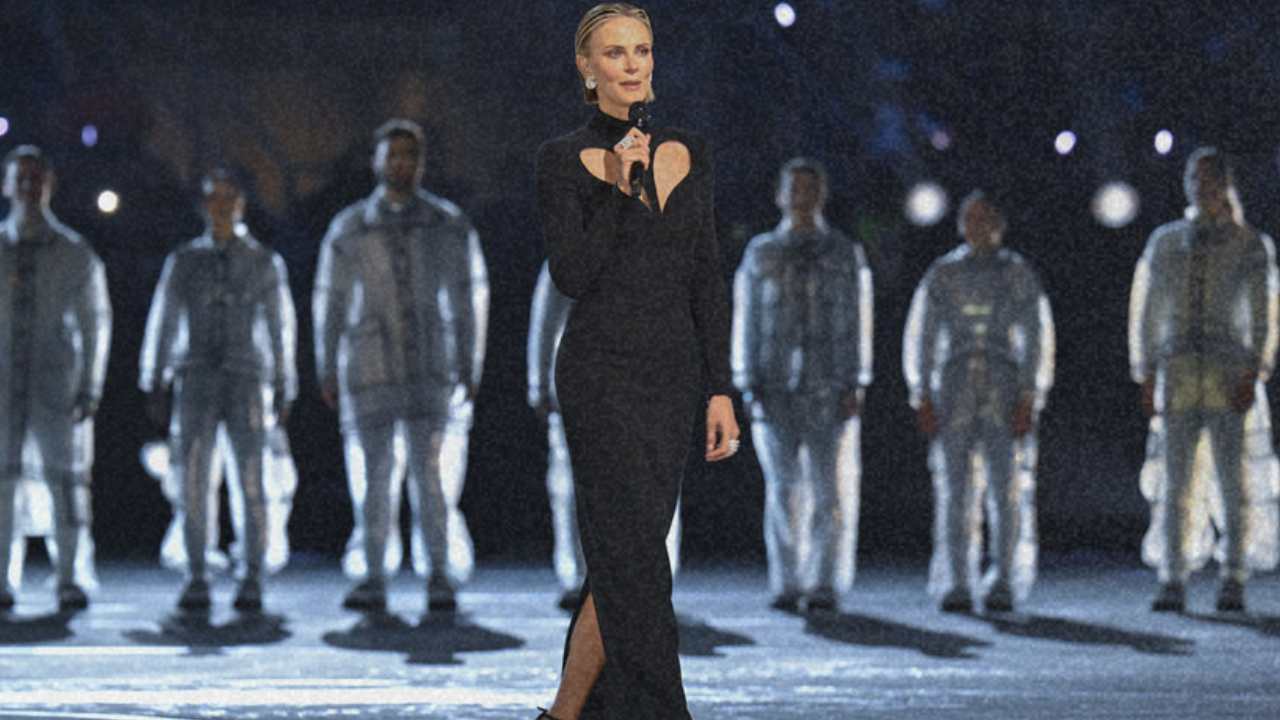
Late in the Milan Cortina opening ceremony on February 6, after the performers on the San Siro floor had arranged themselves into the shape of a dove, they parted to let Charlize Theron walk to a microphone. She was there in her capacity as a United Nations peace ambassador, and she read a single sentence from Nelson Mandela.
“Peace is not just the absence of conflict,” she said. “Peace is the creation of an environment where all can flourish, regardless of race, color, creed, religion, gender, class, caste or any other social markers of difference.”
Then, in her own words: “Today, this message seems more relevant than ever. So let these Games be more than just sport. Let them be a reminder of our common humanity, our respect for one another, and a resounding call for peace everywhere.”
That was the whole address — one borrowed sentence and one line of her own. NBC called the moment stunning. CNN, CBC, PEOPLE and Today all filed it as a message of peace or hope. WWD gave more column inches to the Atelier Versace gown than to the speech.
The organisation quoting him banned his country
The International Olympic Committee barred South Africa from the 1964 Games. The exclusion held for twenty-eight years. South Africa did not return to the Olympics until 1992, after apartheid had begun to be dismantled and Mandela had been out of prison for two years.
This is not obscure history and it is not contested. Olympics.com hosts a page about it. The IOC acted because it had concluded that a state organised around racial hierarchy could not be admitted to an event premised on universal participation, and that keeping South Africa in the movement would have meant the movement endorsing the arrangement. The ban was one component of a broader isolation campaign — alongside the UN resolution, the arms and trade embargoes, the cultural boycott — that took three decades to produce a result.
That exclusion is the most consequential political act in the IOC’s history, and its content is the opposite of what gets said at opening ceremonies. Sport did not unite anybody across that line. Sport was withheld, deliberately, because uniting with the South African state would have meant legitimising it. The Olympic movement’s own most defensible moment rests on the premise that sport is political and that neutrality is a position.
What the sentence was doing in the original
The line comes from a message Mandela sent to the Global Convention on Peace and Nonviolence in New Delhi, dated 31 January 2004. The full text sits in the Nelson Mandela Foundation’s archive. It runs to a few hundred words, and the sentence Theron read is not a standalone aphorism in it. It is the second half of a thought.
The paragraph it belongs to opens by asserting that development and peace cannot be separated, and that without peace and international security nations cannot turn their attention to lifting up their most underprivileged citizens. That is the argument. The flourishing line is Mandela specifying what he means: the barrier to the poorest people living decently is not disorder in the abstract but a set of named divisions — race, class, caste — that determine who gets to flourish and who does not.
The IOC kept the definition and left the poverty behind it in the archive. What was read at San Siro sounds like a call for mutual respect. What Mandela wrote was a claim about material conditions, addressed to a convention on nonviolence, by a man who had spent the previous decade watching how much of apartheid’s structure survived the laws that built it.
The rest of the message makes the omission harder to defend. Mandela writes about South Africa directly — the country that inspired Gandhi and was inspired by him in turn, choosing a path of peace against every prediction of catastrophe, choosing negotiation and compromise. He notes that those who preach love rather than hatred are frequently made to suffer for it, and says it should not have to be that way.
That is a message about what South Africa decided and what the decision cost. The Olympic committee extracted one sentence from it, discarded the country, discarded the poverty, and used what remained as ceremonial atmosphere at a ski competition attended by, among others, the Vice President of the United States.
The messenger the committee chose
Theron was born in Benoni in 1975, into an Afrikaner family, and grew up under apartheid. She left South Africa in the early 1990s, became an American citizen in 2007, and has held both passports since. She founded the Charlize Theron Africa Outreach Project in 2007 and was appointed a UN Messenger of Peace in 2008. Olympics.com anticipated the question and answered it in advance, describing her as someone who has repeatedly spoken out against violence, inequality and discrimination.
None of which is in dispute, and the objection here is not that a white South African is disqualified from quoting Mandela. It is that the IOC selected, to represent South Africa’s most famous political inheritance before a global audience, someone whose standing as a representative of South Africa is contested inside South Africa itself.
In 2023 she described Afrikaans on an American podcast as a dying language spoken by roughly forty-four people. It is one of eleven official languages and the first language of around twelve percent of a country of nearly sixty million.
The response at home split along lines worth noticing. A lawmaker from the Economic Freedom Fighters backed her; the Freedom Front Plus — the small right-wing Afrikaner party — said she was not up to date with what was happening in her country of birth. Both responses treat her as someone speaking about South Africa from outside it.
An organising committee looking for a South African voice had options. It could have found an athlete, a Robben Island survivor, a member of the family, a South African who lives there. It selected an Oscar winner with a UN title who has lived in Los Angeles for three decades, and it did so for reasons that have more to do with broadcast recognition than with who is best placed to speak those particular words.
Nobody in the coverage noticed
The most striking thing about the moment is not the moment. It is that a global press corps watched an institution recite the words of an anti-apartheid revolutionary, an institution whose own defining act was a boycott of the regime he fought, and produced no coverage connecting the two facts.
The pattern is familiar. Mandela is now quoted at ceremonies the way scripture is quoted at weddings — the specific words matter less than the general aura of moral seriousness they lend the proceedings. The passages that circulate are the ones about reconciliation and forgiveness and shared humanity. The ones about the necessity of armed struggle do not appear on the jumbotron.
Which is its own kind of instructive, because that material is also on Olympics.com. The same page that documents the ban quotes Mandela explaining why the ANC formed a military wing: that it would have been wrong and unrealistic to keep preaching non-violence while the government answered peaceful demands with force, and that the decision was taken only when every channel of peaceful protest had been closed. He co-founded Umkhonto we Sizwe. He was imprisoned for it in 1962 and served twenty-seven years.
That is the man whose definition of peace was read out at San Siro, by an organisation that has his biography on its own website, to an audience told that these Games are a reminder of our common humanity.
What the ban was for
There is a version of this ceremony that would have worked. The IOC could have said out loud what it did between 1964 and 1992 — that it once decided a state’s racial order made its athletes’ participation impossible, that the decision cost South African sportspeople their careers, and that the movement judged it worth the cost. That is a real thing an institution can say about itself, and it would have given the Mandela passage somewhere to land.
Instead the committee that enforced the longest political exclusion in Olympic history spent that history as ambient inspiration, in a ceremony built on a theme of harmony, and its own broadcast partners reported the result as a triumph of unity over division.
Mandela’s argument was that peace is not the absence of conflict. The IOC once understood the corollary well enough to act on it: that a Games everyone attends is not the same as a Games worth attending, and that there are circumstances in which the movement has to choose. It made that choice once, held it for twenty-eight years, and was proved right. At San Siro it read his words aloud and did not appear to recognise them.
Sources
- Nelson Mandela Foundation Archive — the complete message to the Global Convention on Peace and Nonviolence, New Delhi, 31 January 2004; the paragraph on development and peace being indivisible, and the passages on South Africa’s choice of negotiation
- Olympics.com — “Why South Africa Was Barred From the Olympics”; the IOC’s own account of the 1964 ban, the exclusion until 1992, Mandela’s founding of Umkhonto we Sizwe and his explanation of the turn to armed struggle
- Today — live coverage of the Milan Cortina opening ceremony, including the full text of Theron’s remarks
- NBC Insider — the dove formation and Theron’s entrance; the identification of the passage as Mandela’s 2004 New Delhi message; and Olympics.com’s stated justification for the casting
- CNN — opening ceremony photo coverage, including the attendance of US Vice President JD Vance
- CBC Sports — the ceremony’s peace protocol sequence and the framing of Theron’s reading
- WWD — ceremony coverage, with the Atelier Versace gown given more attention than the speech
- Gulf News / AFP — the 2023 Afrikaans controversy; the EFF and Freedom Front Plus responses; language demographics
- Charlize Theron — biographical detail: Benoni, Afrikaner descent, departure from South Africa, dual citizenship since 2007
- TIME (via AOL) — the ceremony’s “armonia” theme and producer Marco Balich’s framing