
How modern sports bind emotion, media, infrastructure, and nationalism into a single system that monetizes loyalty while shaping politics and power
On the surface, sports look like pure entertainment. A playoff run, a championship drought, a trade deadline frenzy. The emotional highs and lows feel organic, unscripted, even sacred to fans who invest decades of loyalty into teams that rarely reward them.
But step back and a contradiction emerges.
Why do some franchises remain wildly profitable despite never winning? Why do telecom monopolies spend billions acquiring broadcast rights? Why do government economic campaigns appear in between innings and intermissions?
Because professional sports are no longer just games. They are cultural infrastructure. They bind audiences emotionally, deliver political narratives, justify corporate expansion, and project national identity. What looks like entertainment is, in reality, a multi-layered system where profit, media, infrastructure, and state power converge.
Profit Without Winning
Consider the ownership logic behind major franchises.
Maple Leaf Sports & Entertainment (MLSE), for example, operates within a revenue-sharing league structure that cushions financial risk. Playoff revenues, merchandising, national broadcast deals, and sponsorships are distributed across teams. From a purely economic standpoint, sustained competitiveness can be more valuable than outright victory.
Winning a championship is expensive. It requires aggressive spending, risky contracts, and roster decisions that can damage long-term profitability. Remaining “in the mix,” however, keeps fan engagement high while maintaining financial stability.
There’s also the spectacle economy of losing.
A decades-long championship drought becomes a narrative asset. The “curse,” the “window,” the endless analysis of trades and rebuilds. These narratives generate ratings, clicks, and debate year after year. The chase itself becomes monetizable content.
When the Raptors won in 2019, it was euphoric, but it also closed a narrative loop. The mystique dissolved overnight. Paradoxically, the absence of victory can sometimes produce more long-term engagement than winning itself.
In this model, sports function less as meritocratic competition and more as managed entertainment markets.
Owning the Broadcast, Owning the Story
If teams generate emotional investment, broadcasters control how that investment is directed.
Rogers’ ownership of Sportsnet illustrates this vertical integration. Telecom infrastructure, cable distribution, streaming platforms, and sports rights all feed into the same corporate ecosystem.
The result is not just content delivery but narrative control.
Broadcast production quality, commentary framing, promotional storytelling, and national symbolism are all curated. Sportsnet doesn’t merely show games. It produces a vision of Canada through sport. Hero narratives, regional pride, national unity, and economic optimism are woven into the broadcast fabric.
Sports media becomes cultural governance.
The emotional energy fans bring to the game is captured, packaged, and redirected through corporate storytelling.
From Broadcast to Infrastructure
This narrative power does not stop at media. It extends into physical infrastructure.
Telecom expansion into rural and remote regions is frequently marketed through the language of sports accessibility, with satellite connectivity campaigns promising fans they can “watch the game anywhere.”
In this framing, entertainment becomes the consumer-facing justification for large-scale network buildout.
Beneath that messaging, however, sit massive infrastructure projects, including satellite-to-mobile services, remote broadband deployment, and expanded emergency connectivity systems.
Sports fandom generates emotional demand, and that demand helps legitimize corporate expansion into territories previously considered unprofitable.
The game, in this sense, becomes a kind of Trojan horse for telecom reach, where what begins as media consumption gradually evolves into the extension of corporate and technological presence across physical geography.
Development Frontiers and Resource Narratives
Infrastructure expansion intersects with resource development, particularly in northern regions like Ontario’s Ring of Fire.
Mining campaigns are advertised through sports broadcasts, framed as engines of national prosperity and economic security. The messaging is aspirational: jobs, growth, Indigenous partnership, national strength.
But the reality is more complex.
Many development projects remain speculative, years from realization. Some First Nations communities have challenged the portrayal of unified consent, arguing that selective agreements are framed as broad approval. Critics describe this as “consentwashing,” where limited partnerships are marketed as collective endorsement.
Sports broadcasts, however, present the development narrative as inevitable and beneficial. The emotional trust fans place in the sports platform spills over into the political messaging embedded within it.
In this way, sports media becomes a delivery system for extractive economic narratives.
Privatized Statecraft
Historically, cultural nation-building through sport was often mediated by the state.
Public broadcasts like Hockey Night in Canada functioned as shared civic rituals. They were as much about national identity as entertainment.
Today, much of that cultural infrastructure has been privatized.
Corporations like Rogers control not only distribution networks but the symbolic frameworks surrounding sport. They deliver the anthem, the storytelling, the historical retrospectives, the national mythology.
At the same time, telecom companies are building connectivity infrastructure in regions where the state once held primary responsibility.
The result is a neoliberal inversion:
Corporate entities increasingly perform functions once associated with public nation-building. Cultural cohesion, territorial connectivity, and narrative framing now flow through private monopolies rather than state institutions.
Sports are the emotional interface that makes this privatization feel organic.
Unity in an Age of Fracture
International competition amplifies this dynamic.
Olympics, World Cups, and international hockey tournaments become sites of national consolidation. Internal divisions, political tensions, and regional fractures are temporarily subsumed beneath the flag.
Sports unify through shared emotional stakes.
This is particularly potent in moments of geopolitical uncertainty. As global power balances shift, sports provide symbolic arenas where national strength can be performed without military confrontation.
Broadcasts often layer in economic messaging alongside this symbolism. Trade policy ads, tariff debates, and industrial campaigns appear in sports slots, blending nationalism with economic ideology.
The game becomes both spectacle and soft power projection.
Political Branding Through Sport
Political leaders understand this emotional currency.
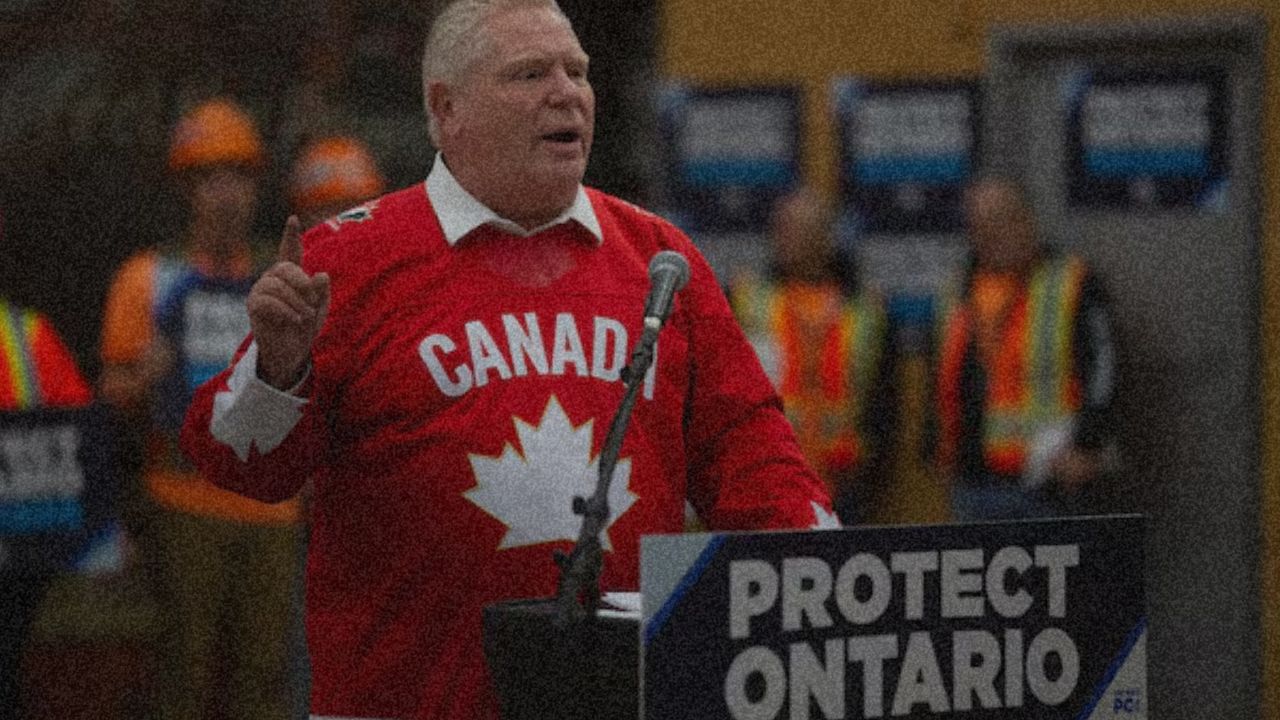
Aligning with successful teams, appearing at championship games, or invoking sports metaphors allows politicians to tap into preexisting reservoirs of public affection and pride.
The symbolism is efficient.
A jersey, a locker room speech, a celebratory tweet. These gestures signal relatability, unity, and patriotism without overt political messaging.
Sports provide a politically neutral stage upon which leaders can perform national belonging.
It’s branding through cultural osmosis rather than policy argument.
Why Hockey Hits Differently
No sport carries this weight in Canada like hockey.
Part of it is structural. Hockey’s fluid line changes and live substitutions create a sense that every player is part of a collective machine. Fans internalize this rhythm. Identification feels immediate, participatory.
There’s a psychological “on the bench” sensation that few other sports replicate.
International hockey intensifies this further. National teams condense identity into a single roster. Victory feels civilizational. Loss feels existential.
Some analysts frame this as a sublimation of martial culture. The tribalism, rivalry, and symbolic conflict of war are displaced into athletic competition. National pride is contested through goals instead of violence.
Hockey becomes both cultural mirror and emotional outlet.
Bread, Circuses, and Infrastructure
When viewed together, these layers form a coherent system. Sports generate emotional investment; the media captures and directs that investment, and corporations monetize it.
Infrastructure then expands to sustain and grow the audience, while development narratives travel through the same channels.
Governments, in turn, leverage the platform, and national identity crystallizes around the shared spectacle.
In this way, entertainment operates only as the entry point into a much larger structure.
Professional sports now function as a convergence zone where capital accumulation, political messaging, territorial expansion, cultural identity, and national unity all intersect.
What appears to be a simple game broadcast is, in reality, a dense web of power relations.
Stadium lights illuminate not just the ice or the field, but the machinery of profit, policy, and nationhood operating behind the spectacle.
Sports are no longer merely adjacent to political economy; they have become one of its most effective operating systems.