
The World Juniors stopped being a coronation and became a competition, exposing how Canadian hockey fandom confuses comfort, dominance, and tradition.
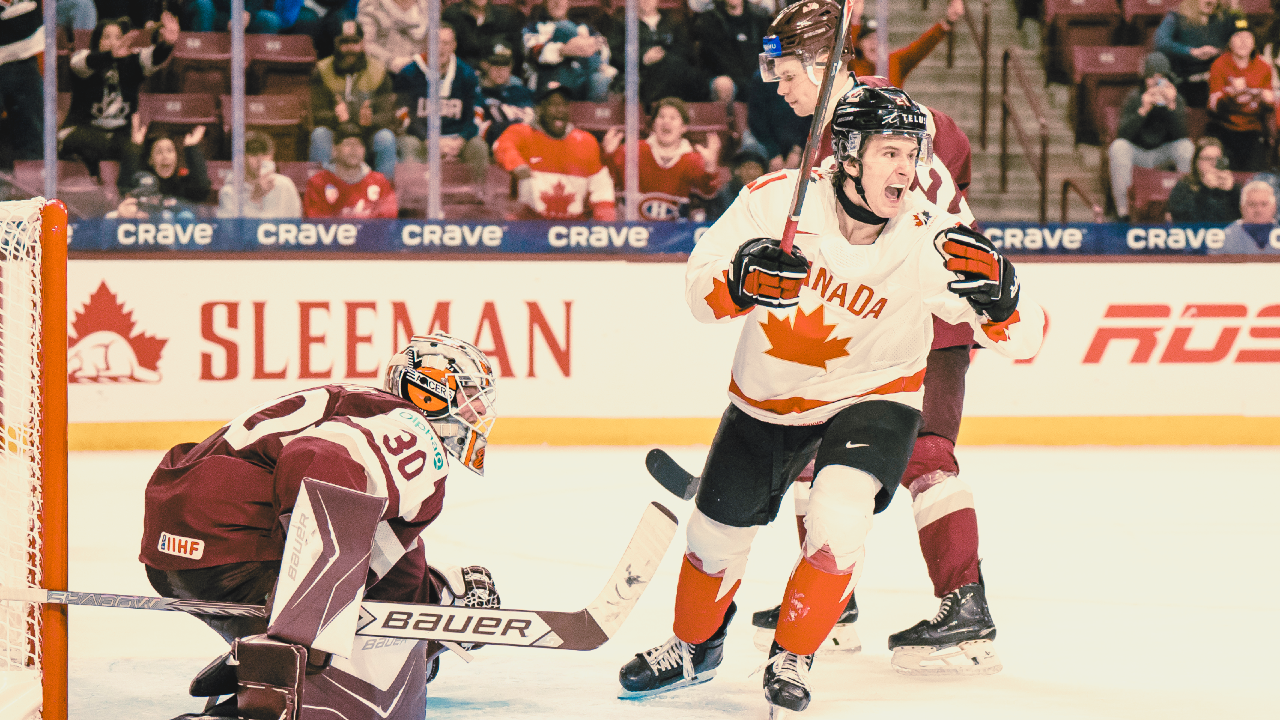
Canada beat Latvia 2–1 in overtime at the 2026 World Junior Hockey Championships, and for a moment, it felt like a national emergency.
Not because Canada lost. Not because the tournament standings were in danger. Not because the roster suddenly forgot how to play hockey. The panic arrived because the game violated a deeply held expectation: that this tournament is supposed to feel easy. That Canada is supposed to cruise. That discomfort is a sign something has gone wrong.
The reaction was instant and familiar. Hand-wringing. Outrage. Complaints that the tournament “isn’t what it used to be.” Worry about effort, development, culture, coaching, officiating. All of it wildly disproportionate to the actual situation on the ice.
That’s the tell. Because this reaction had very little to do with hockey.
What the Latvia game exposed was not fragility in Canada’s roster, but fragility in Canada’s relationship to the tournament itself. For decades, the World Juniors functioned less as a competition and more as a ritual of reassurance.
A yearly reminder that whatever else might be slipping economically, politically, culturally, at least this hierarchy still held.
Once that reassurance falters, even briefly, the response isn’t curiosity or engagement. It’s withdrawal. And that tells you everything.
World Juniors as Canada’s Security Blanket
To understand the reaction, you have to understand what the World Juniors became in Canada.
This tournament was never just another international event. It arrived at the same time every year, during a slow news cycle, wrapped in nostalgia and nationalism, broadcast wall-to-wall as if it were a civic duty.
The framing was always the same: Team Canada is the standard. Canada is the benchmark. Canada is defending something that already belongs to it.
Gold medals weren’t celebrated as difficult achievements. They were treated as the natural order. Anything less demanded explanations, scapegoats, or structural overhauls. Losses weren’t absorbed as part of sport; they were moral failures or aberrations in an otherwise stable system.
Broadcasts reinforced this constantly. Anthem-heavy coverage. Flag-forward visuals. Panels that spoke in terms of legacy and birthright rather than tactics and variance. The tournament was sold not as uncertainty and risk, but as destiny with occasional turbulence.
That framing trained fans to experience the event incorrectly. The emotional payoff wasn’t tension or surprise. It was confirmation. Confirmation that Canada still sat atop a hierarchy assumed to be permanent, earned, and natural.
When you consume sport as reassurance rather than competition, the moment reassurance disappears, the experience collapses.
When Parity Feels Like Theft
This is why competitiveness now feels like loss.
When Latvia pushes Canada to overtime, or Czechia plays disciplined, modern hockey, or Finland suffocates the neutral zone, the reaction isn’t “wow, this is intense.” It’s “this tournament sucks now.” The quality of hockey improves, but the emotional return diminishes, because the ritual no longer works.
Parity doesn’t register as growth. It registers as something being taken away.
That’s entitlement in its purest form. Interest collapses the moment winning stops being automatic. Close games aren’t thrilling; they’re offensive. Underdogs aren’t inspiring; they’re inconveniences. Effort itself becomes suspect, because effort implies that supremacy is no longer guaranteed.
And rather than sitting with that discomfort, a segment of Canadian fandom disengages. They don’t recalibrate expectations. They don’t adjust how they watch. They simply decide the product is worse now.
That response isn’t rooted in love of sport. It’s rooted in attachment to hierarchy.
The Global Catch-Up Is Real and Structural
Here’s the part that gets lost in the noise: the rest of the hockey world didn’t suddenly get lucky. It caught up.
Countries like Finland, Sweden, Czechia, Slovakia, and even Latvia are no longer just producing individual NHL players. They are producing coherent teams. Systems hockey. Patience. Buy-in. Defensive structure. Purposeful puck management.
These programs don’t need to out-skill Canada. They need to out-organize Canada for short stretches. And in a short tournament, that’s often enough.
Latvia’s blueprint is simple and repeatable. Collapse layers in the slot. Force perimeter shots. Treat every puck battle like a playoff shift. Let the goalie be a co-star. Keep the game close long enough that one bounce, one scramble, one late push can flip everything.
That doesn’t make Canada bad. It makes the margins thinner.
Canada still leans heavily on individual skill and depth, often assuming that volume and talent will overwhelm structure. Most of the time, it works. Sometimes, it doesn’t. And when it doesn’t, fans raised on inevitability interpret friction as failure rather than reality.
The truth is that this is what a healthy international tournament looks like. Multiple nations are capable of executing identity hockey. Favourites forced to solve problems instead of posing for trophy photos.
That’s not a decline. That’s maturation.
When the Excuses Run Out
If this dynamic were limited to junior tournaments, it would be easy to dismiss. Kids. Variance. Development curves. A bad bounce here or there. But the same pattern keeps asserting itself even when Canada brings the full weight of its hockey mythology onto the ice.
Canada was eliminated by Denmark in the 2025 World Hockey Championships.
They lost with Sidney Crosby in the lineup. Stanley Cup winners. Veterans. Elite NHL talent. This wasn’t a developmental roster or a soft experimental lineup. This was Canada showing up with the very players fans insist still define national hockey supremacy and losing anyway, in regulation, to a Danish team that played the best hockey its program is capable of playing.
Denmark, on a global scale, is not an elite hockey power. It is a respectable, improving program. Well-coached. Organized. Capable of executing a game plan. But it does not have Canada’s depth, resources, pedigree, or player pool. It does not dominate leagues or pipelines. It does not own the sport. And yet, once again, Canada lost.
That’s the moment the story should change. Because when even the best version of Canada can lose cleanly to a structurally sound but otherwise average program, the old explanations stop working. You can’t blame youth. You can’t blame effort. You can’t blame inexperience. You can’t pretend it’s a fluke when it keeps happening across levels, rosters, and tournaments.
And yet the reaction is always the same: louder complaining, thinner analysis.
The discourse immediately fills with people who clearly don’t watch international hockey outside of highlight clips suddenly diagnosing cultural rot. They talk about pride, heart, and embarrassment.
They talk about what the jersey “means.” They talk about what Canada “should be.”
What they don’t talk about is how the game was actually played.
Systems. Neutral-zone pressure. Defensive layers. Puck denial. Shot suppression. Goaltending. The boring, decisive mechanics of modern international hockey.
Because actually watching hockey is harder than narrating it.
This loss didn’t expose a lack of talent. It exposed a lack of attention. A fan culture still operating as if reputation should tilt the ice, even when the puck no longer cares. Canada didn’t lose because Denmark played above itself. Canada lost because hockey is now competitive enough that belief and pedigree don’t override execution.
And instead of learning that lesson, much of the audience responded the only way it knows how: by complaining louder, as if volume might restore inevitability.
Complaining as Performance
This is where sports culture mirrors politics almost perfectly.
In both spaces, engagement used to imply interpretation. You watched. You read. You learned context. You adjusted your views as reality changed. That takes effort. It requires patience and humility.
Complaining doesn’t.
Modern discourse rewards reaction over understanding. Outrage travels faster than nuance. Complaints signal identity instantly. You don’t need to know systems, development curves, or context to sound confident. You just need a loud, categorical take that aligns with a tribe.
“This player is overrated.”
“This tournament is cooked.”
“This isn’t what it used to be.”
Those lines aren’t analysis. They’re posture.
Once fandom becomes performance, curiosity dies. The incentive to learn disappears because learning doesn’t circulate as efficiently as indignation. The person who actually understands the game often sounds less confident, because reality is contingent and messy. Meanwhile, the loudest voices sound sure because they’ve simplified everything beyond recognition.
That’s how noise replaces nuance. And once that substitution takes hold, the conversation hollows out the thing it claims to care about.
Media Sells Canadians a Sporting Myth
Canadian media played a central role in manufacturing the expectations now causing whiplash.
For years, the World Juniors were marketed less like a competitive ecosystem and more like a patriotic pageant with hockey aesthetics. Narrative came first. Ecosystem came second. The emphasis was always on destiny, legacy, and national character.
That approach didn’t just reflect fan expectations. It shaped them.
So when parity exposes the framing as hollow, fans feel cheated, as if the script was rewritten without their consent. The outrage isn’t directed at the team so much as at the idea that the tournament stopped performing its emotional function.
Instead of acknowledging that the coverage oversold inevitability, the conversation shifts to complaints about effort, youth culture, officiating, or the tournament itself. Anything but the mythology.
The result is a feedback loop where discomfort gets blamed on everything except expectations.
Panic and the Misuse of the World Juniors
The same entitlement logic shows up in prospect discourse.
Every year, Canadian fans elevate top prospects into mythological figures long before they’re finished products. By the time the World Juniors arrive, these players aren’t treated as teenagers in development. They’re treated as symbols.
So when reality intrudes, through a quiet game, a tough matchup, or structured opposition, the response isn’t adjustment. It’s denial. Or worse, dismissal of the tournament entirely.
This is where you hear the loudest cope: “The World Juniors don’t matter.”
That statement isn’t sophisticated. It’s insecure.
No serious evaluator believes the WJC is definitive. But no serious evaluator believes it’s noise either. It’s contextual data. Short games. National pressure. Unfamiliar roles. Heavy targeting. Opponents are designing entire game plans to neutralize you.
That environment doesn’t redefine a prospect. It adds signal. Especially when patterns repeat.
Writing off the tournament outright isn’t intelligent. It’s a refusal to engage with information that complicates certainty. That’s not scouting. That’s belief defence.
Consensus draft status is not a magic spell. It’s a working hypothesis. Built from club play, international play, tracking data, and projection models. It’s meant to be tested, stressed, and refined. Not protected like scripture.
When fans treat critique as heresy, what they’re defending isn’t the player. It’s the comfort of certainty.
Canada Is Still Fine. The Myth Is Not.
Here’s the part that gets lost when everything becomes reactive: Canada is fine.
The roster is talented. The depth is real. The chances of winning the tournament are legitimate. Being pushed to overtime by Latvia does not negate any of that.
But “fine” no longer means inevitable.
Canada has shown defensive instability. The margins are thinner. The field is strong and organized. The U.S., Sweden, Finland, Czechia can all beat you if you let them hang around.
That doesn’t mean Canada is doomed. It means the old myth doesn’t hold anymore.
And that’s the adjustment fans are resisting.
They were trained to experience this tournament as reassurance first. When reassurance disappears, the experience feels broken. But what’s actually broken is the expectation.
Comfort Disappears, Meaning Arrives
This is the healthiest the World Juniors have ever been.
Real stakes. Real systems. Real consequences. Underdogs with identity. Favorites forced to adapt. Outcomes determined by decisions rather than destiny.
That’s sport.
But it requires something from the audience. Attention. Patience. Acceptance of uncertainty. A willingness to engage rather than applaud.
For fans invested in dominance rather than engagement, that shift feels like loss. Comfort disappears. Interest fades. Tradition gets invoked as a shield.
But tradition was never the point. Comfort was.
The backlash isn’t about hockey getting worse. It’s about hockey refusing to perform reassurance on command anymore. And when a culture mistakes comfort for tradition, the moment comfort disappears, so does interest.
Which might be the clearest tell of all: not that Canada is losing its edge, but that many fans never wanted competition in the first place. They wanted confirmation.
And now the game is asking something back.