
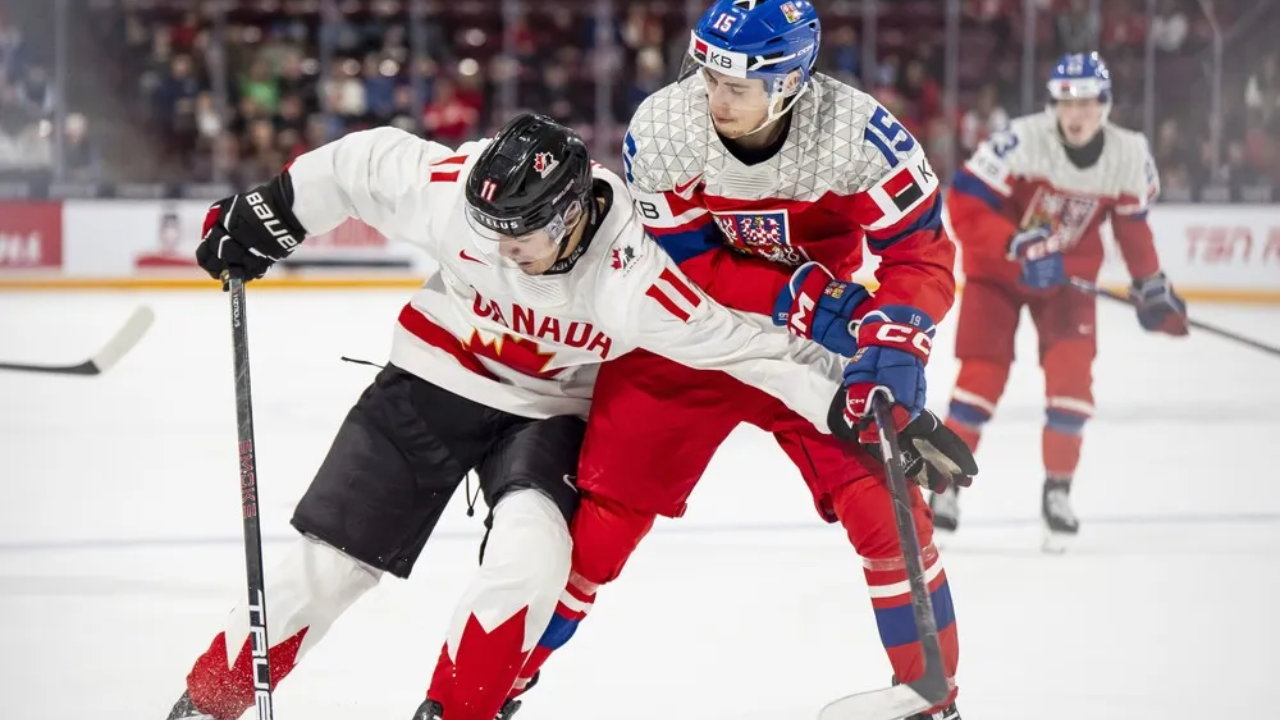
Canada’s 7–5 opener looked reassuring, but recent World Juniors show a clear pattern: beating Czechia once rarely settles anything, and rematches rarely end well.
Canada opened the 2026 IIHF World Junior Championship with a 7–5 win over Czech Republic on Boxing Day in Minneapolis, and on the surface it looked like the kind of result that should calm nerves. Seven goals. Multiple offensive stars producing. A victory over a recent nemesis.
But if you zoom out even slightly, the win does the opposite. It sharpens a familiar anxiety rather than erasing it.
Canada did not control that game. It survived it. Defensive lapses turned the night into a track meet, Czechia stayed dangerous in every period, and the outcome hinged on Canada’s ability to answer mistakes with talent rather than eliminate those mistakes altogether.
That distinction matters, because history suggests that beating Czechia once is rarely the end of the story. In many cases, it is only the beginning.
Czechia Is Not a One-Off Opponent
Canada has no shortage of opponents it can overwhelm on talent alone. Germany, Austria, and Latvia usually fall into that category. Czechia does not.
What separates Czechia at the World Juniors is not star power but adaptability. They absorb information quickly and respond within the same tournament. One meeting is data. A second meeting is execution.
Czechia studies how Canada pressures the puck, where Canadian defensemen cheat for offense, and how quickly Canada is willing to trade structure for speed. They do not need to dominate possession to be effective. They need Canada to loosen just enough for cracks to appear.
This is why Czechia games rarely feel settled, even when Canada is leading. They compress space, counter quickly, and force Canada into high-event hockey. That style does not always win the first meeting. It is far more dangerous in the second.
The Pattern Canada Has Not Broken
This is where the fear becomes rational rather than emotional. In recent World Juniors history, when Canada and Czechia meet twice in the same tournament, Canada rarely comes away with two wins.
The story of this trend begins in 2022, the only recent World Juniors where Canada managed to beat Czechia twice in the same tournament.
That year, however, came with a major asterisk. The event was played in mid-summer after the original tournament was cancelled, under conditions that broke every familiar rhythm of the World Juniors.
There was no winter cadence, no traditional holiday crowd pressure, disrupted rosters, and abnormal preparation across the board.
Canada beat Czechia twice in that environment, but it was not a normal tournament in any meaningful sense. Since the event returned to its usual winter format, that result has not been replicated.
In 2023, Czechia struck first, beating Canada 5–2 in the group stage and exposing defensive vulnerabilities early in the tournament.
Canada eventually earned its revenge with a 3–2 overtime win in the gold medal game, but even then, the outcome followed a familiar rule.
One meeting went Czechia’s way, one went Canada’s way. There was no sweep. The teams split the tournament.
In 2024, there was no opportunity for adjustment or redemption. Canada and Czechia met once, in the quarterfinals, and Czechia won 3–2. Canada’s tournament ended on the spot. One game, one loss, season over.
The same thing happened again last year. Canada did not get a second look. Czechia eliminated them outright in the quarterfinals with a 4–3 win, ending Canada’s tournament the first and only time the teams crossed paths.
Taken together, the pattern is hard to ignore. Outside of the abnormal 2022 summer tournament, Canada has not beaten Czechia twice in the same World Juniors. When they meet twice, Canada escapes with one win at best. When they meet once, Czechia has proven capable of ending Canada’s tournament outright.
That is not a coincidence.

Why the Second Game Is Always Harder
The second meeting between Canada and Czechia is almost never a replay of the first. Canada tends to loosen after an initial win, trusting its offense to solve problems again. Czechia does the opposite.
By the rematch, Czechia has already adjusted its defensive spacing, neutral zone pressure, and counterattack routes. The game slows down. The margins shrink. The goals come harder. That environment favors discipline, not firepower.
Canada’s greatest strength is depth and creativity. Its weakness in these matchups has been impatience. When chances do not appear quickly, structure erodes. Czechia waits for that moment.
This is why rematches feel heavier. The psychological balance shifts. Canada carries the expectation of dominance. Czechia carries clarity.
What the 7–5 Win Really Signaled
The Boxing Day opener in Minneapolis did not disprove any of this. If anything, it reinforced it.
Canada scored seven goals and still spent large stretches reacting rather than dictating. Czechia capitalized on defensive errors, adjusted mid-game, and remained a threat until the final minutes. Canada’s win came through response, not suppression.
That is fine once. It is dangerous twice.
The fear is not that Czechia is unbeatable. Canada has proven it can beat them. The fear is that Canada cannot assume it will do it again when everything is on the line.
Czechia Matters More Than Style Points
At this stage of the tournament, bracket positioning matters more than aesthetics. Canada does not need statement wins. It needs distance.
A quarterfinal or semifinal rematch with Czechia compresses Canada’s margin for error more than almost any other matchup. Sweden and Finland pose different challenges, but they do not carry the same recent psychological and tactical weight.
Canada’s cleanest path forward is not domination. It is separation.
A Win That Creates Pressure
Canada’s opening win was exciting, impressive, and deserved. It was also incomplete.
Canada can beat Czechia, again?
History suggests it should do everything possible not to face them again.
Until that pattern breaks in a typical World Juniors winter, the anxiety will remain justified. Not because Canada is weak, but because Czechia has repeatedly shown it knows exactly how to make Canada uncomfortable when it matters most.