
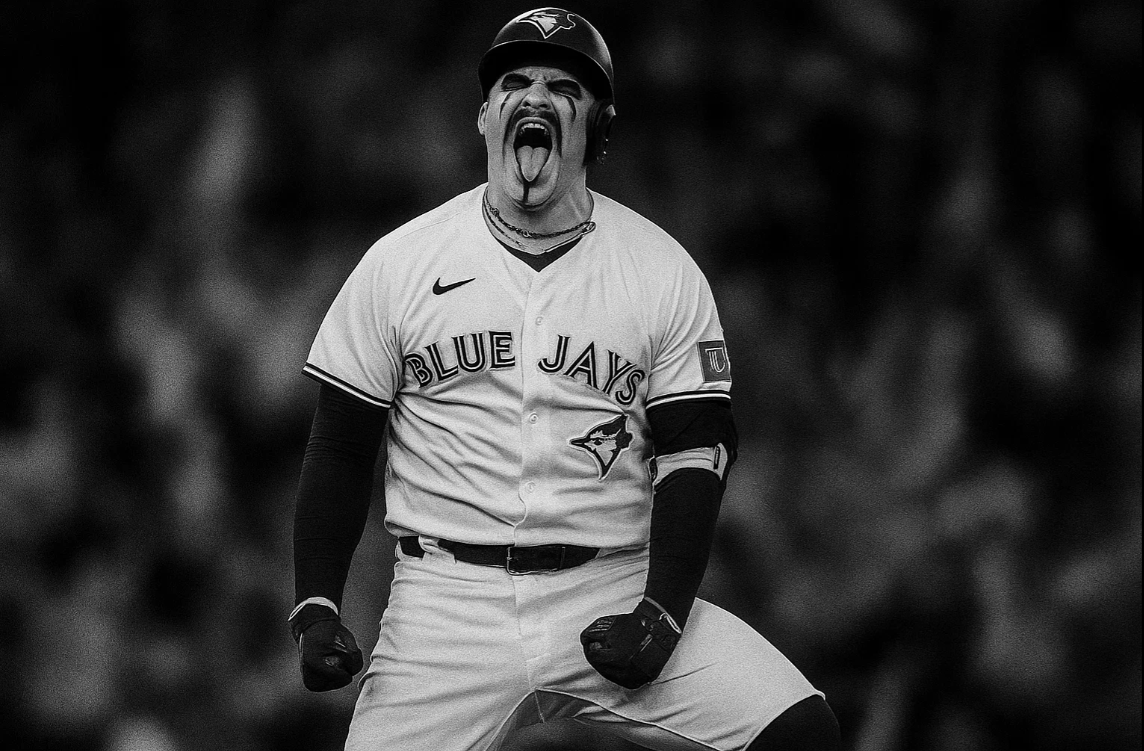
In the first episode of Sports Lovers, Alex and Sam trace Toronto’s chaotic playoff run from the Mariners’ meltdown to a showdown with baseball’s trillion-dollar empire.
Alex and Sam argue that “vibes” aren’t just superstition — they’re strategy. Along the way, they unpack the psychology of Game Seven, the moral gray zones of cheating, and what it means when a sport becomes a proxy for empire. This isn’t just about baseball; it’s about power, spectacle, and being a lover of sport in the most dangerous of times.
But to understand why this Jays run has become the emotional backbone of the show, you have to go back to 2015 — the year both hosts became, in their words, “real baseball guys.” That was the season when Toronto felt cosmically destined, only to watch the universe shrug. A decade later, the sequel arrived unexpectedly and with stranger energy. This year’s Jays weren’t dominant, coherent, or even particularly sensible. They were chaotic, moody, improvisational… and then suddenly, absurdly, unstoppable.
The through-line of this postseason is that Toronto keeps winning games they should have no business winning, and losing games they were supposedly too good to drop. That instability is the entire thesis. Schneider’s Jays don’t operate like the rigid, matchup-driven 2015 team under John Gibbons. Instead of treating baseball like a flowchart, they treat it like theater. Their manager makes decisions that look disastrous in a vacuum but accumulate psychological weight over a series. Every move feels half baseball logic, half ritual magic.
The turning point — the moment where vibes became visible as strategy — was the Mariners’ meltdown. Seattle entered the series convinced they were the more rational, disciplined team. Toronto chipped away not by out-slugging them, but by forcing them into emotional mistakes: defensive miscues, panic pitching changes, and the fatal overthinking of Springer’s at-bat in Game Seven. That entire chess sequence began a week earlier when Springer was drilled in the knee and booed by Seattle fans relitigating the Astros scandal. Schneider’s choice to turn the narrative back onto Mariners fans wasn’t just media gamesmanship; it was psy-ops. By Game Seven, Seattle’s dugout approached Springer like a wounded morality play instead of a hitter with a plan. They misread the moment. They paid the price.
Alex and Sam use this sequence to ask a bigger question: why do we pretend baseball is immune to the psychological warfare we recognize instantly in hockey, MMA, football, or pro wrestling? Why do we insist that vibes are irrational when every great postseason moment — from Curt Schilling’s bloody sock to Max Scherzer screaming “I’m not leaving” — is pure dramaturgy? Sports are performance. They always have been. Fans want to believe they’re watching objective contests of skill, but what they’re really consuming is narrative theatre calibrated precisely to their emotional bandwidth.
That’s where the show turns to the darker corners of fandom. Both hosts admit they’ve cheered injuries — not out of cruelty, but out of a sudden, involuntary surge of competitive desire. It’s the same impulse that made Eagles fans cheer Michael Irvin’s spinal injury and Mariners fans boo a limping Springer. We’re told to be ashamed of these moments, to rise above them, to remember the human being behind the jersey. But as Alex points out, if sports are built on gladiatorial logic, why moralize the audience? You don’t scold Romans for shouting in the Coliseum. You don’t lecture viewers of pro wrestling about kayfabe ethics. Sports create a sanctioned space for emotional extremity. Telling fans to be “classy” is the real hypocrisy.
From there, the podcast shifts into the moral gray zones of cheating. Not the finger-wagging morality of sports talk radio, but a structural analysis. Springer is a symbol of forgiven cheating. Ohtani is a symbol of unexplained gambling irregularities that Major League Baseball seems strangely uninterested in pursuing. The NBA is now drowning in gambling scandals. And yet, the timing of these stories always feels suspiciously convenient. Not because leagues are masterminds, but because information flows according to power. As Sam puts it: “Cheating isn’t a crime against the game. It’s a crime against the wrong person’s interests.”
This leads into the central political argument of Episode One: sports are a proxy for empire.
Toronto’s opponent in the World Series — the Los Angeles Dodgers — are less a baseball team than a sovereign financial entity. They represent the most perfectly engineered version of sports as statecraft: a machine built on unlimited payroll, international branding, and the gravitational pull of Shohei Ohtani. The Dodgers aren’t just a team to beat; they’re a system to defy. This is the series’ real narrative weight: the scrappy, vibes-powered Jays against baseball’s trillion-dollar superstructure.
Alex and Sam draw a line between franchise economics and geopolitics. Baseball teams behave like political actors: extracting public money for stadiums, threatening relocation as leverage, shaping urban policy, and cultivating fan loyalty the way states cultivate nationalism. The sudden reappearance of “Who Killed the Montreal Expos?” on Netflix during this playoff run isn’t a coincidence. It’s narrative groundwork, the way think tank papers precede foreign policy moves. Sports media is soft power. Relocation talk is coercion. Teams function as municipal oligarchs.
The Jays’ presence in this landscape is what makes the vibes so potent. They are the least empire-like team left in the postseason: inconsistent, injury-ridden, emotionally volatile, yet powered by the exact irrational belief structures that define playoff legends. Vlad Jr., quiet all season, turns into a postseason destroyer. Underused relievers suddenly become central figures in a sprawling epic. The team’s emotional wavelength is visible from inning to inning. It’s messy, but it’s legible. It’s the opposite of the Dodgers’ cold precision.
Episode One ends with a prediction rooted not in odds or analytics, but in the metaphysics of sport: if this World Series goes six or seven games, Toronto becomes dangerous. Not because they’re better on paper, but because long series reward instability, momentum, and belief. Teams that survive seven-game LCS wars tend to beat teams that sweep. Rust beats rest. Chaos beats empire.
What Alex and Sam are really arguing is that sport, in its highest form, is a battleground of vibes. A ritual where belief becomes a weapon. A spectacle where the psychological outmaneuvers the statistical. A place where fans are allowed to feel the extremes our political world no longer accommodates.
It’s not just baseball. It’s not just the Jays. It’s the emotional architecture of modern life — compressed into nine-inning rituals and broadcast to millions.
This is what it means, the episode concludes, to be a lover of sport in the most dangerous of times.